

The void of civilization
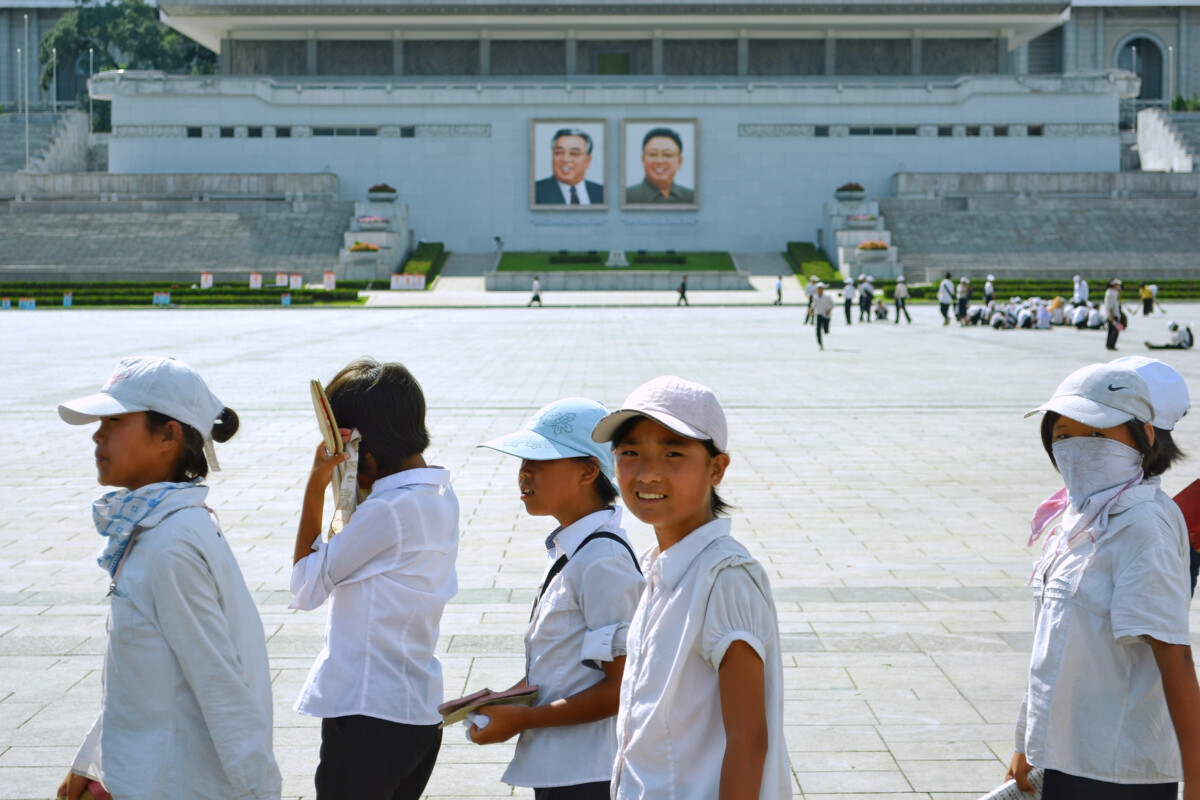
Students in Kim Il-sung Square in Pyongyang (Shutterstock/Chintung Lee)
Sign up here.
Today, I would like to begin my story by quoting a line from a North Korean song: “We, with 5,000 years of history and culture, are wise and civilized people.”
Although cut off from the outside world, we North Koreans dreamed of being civilized. Deep down, we also hoped others would see us that way.
Our mothers, despite their meager means, pushed us to attend elite science high schools. They believed that studying hard and becoming “civilized” would help their children navigate life in many ways.
I am living proof of that belief. Through my parents’ tireless efforts, I graduated from one of the country’s top science universities. By that measure, wasn’t I a quintessential symbol of North Korean “civilization”?
So now, I would like to tell you just how “civilized” I truly was. I believe my defection journey reveals that clearly.
To me, North Korea felt as confined as a well. As someone who considered myself civilized, I longed to use my talents and intellect in a broader world.
For those who make it to Thailand in search of a new life abroad, there is a common process: after being detained as an illegal immigrant and before being handed over to immigration authorities, there is a mandatory period in prison.
Anyone who wanted to emigrate somewhere other than South Korea had to stay in a cell designated for foreigners. I was one of them. I wanted to immigrate to the United States. Someone once told me that even dogs there roam around carrying dollars in their mouths. Carrying a bundle of instant noodles that others had generously packed for me, I stepped into that unfamiliar room—unable to speak their language—taking my first step toward the world I had long dreamed of.
I tried to appear confident, but inwardly, I was afraid.
Most of the people in my cell were Black, and many of them were twice my size. Yet my concerns quickly proved unnecessary. They approached me warmly, gathering around the corner where I had settled.
I smiled. It seemed my humanity and charm were visible to them at a glance.
After a brief exchange, they asked me a question: “Could you lend us some ramen?”
In my life, I had heard people ask to borrow erasers or pencils, but never ramen. Still, seeing my large supply, I decided to be generous.
They lined up and took the noodles one by one. About fifteen minutes later, my entire stock was gone.
It happened so quickly that I was stunned. Having lost everything, I felt so unsettled that I couldn’t even eat the meals provided in the cell.
In that place, I was nothing but a complete fool.
Next to me was a girl from Russia named Natasha. Though she was only seventeen, she seemed to understand the world far better than I did.
She taught me many things. I learned about Facebook and YouTube, for example. I had never seen or heard of them, so I could hardly grasp what they were.
What I did understand was astonishing: individuals could run their own broadcasting platforms and communicate with people all over the world—even strangers.
To me, this was nothing short of an entirely new civilization.
She also told me she was a fan of Spider-Man. She tried to explain his abilities, as well as those of other heroes: he shoots webs from his hands; another is a small tree that says, “I am Groot.” She even explained the meaning of “I love you 3000.”
“I love you 3000”? Not “I love you to death,” but “3000”? I thought to myself: this world is full of incomprehensible things.
I had once taken pride in being civilized, yet now I felt like a blind man. I had to prove that I knew something about her world.
At that moment, as a youngster raised in a communist country, one name came to mind: Stalin. Yes, my connection to her world must be through Stalin and Lenin.
So I asked her, “Do you know Stalin and Lenin?”
She widened her eyes and asked, “Who are they?”
My mind flooded with questions. Who are they? They weren’t ordinary people—they had led Russia. She was Russian. How could she not know them? How could someone living in Russia not know figures that even I, living in North Korea, had learned about?
I wondered then: Why did we have to learn things that even Russians didn’t need to know? And why were we unable to know things that everyone else in the world seemed to understand?
Before we parted, Natasha asked me seriously, “Where are you from?”
In North Korea, there is an app called “Him-il-se,” which ranks number one in downloads. It provides all kinds of general knowledge and is immensely popular among young people.
But what is the use of reading it cover to cover?
Even a seventeen-year-old girl knew countless things that I did not.
One person I know who arrived in South Korea before me truly believed he knew everything. When he came to the Hanawon processing center, he thought there was almost nothing about South Korean society that he didn’t know.
But the first time he went to a coffee shop, his shoulders involuntarily shrank every time well-dressed people passed by. He became self-conscious about the blue uniform he had been given at Hanawon.
He thought that if it weren’t for that uniform, people might believe he was an “original” South Korean.
He tried to order coffee as naturally as possible, recalling what he had seen in movies.
“An Americano espresso, please,” he said.
The barista looked at him carefully.
“Sir, do you mean an Americano?”
“No, an Americano espresso. Just go ahead.”
From his appearance and tone, she had already realized he didn’t know what an espresso was.
A tiny cup was brought to him. He felt disappointed. The moment he took a sip, he tasted something he had never experienced before in his life. It was so bitter that it was impossible to swallow.
Glancing sideways, he saw the barista still watching him, perhaps to check if he was okay.
Summoning all his strength, he downed it in one gulp.
“At least I have my pride,” he said to himself.
This is the reality for people who studied hard and even graduated from university in North Korea.
In a closed society, we struggle to expand our knowledge. Yet when we step into the outside world, we cannot even order a cup of coffee.
No matter how much we polish ourselves, once we leave that system, we realize how insignificant we truly are.

Born in Chongjin in 1990, Jang Mi was not a studious child, but under her mother’s influence, she graduated from high school and went on to university to take math and science. She worked as a wedding video editor for seven years until her defection in 2019.
Latest posts by Jang Mi (see all)
- When will the Koreas be reunited? - October 1, 2026
- Is the Kim family still Big Brother? - September 6, 2026
- Electricity, not slogans: What North Korean women really need - August 3, 2026