

When seeing the world makes “My Country is the Best” harder to sing
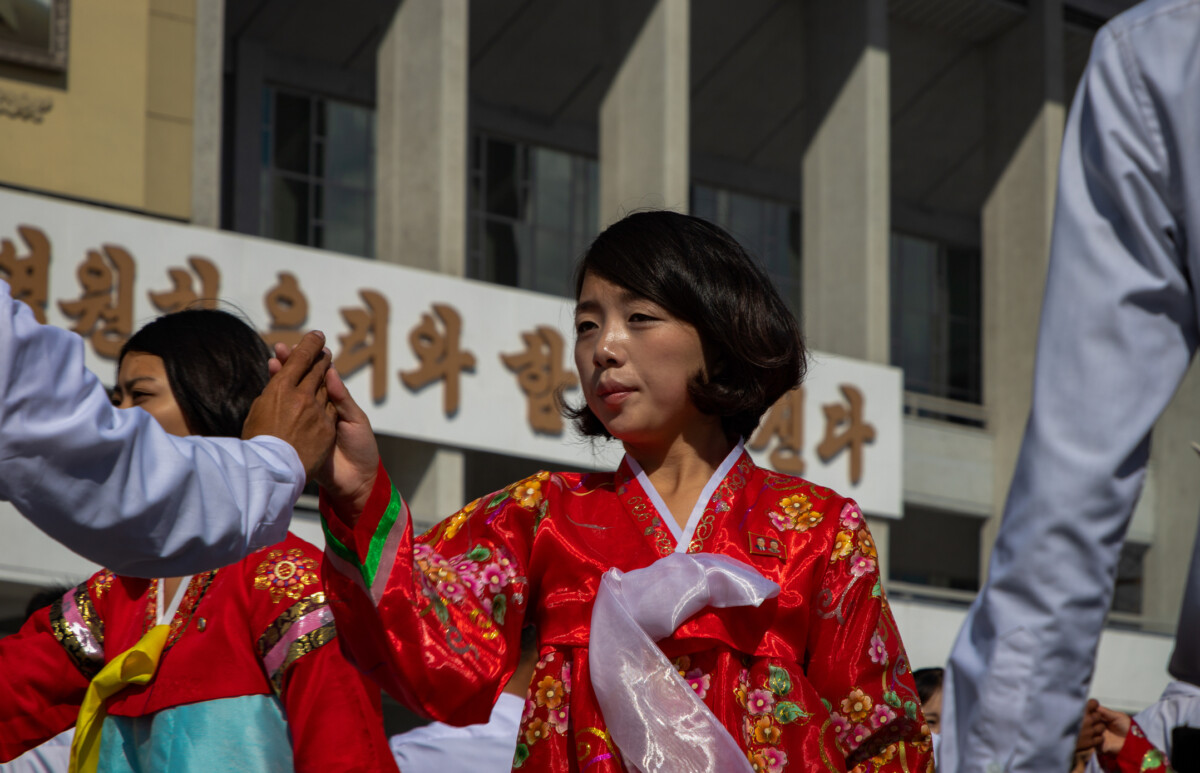
A woman participating in a mass dance, a common public performance in North Korea [Image: iStock/redonion1515]
There is a song beloved by many people in North Korea.
It is called My Country Is the Best.
Even the flowers blooming in a foreign land,
Were not as beautiful as the flowers of my country.
When I look back, the world may be vast and wide,
But the country where I live is the best of all.
It is truly a masterpiece. The melody is beautiful, and so are the lyrics.
Of course, I know that claiming the flowers of one’s own country are more beautiful than identical flowers elsewhere is an expression of bias. Yet people naturally feel more affection for what is theirs than for what belongs to others.
The desire to believe that one’s own country is the best place to live is a deeply human feeling.
But how much better would it be if that were true—not merely a wish?
For someone born in North Korea, going abroad is as difficult as winning the lottery. Foreign travel is effectively forbidden. Strictly speaking, most North Koreans have no way of knowing whether their country is a good place to live or not.
How could they, when they have never seen another country?
The government maintains tight control over its people because it fears that the lies it has told will be exposed. Only a tiny number of citizens—those who pass an exhaustive screening process that extends even to distant relatives—are permitted to travel abroad.
Becoming one of those few is as difficult as a camel passing through the eye of a needle.
My brother was one of the people who passed through that needle’s eye.
As a student, he traveled to China for a programming competition. He was stunned by the seemingly endless expanse of Beijing Airport. The vast glass structures, the rows of airplanes, the countless shops, and the abundance of goods filling them from end to end were unlike anything he had ever seen.
One thought kept returning to him:
The world is wide. So wide.
Before returning home, he was required to sign a pledge promising that, under no circumstances, would he reveal what he had seen or heard abroad.
As expected, many people questioned him after he returned.
“What is a foreign country like?”
His answer was always the same. “The song My Country Is the Best came to me naturally,” he said.
After that trip, my brother made a life-changing decision.
His dream had once been to live in Pyongyang. For North Koreans, that is a privilege among privileges. Because there is no freedom of movement within the country, only those born in Pyongyang are normally allowed to reside there.
In fact, it may be easier for you to immigrate overseas than for a North Korean to move to Pyongyang.
When someone from the provinces manages to relocate to the capital, people call it a “regional revolution.” It is considered something so extraordinary that it could only happen through a revolution.
Such a revolution had occurred in our family. Yet my brother voluntarily gave up his right to live in Pyongyang and chose to return to our hometown of Chongjin.
To be honest, I thought he had lost his mind. But he explained things simply.
“After visiting China, Pyongyang felt like a rural village,” he said.
His choice meant more than giving up a place to live. It was, in many ways, a surrender of his faith in the regime.
What brought him to that point?
It was not simply the realization that our country was poor.
When he flew to China on an Air Koryo aircraft, he was deeply uneasy. The plane looked old, and it shook so violently that he spent much of the two-hour flight staring at the propeller, wondering whether it might fail.
On the return journey, he flew on an American-made Boeing aircraft. The flight was so smooth that he could barely distinguish takeoff from landing.
My brother wanted his country to prosper. Even if it did not, he was willing to accept that reality. As his flight crossed back into North Korean airspace, he was overcome with emotion.
“From this point on, we are entering the territory of the Democratic People’s Republic of Korea,” the pilot announced.
At last, I am home, he thought.
But home rejected him at the door.
The moment he arrived at the airport, uniformed soldiers began searching his luggage item by item. They pushed him into a corner as though he were a criminal. They demanded to know whether he had brought back anything “bad” from capitalism.
My brother was not singled out. Every North Korean returning from abroad was treated the same way.
They had received a welcome in foreign countries.
Not in their own.
One acquaintance with overseas experience told me she felt ashamed of being North Korean while she was abroad.
She had been sent overseas as a doctor and met professionals from several countries. They were free to call their families whenever they wished. The North Koreans were forbidden from doing so.
She envied them deeply.
What made it harder was that she had never considered herself inferior to people from other countries. Yet in that situation, she felt diminished.
She wrote letters home to her children. Knowing government censors would read them first, she could not write honestly.
Every letter began in much the same way:
“Now that I have come here, I realize once again how good a place my country is to live …”
But she later told me she did not believe those words.
North Korea is a beautiful place. Its mountains are clear, its waters clean. I love the sky of my hometown, the green fields, and the sea I have known since birth.
But if human rights are not protected, if people are not rewarded for their labor, and if leaving in search of a better life is treated as a crime, can such a place truly be called a good place to live?

Born in Chongjin in 1990, Jang Mi was not a studious child, but under her mother’s influence, she graduated from high school and went on to university to take math and science. She worked as a wedding video editor for seven years until her defection in 2019.
Latest posts by Jang Mi (see all)
- Is the Kim family still Big Brother? - September 6, 2026
- Electricity, not slogans: What North Korean women really need - August 3, 2026
- When seeing the world makes “My Country is the Best” harder to sing - June 9, 2026