

Kim Jong-un inspects new facility as North Korea openly asserts its status as a nuclear state
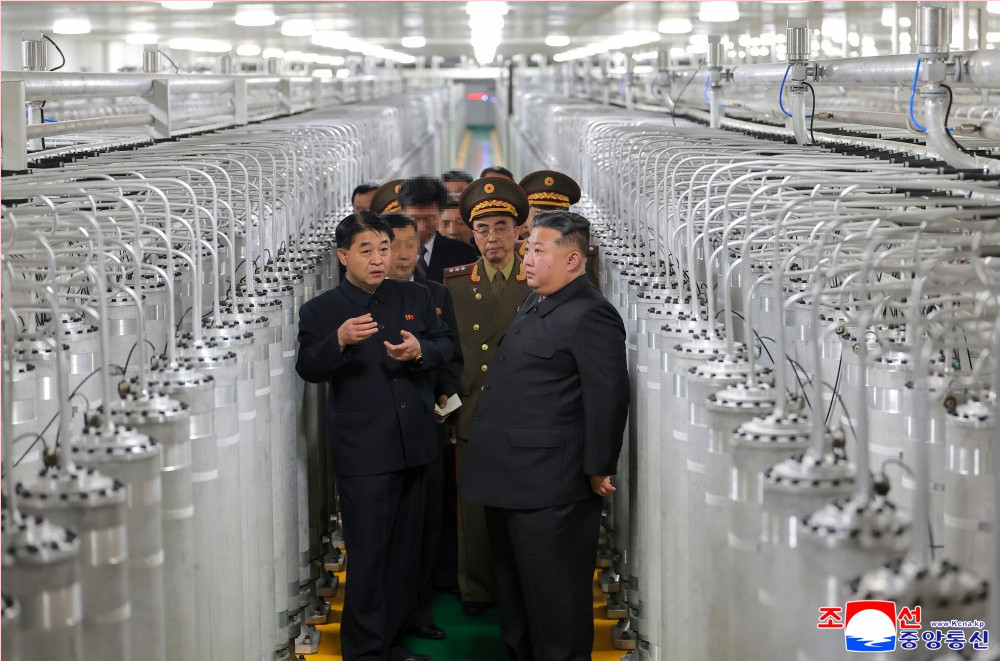
Kim Jong-un visits a new nuclear facility on June 4. (Image/KCNA).
North Korea has revealed a new nuclear production facility in what analysts say is a deliberate effort to showcase its determination to expand its nuclear forces.
Leader Kim Jong-un conducted an on-site inspection on June 3 of a “newly operational nuclear material production facility,” KCNA reported.
The country’s capacity to produce weapons-grade nuclear material had “more than doubled” since five years ago, Kim claimed.
He made it clear that the country would continue increasing its number of nuclear weapons.
The significance of this report is threefold: the expansion of Pyongyang’s nuclear production capacity, the increase in the number of weapons, and the exercise of its status as a nuclear-weapons state.
Touring the new production processes, Kim reviewed operational indicators and future production plans, and praised nuclear experts for strengthening the “foundation for producing weapons-grade nuclear material.”
His comments follow the “new five-year plan for strengthening nuclear forces” announced at the Ninth Party Congress earlier this year.
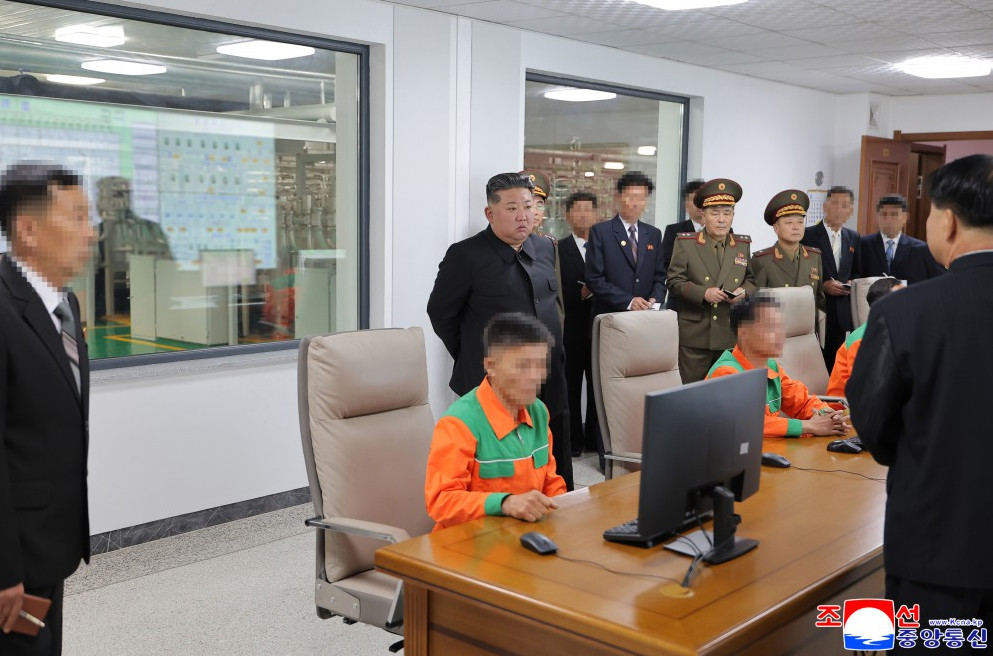
Kim’s remarks reveal a strong political intent to make North Korea’s “status as a nuclear-weapons state” appear irreversible.
He said that “further expanding and strengthening the state’s nuclear forces and thoroughly exercising its status as a nuclear-weapons state” is an “unchanging political and military position.”
AP also assessed that the disclosure signaled Kim’s effort to cement North Korea as a nuclear-weapons state and showed that he has no intention of putting his nuclear program on the negotiating table.
AP suggested that photos released by KCNA showed Kim walking through what appeared to be a centrifuge hall.
South Korea’s military and experts believe the facility is likely a new uranium enrichment site within the Yongbyon nuclear complex.
Ankit Panda, a senior fellow at the Carnegie Endowment for International Peace, told AP that it appears to be a two-story structure and represents a significant expansion of enrichment capacity. He also said there is “no near-term end in sight” to North Korea’s continued nuclear expansion.
Reuters, citing satellite imagery and expert analysis, also reported that the facility may be at Yongbyon.
The timing of the disclosure is also significant. Kim’s visit may have been intended to raise North Korea’s bargaining power ahead of the visit this week of Chinese President Xi Jinping.
Lim Eul-chul, a professor at Kyungnam University’s Institute for Far Eastern Studies, told Reuters that South Korea’s push for nuclear-powered submarines and discussions with the United States over uranium enrichment rights could be used by North Korea as justification to accelerate and expand its nuclear weapons program.
Recent assessments by the International Atomic Energy Agency also underscore the seriousness of the report.
According to The Guardian, IAEA Director General Rafael Grossi warned during a visit to Seoul in April that North Korea was making “very serious” progress in its nuclear weapons production capacity. He said activity had intensified at Yongbyon’s 5-megawatt reactor, reprocessing facility, light-water reactor, and other facilities, and noted that North Korea’s nuclear program is a “clear violation” of UN Security Council resolutions.
Another notable point in Kim’s remarks is that he defined nuclear forces not simply as a deterrent, but as the backbone of North Korea’s “war deterrence strategy and war-fighting strategy.” This goes beyond the previous explanation that North Korea possesses nuclear weapons only as a last-resort defensive measure. It more openly reveals an intent to operate nuclear weapons within actual war-fighting scenarios. In other words, North Korea is integrating tactical nuclear weapons, strategic nuclear weapons, nuclear material production capacity, and advanced delivery systems into a single operational framework.
Ultimately, this report shows that North Korea’s nuclear policy is moving from the stage of “possession” to the stage of “mass production and operational deployment.” Kim said North Korea had “updated important figures in its nuclear activities” and “confirmed the sequence and guarantees for implementing the vast plan ahead to exponentially strengthen the state’s nuclear forces.” This is not merely political rhetoric. It is closer to a systematic declaration that North Korea intends to expand nuclear material production, the number of nuclear warheads, delivery systems, and operational planning all at once.

Taesung offers informed perspectives on North Korean society, grounded in years of experience within a key state-run institution. After defecting to South Korea in 2024, he now focuses on providing analysis of the country.
Latest posts by Kim Taesung (see all)
- Man jailed for spying on defectors and soldiers for North Korean agent - September 9, 2026
- Trump wants Kim back at the table. This time, Kim holds the cards. - August 28, 2026
- In North Korea, a newspaper editorial is never just an editorial - August 12, 2026