

North Korea tests new weaponry for use against South Korea
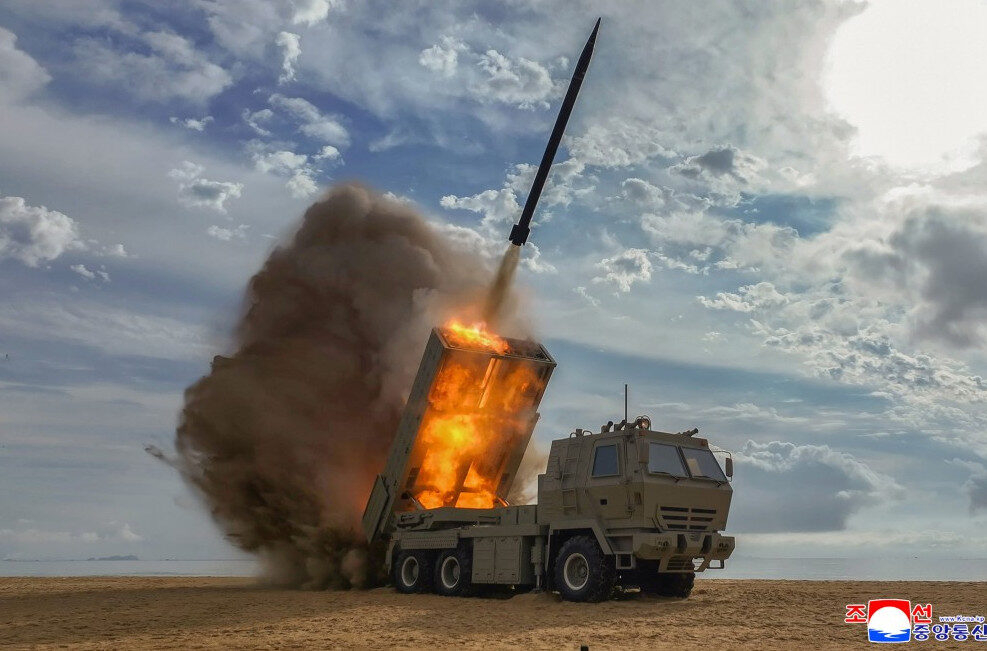
Upgraded 240 mm 24-tube multiple rocket launcher tested on June 25. Image: KCNA.
On June 25 – the day his grandfather invaded South Korea in 1950 to start the Korean War – Kim Jong-un attended an “important weapons test” demonstrating what analysts say are upgraded firepower systems aimed at the South.
The systems tested were an upgraded 240 mm 24-tube multiple rocket launcher, a “special-mission warhead” for a tactical ballistic missile, and a 65 km extended-range shell for a 155 mm self-propelled howitzer.
“(The test) proved a major technological advance achieved in realizing the three principles of automation, long-range capability, and ultra-precision,” Kim said.
“Our Party’s self-defensive defense policy is not a policy of merely enhancing defensive functions based on defensive means, but a policy of raising a lethal and destructive offensive posture so that no adversary can confront us,” Kim said.
The 240 mm 24-tube multiple rocket launcher shown in the photos released by KCNA appears to be a rectangular launch module mounted on a large armored wheeled vehicle. In appearance, it shares the concept of a “high-mobility wheeled vehicle plus rear launch pod” with the U.S. HIMARS.
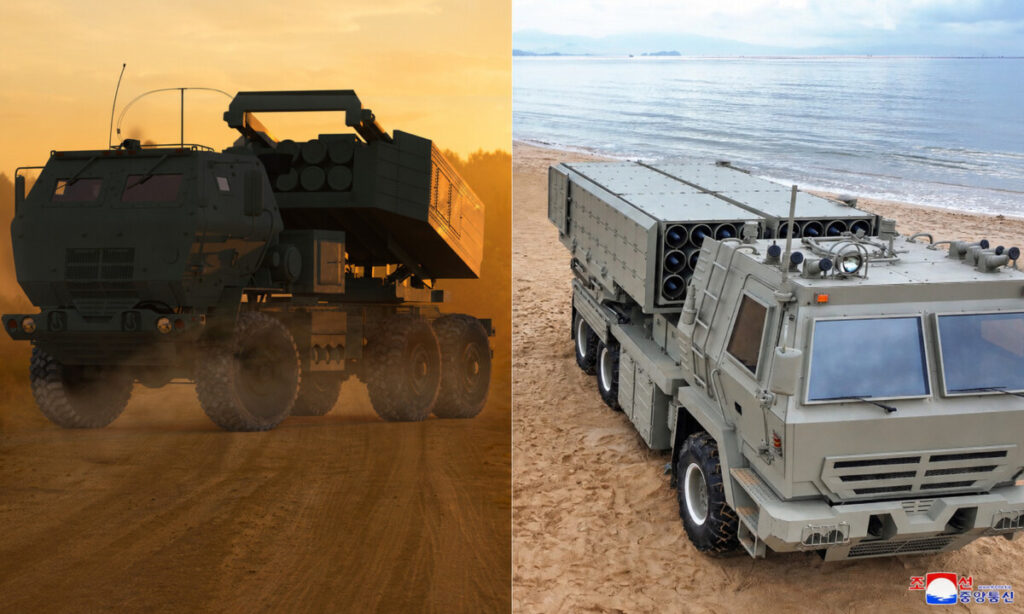
However, whereas HIMARS operates six 227 mm rockets or one tactical missile, North Korea’s new system is closer to a corps-level multiple rocket launcher for mass firepower, carrying 24 rockets of roughly 240 mm caliber.
North Korea’s stated range of 90 km reveals its intention to threaten targets deeper into the rear than existing long-range artillery can reach. In particular, the phrase “autonomous precision guidance system” is meant to emphasize precision-strike capability using guided rockets, rather than simple area bombardment.
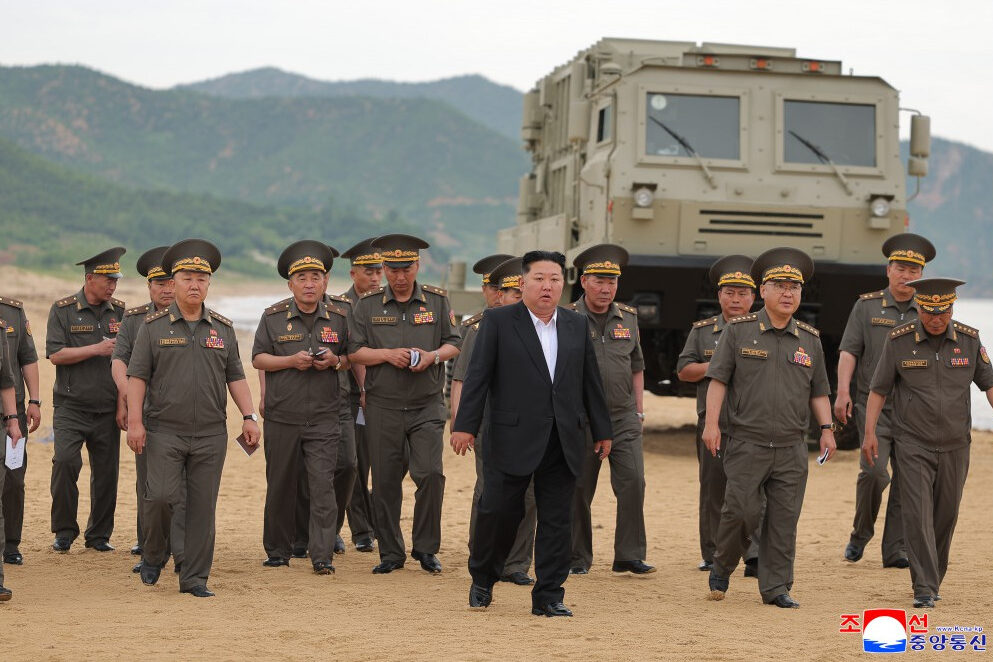
The staging of the photos also sends an important message. The image of Kim with his generals and a large launcher vehicle behind them serves to promote both the supreme leader’s direct control and the operational deployment of new weapons.
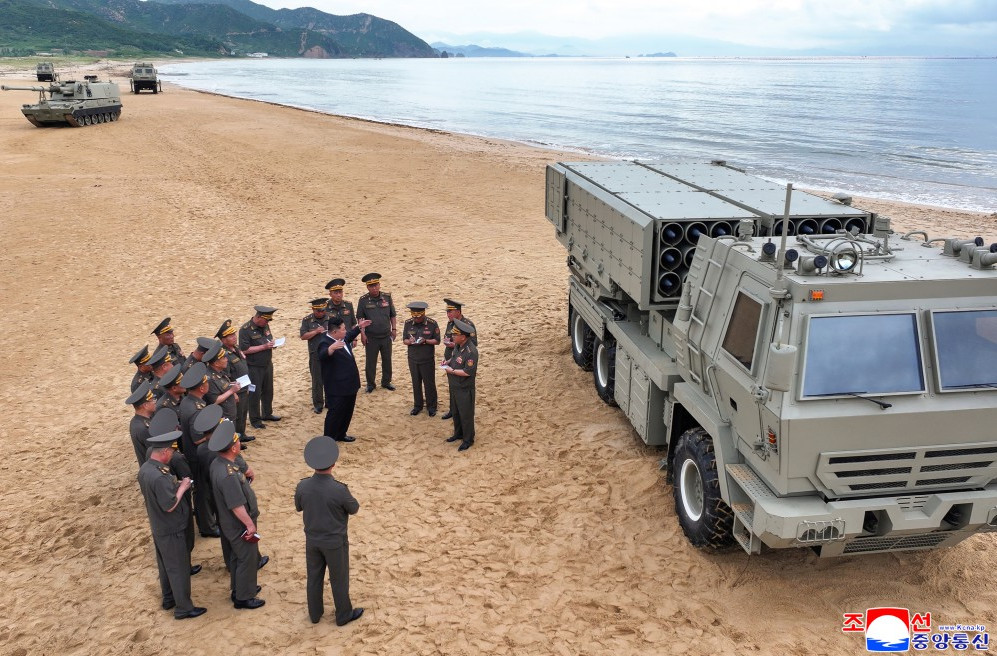
Another photo shows generals holding notebooks surrounding Kim in a semicircle, a scene that can be read as an attempt to give the impression that the weapon is not merely a prototype, but has reached the stage where operational concepts and deployment plans are being discussed.
The “special-mission warhead” for the tactical ballistic missile is the most sensitive part of this report.
In its report, KCNA explained that the warhead is intended to destroy “enemy airfields, ports, and power facilities.” This suggests it could be a high-explosive device, or a special warhead hinting at dual nuclear-conventional use.
When the U.S. Defense Intelligence Agency confirmed that debris found in Kharkiv, Ukraine, on January 2, 2024, came from a North Korean short-range ballistic missile, analysts said North Korea may have obtained performance data from the use of tactical ballistic missiles on the battlefield.

The test of the 65 km extended-range shell for the 155 mm self-propelled howitzer should also be examined separately. North Korea’s existing artillery systems have been centered on Soviet-style or North Korean calibers such as 122 mm, 152 mm, 170 mm, 240 mm, 300 mm, and 600 mm. The 155 mm caliber, however, is the same as South Korea’s K9 self-propelled howitzer, the U.S. M109, and NATO-standard artillery systems.
This suggests it is more accurate to view the 155 mm system not as simply a copy of Russian equipment, but rather North Korea’s response aimed at catching up with the long-range capability of South Korea’s long-range self-propelled artillery forces, especially the K9 series.
Reuters reported that Kim had also inspected a production facility for 155 mm self-propelled howitzers on May 7, when North Korea claimed a range of more than 60 km.
Based on currently available public evidence, it cannot be concluded that Russia directly provided the designs for this 240 mm 24-tube multiple rocket launcher or the 155 mm self-propelled howitzer.
The site 38 North noted that North Korea’s 155 mm self-propelled howitzer does not match the Russian military’s standard caliber, analyzing that it is difficult to define the weapon as a direct product of Russian assistance.
However, there is a strong possibility that military cooperation with Russia has accelerated North Korea’s weapons modernization with the battlefield serving as a combat test site for improving North Korean weapons.
RUSI has also analyzed that North Korea is incorporating lessons from the Russia-Ukraine war into its military modernization. In particular, AI-assisted target identification, layers of autonomy, guidance and acquisition technologies in electronic-warfare environments, and the integration of reconnaissance drones with artillery and multiple rocket launcher systems are cited as important trends in North Korea’s military modernization.
This aligns with the phrases “automation of the firepower service system” and “autonomous precision guidance system” that appeared in the Korean Central News Agency report. It means North Korea is not merely building weapons that can fire farther, but is pursuing a modern firepower system that rapidly connects detection, decision-making, launch, and corrective strikes.
The most direct target of this weapons test is South Korea. The peninsula has short north-south depth, the Seoul metropolitan area is very close to the Military Demarcation Line, and mountainous terrain and coastal axes are intricately intertwined. Under these conditions, the upgraded 240 mm 24-tube multiple rocket launcher with a range of 90 km is not simply a weapon for striking frontline areas. If deployed in North Korea’s forward areas, it could threaten northern parts of the Seoul metropolitan area, military facilities in Gyeonggi and Incheon, access routes to air bases, port and logistics hubs, and command-and-control facilities.
The U.S. Army’s Modern War Institute has assessed that North Korea’s long-range artillery has long been deployed around the Demilitarized Zone and regarded as a key means of threatening Seoul.
What is even more burdensome for the South Korean military is that the battlefield environment on the Korean Peninsula makes the “detect-decide-strike” timeline extremely short.
A 240 mm guided multiple rocket launcher or 65 km-class 155 mm extended-range shell fired from North Korea’s forward areas would have a short flight time, placing great pressure on South Korea’s counter-battery detection, interception, runway repair, and distributed operation of command facilities.
In particular, the western front and the Seoul metropolitan axis are densely packed with roads, railways, ports, and air bases. If North Korea fires a mix of multiple rockets and tactical ballistic missiles in the early stages of a war, it could disrupt the rhythm of South Korea’s reinforcement, resupply, and air operations.
The threat to Japan is different in character. The 240 mm multiple rocket launcher and 155 mm self-propelled howitzer cannot reach the Japanese mainland. However, the “special-mission warhead” for the tactical ballistic missile included in the test was relevant for Japanese security. North Korea identified “airfields, ports, and power facilities” as targets, and Japan is a key hub for U.S. reinforcement and rear-area logistics support in the event of a crisis on the peninsula. Ultimately, the significance of the June 25 weapons test lies in North Korea’s effort to transform its forward artillery from a simple mass-bombardment tool into a long-range precision-strike system that threatens South Korea and Japan.

Taesung offers informed perspectives on North Korean society, grounded in years of experience within a key state-run institution. After defecting to South Korea in 2024, he now focuses on providing analysis of the country.
Latest posts by Kim Taesung (see all)
- Two North Korean prisoners, one diplomatic dispute: What was agreed between Seoul and Kyiv? - September 28, 2026
- North Korea is building new weapons and drones. Russia may be making them better - September 24, 2026
- North Korea drops ‘unification’ from party charter, boosts Kim Jong-un’s power - September 13, 2026