

War on women’s clothing: How fashion has become a political crime
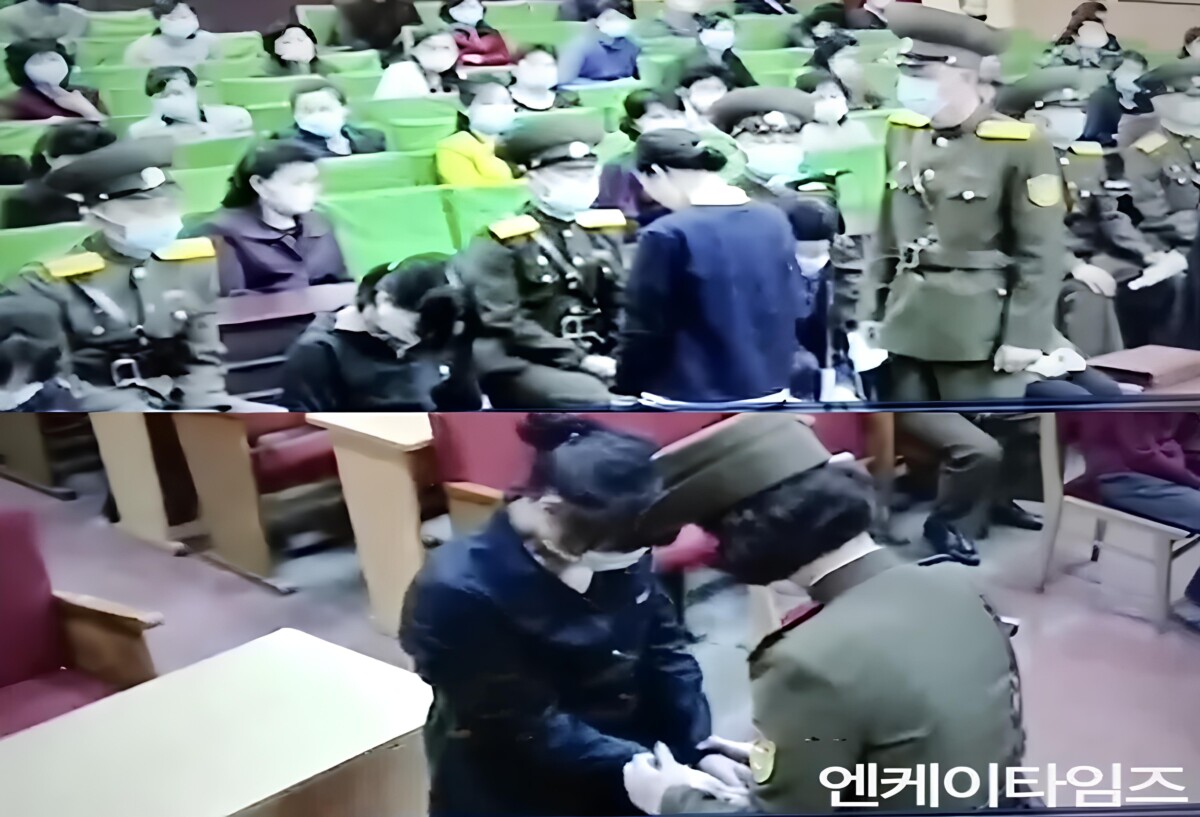
A woman is handcuffed after a public trial (Image: NK Times)
Authorities in North Korea are intensifying propaganda against so-called “anti-socialist” behavior, condemning women’s clothing, hairstyles, speech, and other foreign cultural influences, according to a source inside the country.
Materials circulated through regular ideological education sessions warn residents that even minor personal choices can be treated as signs of ideological corruption, the source said.
The state claims that “enemies” are trying to plant “the eggs of capitalism” in the country in order to “degenerate and destroy our revolutionary ranks from within.”
If women in particular are not properly guided, “even the slightest changes in their ideological and spiritual life” could push them “onto the path of betraying the revolution,” the propaganda material says.
The message is clear: clothing is not private. It is political.
The material states that wearing clothes and hairstyles “in a modest and sound way that suits the socialist lifestyle” is “by no means a practical matter.” In other words, a woman’s shirt, pants, or haircut is treated not as a matter of comfort or taste, but as a test of loyalty.
It cites as an example a woman wearing a T-shirt with English lettering under a suit jacket. Such offenders can be stopped in the street and “inspected.” Once caught, the person may be reported to her workplace, factory, institution, or social organization, then forced to face public criticism before colleagues.
Another section condemns tight pants that cling to the legs and reveal the body’s shape as part of “rotten capitalist culture.” Wearing them is described as an “anti-socialist” act influenced by hostile forces seeking to corrupt North Korea from within.
Thus, a young woman’s desire to look stylish or slim is recast as participation in an enemy plot.
The content describes women as “a wheel of the revolution,” implying that their appearance must serve the state’s political project. Women are not treated as individuals with dignity, preferences, or autonomy, but as bodies to be disciplined in the name of socialism.
Punishment is not limited to warnings. Offenders can be made to stand publicly as examples of “anti-socialist” behavior and then subjected to collective criticism afterward.
The restrictions also extend to jeans, which the regime associates with foreign culture. According to the source, when women are caught wearing tight pants or jeans, patrols may cut the clothing with scissors in public.
One reported incident in the Pohang District of Chongjin, North Hamgyong Province, shows how such abuse can provoke public anger. A woman wearing tight pants was stopped by a patrol, which cut her pants so severely that her legs were exposed.
“Do you feel satisfied after tearing the pants of a woman who could be like your own sister?” some bystanders reportedly shouted at the male patrol members. “What about those pants is anti-socialist?”
As more people gathered and the situation grew tense, the patrol group reportedly called the Ministry of Social Security, and armed security officers arrived to disperse the crowd.
The incident shows that forced obedience should not be mistaken for acceptance. Many North Koreans may comply because they have no choice, but they understand the cruelty and absurdity of these controls.

Era is a North Korean defector and an experienced journalist who offers a unique perspective on one of the world's most secretive nations. Having escaped the oppressive regime, Era has leveraged her keen understanding of North Korean society to become a beacon of truth. Through her extensive network of in-country reporters, she maintains real-time communication with sources inside North Korea, providing unparalleled insights into the ground realities of the closed society.
Latest posts by Era Seo (see all)