

North Korea to send a club team to play in “hostile state” of South Korea… Could a women’s football match open a small crack in the glacier of inter-Korean relations?
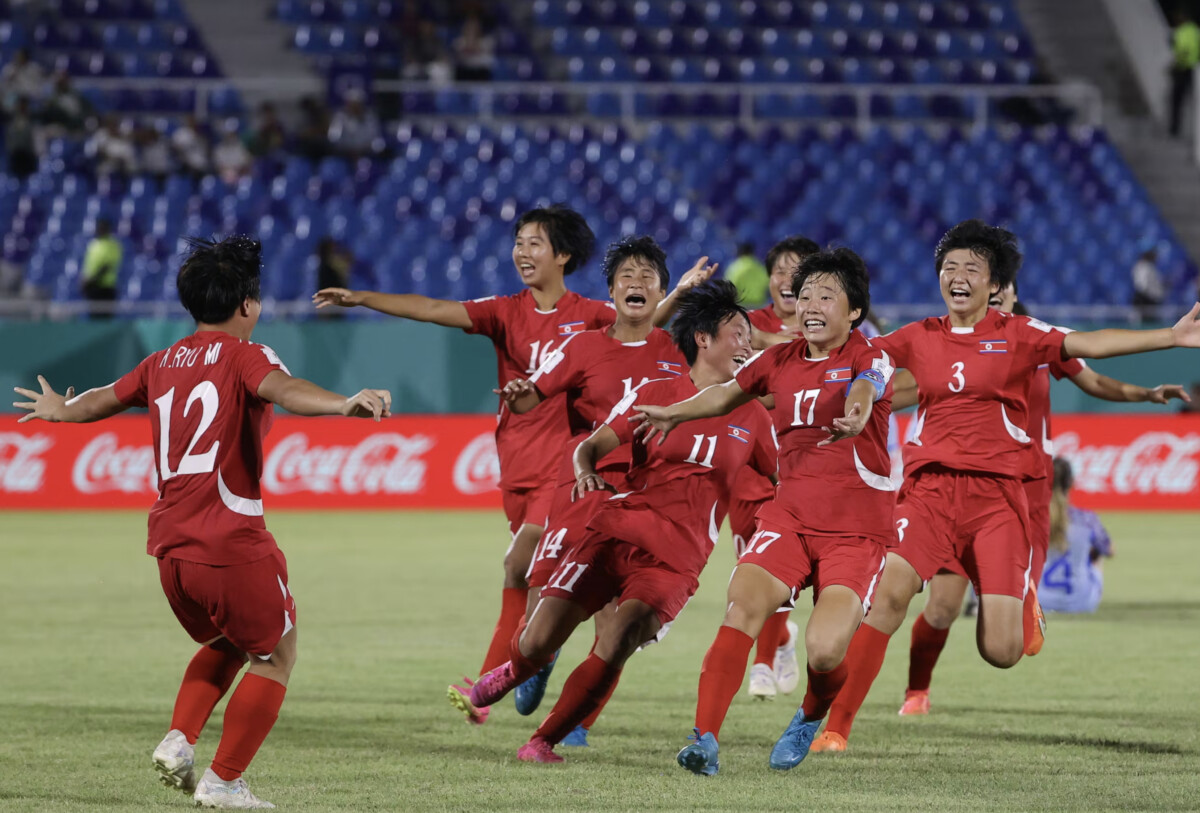
North Korea’s women’s national team beat Spain on penalties in the U-17 World Cup final. / EPA, Yonhap News
Sign up here.
Despite long-frozen inter-Korean relations, North Korea’s women’s football team, the Naegohyang Women’s Football Club, will arrive in South Korea on May 17 to participate in the semifinal of a regional tournament.
This club is one of the final four teams in this year’s Asian Football Confederation (AFC) Women’s Champions League. It will face South Korea’s Suwon FC Women at the Suwon Sports Complex, about 30 kilometers south of Seoul, on May 20. The winner will play either Melbourne City FC or Tokyo Verdy Beleza in the final in Suwon on May 23.
This marks the first visit by a North Korean delegation to the South since 2018, and the first by a North Korean women’s football team since the 2014 Incheon Asian Games.
Significantly, the visit is not the result of any agreement between the two Koreas. Rather, it stems from North Korea’s advancement to the semifinals of the regional club competition, with both the semifinal and final matches scheduled in Suwon.
Mindful of this, the South Korean government is downplaying the development and emphasizing that it is part of an international sporting event, rather than attaching broader political significance. “We welcome Naegohyang Women’s Football Club’s participation in the AFC Women’s Champions League semifinal,” a statement from the presidential Blue House said. “The government will cooperate with the AFC and Suwon FC to ensure the team can compete smoothly.”
Despite the low-key response, the Unification Ministry expressed cautious hope for a thaw. “We will prepare to ensure that a positive precedent can be established,” an official said.
The match comes after a steady deterioration in inter-Korean relations since the collapse of the U.S.–North Korea summit in Hanoi in 2019. Tensions deepened further after North Korea formally dropped reunification as a national objective in late 2023, redefined relations with the South as those between “two hostile states,” and cut off exchanges.
Recent developments following a civilian drone incident have added another layer of complexity. After President Lee Jae-myung expressed regret that a drone had been flown from the South into the North, Kim Yo-jong, vice department director of the Workers’ Party of Korea and sister of Kim Jong-un, said, “We view it as highly fortunate and a wise decision for the President to have personally expressed regret and mentioned measures to prevent recurrence.”
She added that Kim Jong-un regarded this as “an attitude showing honesty and boldness,” marking a rare instance of North Korea positively evaluating a statement by a South Korean president.
However, there are limits to interpreting the response as a signal for dialogue. In the same statement, the North warned the South to “abandon any attempt at contact.” In other words, while Pyongyang appeared to use the conciliatory gesture to claim its pressure had been effective, it maintained its distance.
North Korea’s motives for allowing its women’s football team to play in the South are complex. First, the fact that the competition involves clubs, not national teams, reduces the political burden. This allows Pyongyang to avoid contradicting its two-state doctrine, even while entering what it calls a “hostile state.”
At the same time, the match offers an opportunity for domestic propaganda. North Korean women’s footballers have demonstrated strong international competitiveness, and Naegohyang previously defeated Suwon 3–0 in the group stage. Domestically, this can be framed as “a proud victory over a hostile state on the international stage.”
Economic incentives also cannot be ignored. The tournament offers $1 million in prize money for the champion and $500,000 for the runner-up. For a country under sanctions and facing economic hardship, such sums represent a meaningful source of foreign currency.
Ultimately, the visit is less a sign of a broader thaw in inter-Korean relations than a limited, calculated move by North Korea to minimize political costs while securing practical benefits.
Even so, the match is not without significance. In inter-Korean relations, sports have often served as a narrow channel through which political barriers are temporarily eased.
What matters is that the South Korean government manages the event carefully—without over-politicizing it—while ensuring it proceeds safely and smoothly.
The 90 minutes in Suwon will not spark dialogue. Yet on a frozen peninsula where hostile rhetoric has prevailed, the sight of players from rival sides sharing the same field offers a rare crack in the ice.

Taesung offers informed perspectives on North Korean society, grounded in years of experience within a key state-run institution. After defecting to South Korea in 2024, he now focuses on providing analysis of the country.
Latest posts by Kim Taesung (see all)
- A DMZ mine tests Lee Jae-myung’s North Korea policy - October 8, 2026
- From test to drill: North Korea signals hypersonic missile readiness - October 7, 2026
- Two North Korean prisoners, one diplomatic dispute: What was agreed between Seoul and Kyiv? - September 28, 2026