

Does the fighting man’s morale still matter in modern warfare?
Image/KCNA
Lately, the world has begun to change in unsettling ways. After World War II, despite localized conflicts, it seemed as if global peace might last forever. It appeared that humanity had reflected on the death and destruction and ultimate futility of war.
Yet with the outbreak of the Russia-Ukraine war, the advanced world has once again entered a period of upheaval. Conflicts involving Israel, Palestine, Iran, and others are spreading across neighboring regions. This might even lead to a Third World War. For, as the saying goes, when clouds gather, rain will fall.
Did we not learn from World War II? That conflict stole countless lives, along with all their dreams and happiness. How did this unimaginable loss profit us?
Or is the desire to fight simply a fact of human nature?
Recent developments have also made nations treat war more lightly. Advances in technology have drastically changed the nature of warfare.
This raises a question. In modern warfare, is technology the only thing that matters? In a war in 2026, to what extent will soldiers’ morale determine victory or defeat?
And will North Korea be able to leverage its own advantages in war?
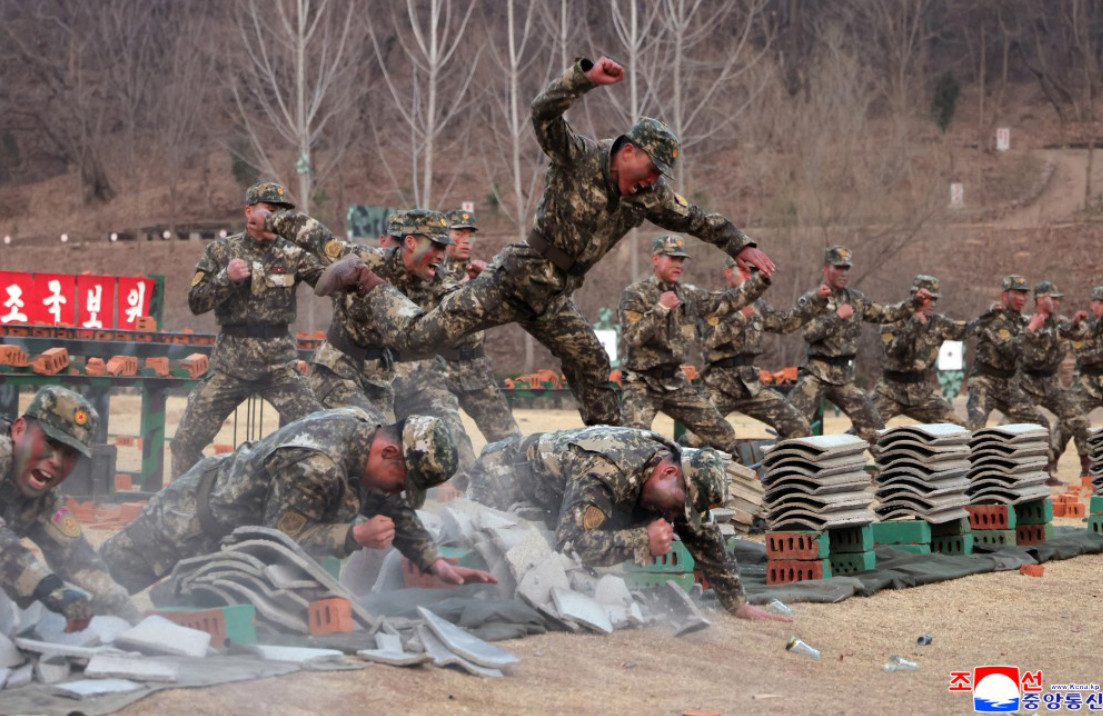
If the two Koreas were to fight, who would win? From the perspective of weaponry, South Korea is overwhelmingly superior. Yet North Korea possesses extremely strong morale.
Since it is people, not weapons, who fight, morale cannot be underestimated. History has proven this time and again. How many times has morale triumphed when the odds made victory seem impossible?
One Korean example is the 1597 Battle of Myeongnyang during the Imjin War between Joseon, as it was called then, and Japan. Thirteen 13 ships faced 133. Before the battle, the Joseon Admiral Yi Sun-sin declared, “I still have 13 ships left.” He prevailed.
How can anyone defeat soldiers who fight with the resolve to die? Even if victory is achieved, it may be a hollow one, leaving only scars. There are victories worse than defeat.
Thus, in life-or-death battles, morale plays a crucial role.
This is why North Korea never neglects ideological indoctrination. The regime often highlights heroic tales of soldiers strapping bombs to themselves and charging enemy submarines.
When survival is at stake, no emotion or sympathy can be allowed.
A popular North Korean movie, called Wangjaesan, featured a character with a disability who initially drew sympathy, but was ultimately unmasked as an enemy. Through such stories, the government demonized the disabled. As a result, North Koreans are trained to scorn rather than sympathize with them.
Even that is not enough. The dictatorship seeks to instill the message that the state is more precious than parents or family members. In the movie Yesterday, Today, and Tomorrow, the protagonist kills his own father for betraying the Party and the nation.
The regime has been tireless in its mission to mold people’s minds in this way. The indoctrination has been carried out for decades, and one could say it has nearly succeeded.
Did the people not endure the “Arduous March” famine of the 1990s? At that time, people often said, “Whether we starve to death or are shot to death, death is the same. Better that war should break out.”
The outside world called this brinkmanship, the will of those facing death to drag others down with them.
This was considered malicious. But will such a mindset prove useful in modern warfare?
Look at today’s wars. We rarely see soldiers carrying rifles into battle. Instead, drones fly in and strike targets. One of the most unusual photos I’ve seen recently was of Russian war heroes.
They looked haggard and bent, unlike any war heroes I had seen before. But they were drone operators, who were said to have played the most crucial role in the war.
Until recently warfare was about troops charging in formation. That was why North Korea built almost no highways. It kept its rough, dusty roads to slow the enemy down.
But now such efforts are useless. Attacks will come not by land, but by air.
Every North Korean military unit displays a large slogan: “Defend the leadership of the revolution with our lives.” This refers to Kim Jong-un.
Yet modern warfare may not even give revolutionaries the chance to fight to the death. Drones will fly over their heads and make straight for the leadership.
Given this, North Korea stands at a crossroads. What decision will the leadership make? Will it doubledown on morale? Or will it opt to stake everything on nuclear weapons?
And, if so, what fate awaits?

Born in Chongjin in 1990, Jang Mi was not a studious child, but under her mother’s influence, she graduated from high school and went on to university to take math and science. She worked as a wedding video editor for seven years until her defection in 2019.
Latest posts by Jang Mi (see all)
- Electricity, not slogans: What North Korean women really need - August 3, 2026
- When seeing the world makes “My Country is the Best” harder to sing - June 9, 2026
- Who created “Oppasi”? How tyranny thrives on power and silence - June 3, 2026