

Can South Koreans change how they see North Koreans?
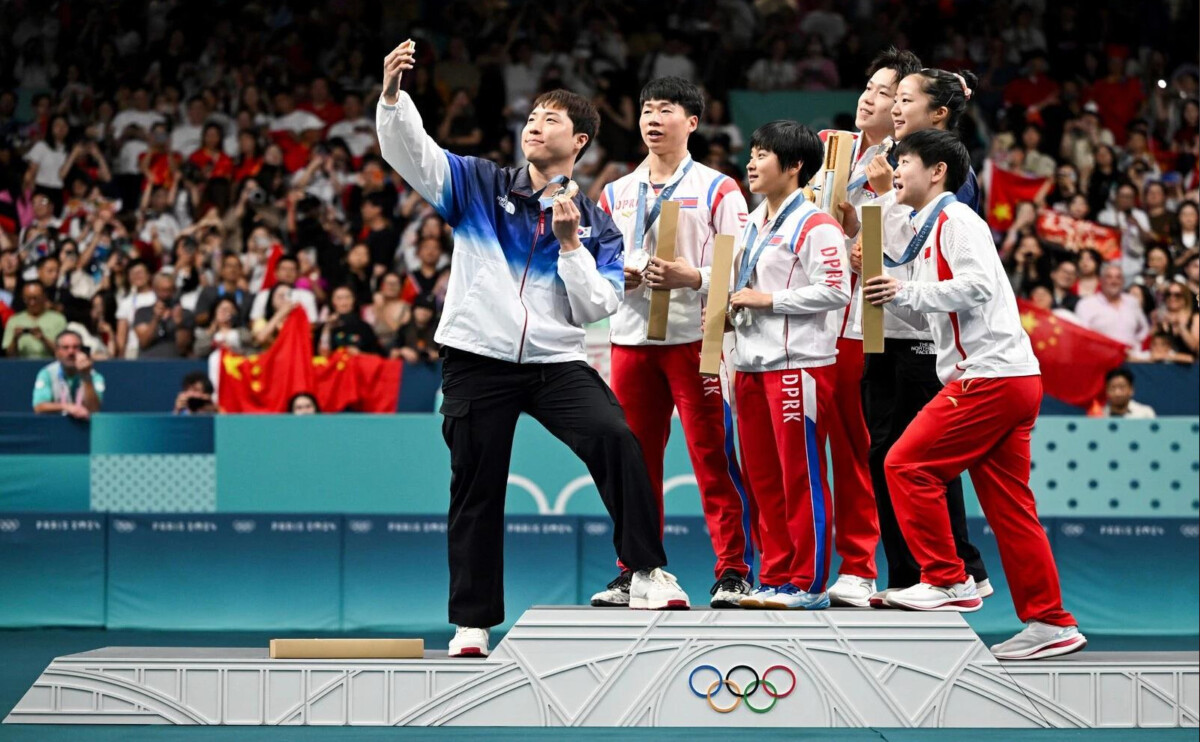
North and South Korean table tennis athletes share one Olympic podium, one frame, and a rare moment of humanity beyond borders on July 30, 2024, in Paris, France (Credit: AFP/Jung Yeon-je)
Sign up here.
When North Korea’s Naegohyang Women’s FC arrives in Suwon on May 17, how will South Koreans view them?
This is far from the simple question it appears to be.
There is already a sense of emotion and excitement. North Koreans have not appeared live and in person in South Korea for years.
They are a club side, not the national team. Nevertheless, the name itself — Naegohyang means “my hometown” — stirs something deep in the South Korean heart.
The team will be the first North Korean women’s football side to compete in the South since the 2014 Asian Games in Incheon. They will face Suwon FC Women in the semi-finals of the AFC Women’s Champions League on May 20. If they win, they will advance to the final on May 23 against either a Japanese or Australian team.
Inter-Korean exchanges were never frequent, but they occurred often enough for the novelty to wear off. In recent years, however, there has been nothing. This will be the first sports delegation to set foot in the South since athletes arrived for the 2018 PyeongChang Winter Olympics.
It was after that event that inter-Korean ties began to deteriorate sharply. Noting the timing, analysts argue that Kim Yo-jong — the powerful sister of Kim Jong-un — returned from her exposure to the South convinced that any form of reunification would mean the end of the North Korean state and perhaps the end of the Kim family itself.
What the leadership appears to have realized, in other words, was that the decades-long contest to be the “real Korea” was over. The South had won.
I admit there is some projection in this interpretation because nobody can know exactly what Kim Yo-jong thought. But it is a reasonable inference given what followed. Dialogue and exchanges collapsed, and Pyongyang dramatically demolished the inter-Korean liaison office built with South Korean funds for bilateral engagement.
The realization that the revolution launched by Kim Il-sung in the 1940s — or the 1920s, if one believes official propaganda — had ultimately failed found its clearest expression in December 2023, when Kim Jong-un formally abandoned reunification as a national objective. South Koreans were now to be regarded as foreigners and enemies.
Since then, Kim has systematically dismantled the very concept of reunification. Laws and state doctrine have been revised. School textbooks have been rewritten. This is crucial because national identity is taught; it is not simply absorbed from the surrounding air.
A new generation of North Koreans is no longer being educated as incomplete Koreans awaiting national reunification.
North Korea may believe it lost the race for legitimacy, but rather than reconcile with the South or simply ignore it, Pyongyang has become more belligerent. It now defines South Koreans as non-Koreans and hostile outsiders.
In this sense, South Korea has shifted in the North’s worldview from a fraternal threat to a foreign threat.
Yet few people in Seoul truly absorbed the significance of this shift. Public debate was limited. Many ordinary South Koreans assumed Kim Jong-un was bluffing and still pursuing reunification by other means.
Many still think that way. Given this, how will they feel when the North Korean players walk onto the pitch?
I ask because, having known Koreans on both sides, I can say that northerners understand they are now expected to regard southerners as foreigners. The existence of the gulag system alone makes North Koreans acutely sensitive to ideological shifts.
Southerners, by contrast, live in a free society and are not being instructed to reinterpret the relationship. Naturally, many will struggle to see these visitors differently from the past.
That perception is itself deeply complicated. To South Koreans, North Koreans are not foreigners. Yet neither are they fully regarded as fellow citizens, despite what the South Korean Constitution says.
They occupy a category entirely their own: family separated by blood and time. Pitied, feared, cared for, yet also looked down upon.
For decades after the Korean War, South Koreans were saturated with grim images of the North. Its forbidden territory and rigid society seemed almost touched by evil. There were reasons for such perceptions, but they also reflected fear and insecurity.
That changed as South Korea grew wealthier, more democratic and more globally confident. Confidence produced a different emotional framework. Fear gradually gave way to empathy.
South Koreans wanted to be loved rather than feared, but many did not realize that the very desire for reunification could itself appear threatening — and still does.
But perhaps this football tournament will begin forcing South Koreans to recognize that history has moved on.
Spectators will almost certainly give the North Korean players a warm welcome. It may be somewhat restrained because Pyongyang has made clear that the team is in Suwon only because it happens to be the venue for an international fixture, not because the North seeks renewed engagement with the South.
Even so, the emotional yearning will remain. South Koreans will see the players as more than representatives of a rival state. They will see them as sisters. Hostages. Every smile, photograph and wave will be scrutinized for hidden meaning.
This tournament may become one of the first moments in which ordinary South Koreans encounter young North Koreans not as symbols of reunification or relics of the Cold War, but as citizens of another state forming its own distinct identity.
Truly seeing them that way may take South Koreans a while.

Hae-song is a Seoul-based analyst and writer on North and South Korean affairs. Having grown up overseas, he has lived his working life in South Korea where he consults on South Korean political and economic issues and on North Korea and defector related issues.
Latest posts by Jun Hae-song (see all)
- Resolute, denuclearization, blah blah…. North Korea has heard this before - September 23, 2026
- Is Trump about to try to solve the Korea question? - August 28, 2026
- Is the day coming when the world admits North Korea has won? - July 27, 2026