

May Day and the unheard cry beneath the propaganda
Sign up here.
What began in 1886 with Chicago laborers demanding an eight-hour workday in response to brutal working conditions has since evolved into International Workers’ Day, or May Day, on May 1 — a global occasion dedicated to protecting workers’ dignity and guaranteeing time for rest.
This year, the occasion carried particular significance in South Korea. For the first time in 63 years, May 1 was designated a full national holiday.
On the northern side of the peninsula, however, one might assume there are no days off.
Surprisingly, North Korean workers also celebrated “May Day” last week. State media publicly honored workers and praised the dignity of labor.
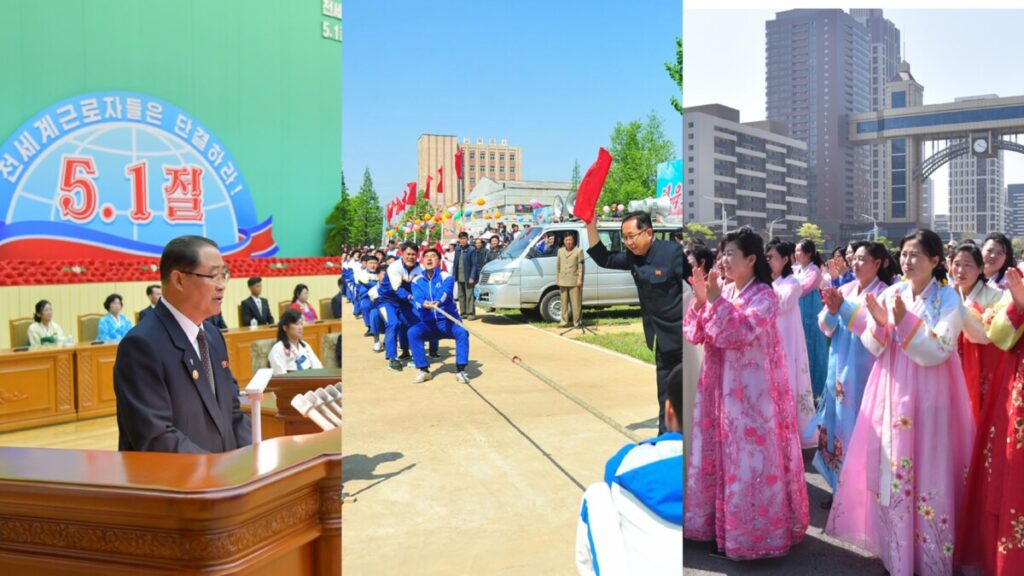
Coverage of this year’s celebrations depicted scenes of joy and happiness: workers relaxing, lively festivities filling the streets and officials warmly mingling with laborers.
In Pyongyang’s official narrative, labor carries dignity and honor, and the regime portrays itself as a guardian rewarding the devotion of its workers.
At the center of that carefully staged performance this year were officials declaring that workers were the “true owners of society,” fully enjoying the fruits of their labor and creativity.
State media also claimed that the ruling party valued workers’ well-being more than industrial output itself, pointing to welfare facilities, holiday resorts and state-provided housing as evidence.
The reality, however, appears starkly different.
More revealing than the regime’s carefully curated archives are the records preserved beyond state control: defector testimonies, reports of forced labor and evidence of public executions. The United Nations Human Rights Council has documented a far harsher reality of labor conditions in North Korea.
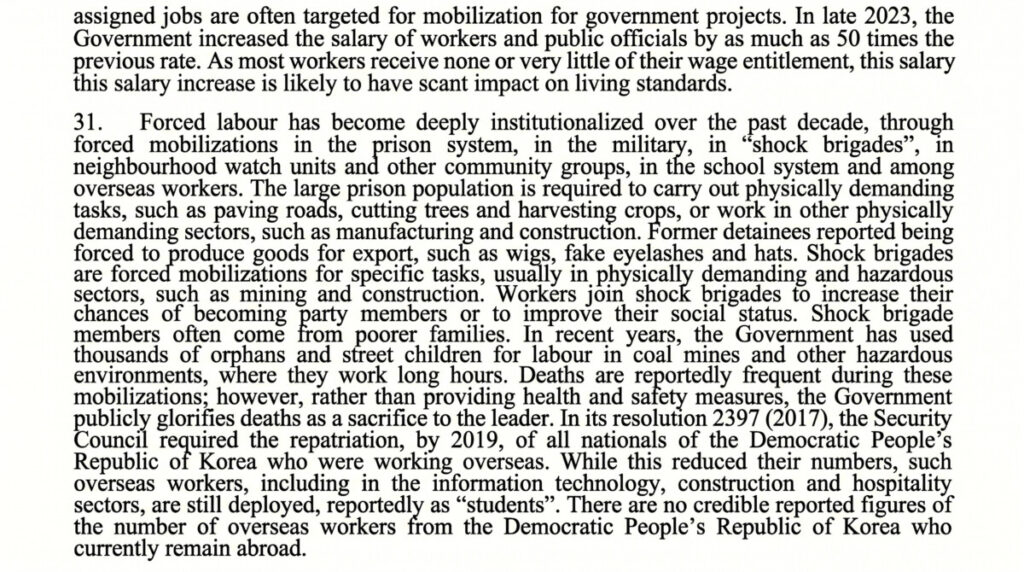
According to a report released in September by the Office of the United Nations High Commissioner for Human Rights, the human rights situation in North Korea has deteriorated significantly over the past decade, with forced labor deeply embedded in prisons, military-style mobilizations, student work assignments and overseas labor deployments.
The report described political prison camps as continuing centers of enforced disappearance, forced labor, summary executions and other grave human rights abuses.
The contrast between these competing narratives presents sharply different portraits of labor in North Korea.
Pyongyang’s propaganda depicts labor as a source of dignity and national identity. U.N. documentation, by contrast, suggests labor is extracted through pressure and stripped of dignity altogether.
The irony is difficult to ignore. The same regime that glorifies labor stands accused of sustaining it through fear and coercion. The tragedy is that North Korean workers exist within both narratives simultaneously.
What makes this contradiction significant is not merely the possibility that the propaganda is false, but the role propaganda itself plays within North Korea. It does more than praise workers — it conditions them into obedience.
Through relentless images of cheerful factory workers, state welfare and grateful citizens, the regime transforms labor into a symbol of political loyalty and state legitimacy rather than treating it as a matter of rights.
The government praises workers as masters of society enjoying the fruits of their labor, while simultaneously demanding the unconditional fulfillment of production targets under its current Five-Year Plan.
The irony is embedded even in the term itself. While “May Day” refers to a holiday celebrating workers, in aviation the phrase “mayday” is universally recognized as a distress call.
Viewed through the lens of the U.N. report, the phrase takes on a different meaning: not “May Day” as a celebration of labor rights, but “MAYDAY” as a cry of alarm.
If one listens closely to the silences beneath those carefully orchestrated photographs — to the words left unspoken out of fear — what emerges may not be celebration at all, but a MAYDAY: a plea for rescue echoing across the peninsula, unheard and unanswered.
Are North Korean workers crying “MAYDAY” on May Day?
The answer is unlikely to appear in official speeches or regime photographs.
Instead, it survives in international documentation, satellite imagery and the testimonies of defectors — realities that propaganda, no matter how meticulously crafted, cannot fully erase.
And so the unheard MAYDAY of North Korean workers continues to echo across the peninsula.

Yoonseo Im is a Seoul-based trilingual journalist and researcher. Growing up in three different countries has shaped her international perspective on the Korean Peninsula. She is a Ph.D. candidate in International Studies and holds prior degrees in Political Science and International Relations. She is also active in multiple research organizations focused on regional issues, including North Korean affairs. Her work explores the intersection of economics, industry, politics, and security in Korea and the broader region, combining academic expertise with reporting experience gained through field journalism. Contact: [email protected]
Latest posts by Yoonseo Im (see all)
- North Korea isn’t building the next ChatGPT. It’s building something else. - June 14, 2026
- May Day and the unheard cry beneath the propaganda - May 13, 2026
- North Korea’s new cybercriminals - April 15, 2026