

North Korea amends constitution to finalize rejection of unification
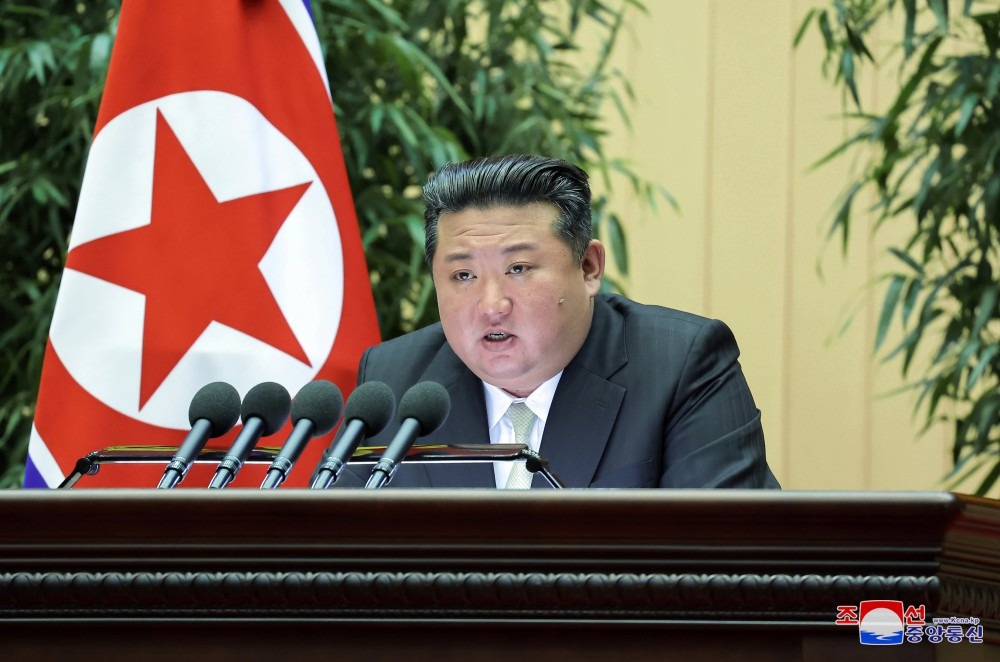
Kim Jong-un (Image: KCNA)
Sign up here.
North Korea has revised its constitution to remove references to reunification with South Korea, Seoul’s Unification Ministry said on May 5.
The amendment, reportedly adopted during the March session of the Supreme People’s Assembly, further institutionalizes leader Kim Jong-un’s view that the two Koreas should no longer be treated as parts of a single nation. It is one of the clearest indications yet that Pyongyang is redefining the peninsula as permanently divided.
According to South Korean officials, the revised constitution deletes language associated with peaceful reunification, ethnic unity, and the long-standing idea that North and South Korea remain one people separated by history and war. Instead, the North now reportedly defines its territory independently, reinforcing the regime’s position that South Korea is a separate and openly adversarial state.
For decades, both governments — despite military confrontation, ideological hostility, and competing political systems — officially maintained that reunification remained the ultimate national goal. That principle helped preserve the notion that the peninsula’s division was temporary, even during periods of extreme tension.Pyongyang now appears to be discarding that framework altogether.
The shift has accelerated under Kim in recent years. North Korean state media and official rhetoric increasingly describe inter-Korean relations not as ties between fellow Koreans, but as relations between hostile states. Kim has repeatedly referred to South Korea as the North’s “main enemy” while reducing references to shared nationhood.
The legal change follows a broader campaign to erase symbols connected to Korean unity. Since late 2023, North Korean authorities have reportedly dismantled reunification monuments, removed language referring to “fellow countrymen,” and altered official imagery to depict only the DPRK rather than the entire peninsula.
Taken together, these developments suggest more than a temporary political message. They point to a deliberate ideological restructuring.
One likely explanation for this strategic shift is the widening contrast between the two Koreas themselves. South Korea has become a globally integrated democracy with a highly advanced economy and broad international influence. North Korea, by contrast, remains economically isolated and heavily sanctioned.
As awareness of outside conditions spreads inside the country through smuggled media and informal markets, maintaining the old reunification narrative may pose growing ideological risks for the regime. Encouraging people to think in terms of eventual unity also invites comparisons between the two systems that could undermine loyalty to the North’s model.
The shift also strengthens the regime’s military narrative. Framing South Korea as a permanently hostile foreign state, rather than a separated counterpart, may make threats, nuclear expansion, and military confrontation easier to justify domestically.
The revision comes amid the near-total collapse of inter-Korean diplomacy, expanding military cooperation with Russia, and continued advances in the North’s nuclear and missile programs. Together, these trends suggest Kim sees little strategic value in returning to reconciliation-centered engagement with Seoul.
The constitutional change may also be aimed at younger North Koreans. Increased exposure to foreign media and outside information has altered how many perceive South Korea. For some, the South may no longer appear primarily as an enemy state, but as a society associated with prosperity, consumer culture, and personal freedom.
By redefining South Korea as an entirely separate hostile country, the regime may be attempting to weaken the sense of shared national identity itself.
At the same time, the broader legal and political reality of the peninsula remains unresolved. North Korea’s constitutional changes do not alter the armistice structure established after the Korean War, nor do they change South Korea’s constitutional position, which still treats the peninsula as a single national territory and maintains reunification as an official objective.
That divergence may deepen future political debate in South Korea over whether reunification remains realistic, or whether the peninsula is gradually moving toward an accepted two-state system.
For older Koreans, the removal of reunification language carries symbolic and emotional weight beyond politics alone. It marks the weakening of a national narrative that shaped identities for generations on both sides of the border.
More than a technical legal revision, the constitutional amendment signals a fundamental shift in how Pyongyang defines the future of the peninsula. North Korea is no longer treating division as an unresolved condition awaiting eventual reunification, but increasingly as a permanent reality.

Taesung offers informed perspectives on North Korean society, grounded in years of experience within a key state-run institution. After defecting to South Korea in 2024, he now focuses on providing analysis of the country.
Latest posts by Kim Taesung (see all)
- North Korea is building new weapons and drones. Russia may be making them better - September 24, 2026
- North Korea drops ‘unification’ from party charter, boosts Kim Jong-un’s power - September 13, 2026
- Man jailed for spying on defectors and soldiers for North Korean agent - September 9, 2026