

North Korea calls China a ‘brother.’ So why does it erase China from history?
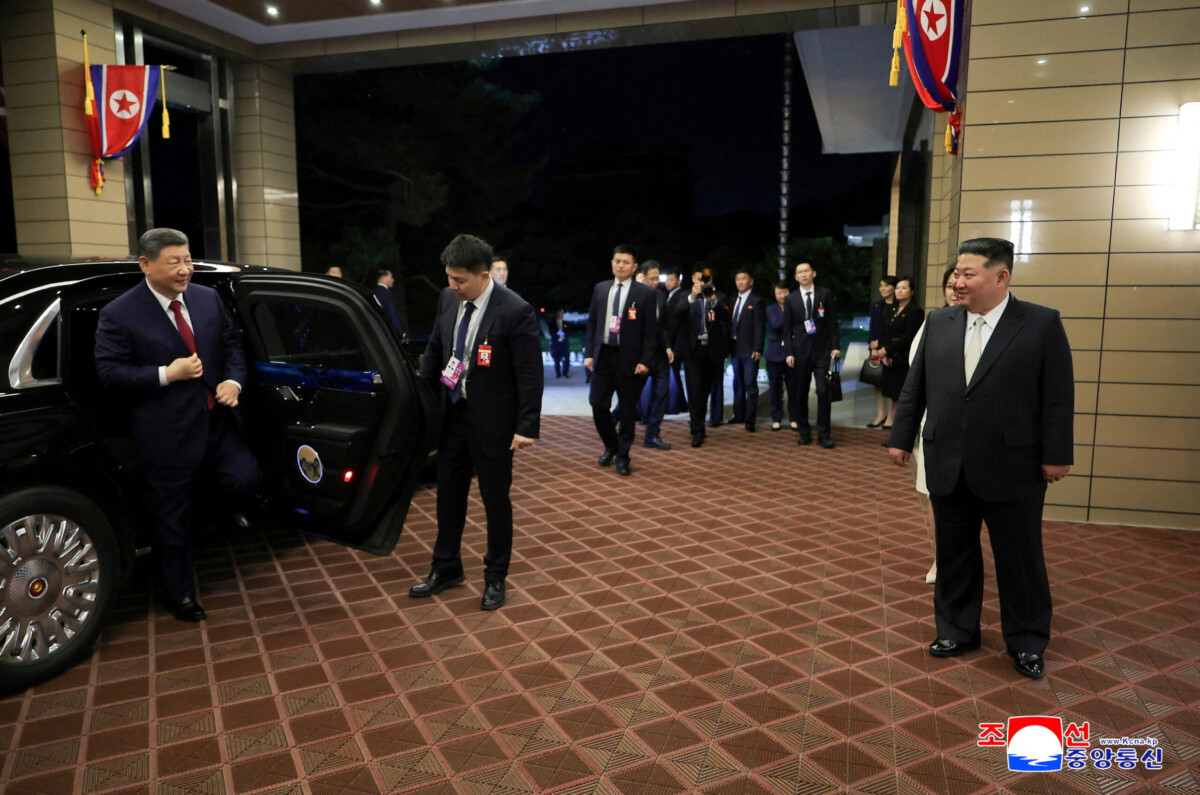
Kim Jong-un greets Xi Jinping in Pyongyang. Image: KCNA
A few days ago, as I watched television images of Chinese President Xi Jinping’s visit to Pyongyang, I was struck by a familiar dissonance.
The streets were draped in red flags and flowers, while North Korea’s state media lavished praise on the “China–DPRK friendship,” the “blood ties,” and a “friendship forged in blood.”
To anyone watching, the two countries appeared to be inseparable brothers bound by history.
But having lived in North Korea, I know the story behind the picture.
The relationship between North Korea and China is defined less by affection than by necessity. It is an uneasy but indispensable partnership. For North Korea, China is a lifeline. When sanctions tighten, markets close, and the outside world turns away, Beijing becomes the wall Pyongyang leans on.
For China, North Korea is an inconvenient but useful strategic asset. As U.S.–China tensions deepen and the international order grows more fragmented, Beijing has every reason to maintain its influence on the Korean Peninsula.
So, while the welcome ceremony celebrated a supposed blood alliance, both governments were quietly calculating their own interests.
This is where North Korean propaganda performs a delicate balancing act. It flatters China abroad while ensuring that, at home, no one overshadows the Kim family.
Inside North Korea, however, China’s role is reduced to a walk-on part. In schools, lecture halls, and official histories, every story ultimately returns to Kim Il-sung, Kim Jong-il, and Kim Jong-un. China is never the protagonist. It may never steal the spotlight.
When I was growing up, teachers told us that “the Great Leader Comrade Kim Il-sung helped the Chinese revolution.”
We heard stories of him sending weapons and ammunition and encouraging Koreans to fight alongside the Chinese Communist Party.
Although we all knew China was a vast country, our textbooks somehow portrayed it as a nation indebted to Kim Il-sung. Even its own revolution became another opportunity to celebrate our Great Leader’s generosity.
Yet when it came to the Fatherland Liberation War – known elsewhere as the Korean War – the role of the Chinese People’s Volunteer Army was barely discussed.
Chinese soldiers occasionally appeared in films or documentaries. We learned about the Friendship Tower and heard friendship slogans. But in the classroom, the central message never changed: victory came through Kim Il-sung’s brilliant strategy and the Korean People’s Army’s heroic struggle under his leadership.
Whenever that lesson arrived, the teacher’s voice would swell with pride.
It was only after arriving in South Korea that I discovered just how much had been left out.
I learned that hundreds of thousands of Chinese soldiers fought in the war and that, without their intervention, Kim’s regime would have collapsed.
The shock was profound. The history I had been taught was a story of Kim Il-sung’s war, Kim Il-sung’s victory, and Kim Il-sung’s military genius. Outside North Korea, however, I discovered another story – one filled with the sacrifices of Chinese soldiers and a truth the regime finds deeply uncomfortable.
Why does North Korea avoid acknowledging this history?
The answer is both simple and consequential. In North Korea, history was never meant to explain the past. It serves to validate the Kim family’s greatness.
No benefactor can appear greater than the Kim family. No outside force can be allowed to appear more decisive.
The moment anyone asks, “What would have happened without China?” cracks begin to appear in the carefully constructed mythology. But our education provided answers before we were allowed to ask questions.
“Thanks to whom?” The answer is always predetermined: thanks to the Leader, thanks to the General, thanks to Kim Jong-un.
Victory in war, national survival, economic endurance – even the food on the table – must ultimately be attributed to the benevolence of the ruler.
That is because, in a dictatorship, nothing is more threatening than a myth that loses its luster.
The same pattern appeared whenever Kim Jong-un’s father, Kim Jong-il, visited China. State media declared that “the leaders and people of China were deeply impressed by the General’s greatness” and that “everywhere the General went, he received enthusiastic welcomes.” The story was never that Kim Jong-il had visited China. It was that China had the privilege of welcoming him. It was always that China was admiring him.
This is the standard formula of North Korean diplomacy. Whoever the foreign leader, the object of admiration is always the Kim family. Every international summit ultimately becomes another chapter in the same story: our leader’s greatness.
Xi Jinping’s visit will almost certainly be presented in the same way. To Beijing, the regime says, “We are brothers.” To its own people, it says, “Even China looks up to Kim Jong-un.”
It is like an orchestra performing two different compositions at once: one instrument plays the melody of brotherhood while another blasts the anthem of the Leader’s greatness. The result is not harmony but discord.
None of this is meant to portray China as a benevolent neighbor. For many North Korean defectors, China is associated with fear, forced repatriation, and suffering. That is precisely why history must be told honestly. China’s support for North Korea, its treatment of defectors, and the strategic calculations that shape the relationship today all deserve to be acknowledged openly.
A relationship built on selective memory and propaganda cannot be genuine.
If North Korea truly believes China is a brother forged in blood, why can it not tell that story honestly to its own people?
I believe the answer is clear. When facts become larger, idols become smaller. When truth enters, propaganda loses its place.
That is why the North Korean regime continues to rewrite history, reshape its relationships, and turn inconvenient truths into yet another testament to the leader’s greatness.

Kim Yumi, a North Korean defector, was born and raised in Haeju, South Hwanghae Province, a coastal military area. Growing up near a naval base, she was able to secretly watch South Korean news programs and TV shows, thereby uncovering the vibrant, democratic society of South Korea. Yumi and her husband made the brave decision to escape North Korea and seek a better future. Now in Seoul, she is actively involved in raising awareness about the realities of life in North Korea, especially on her YouTube channel, “@KimYumiTV.”
Latest posts by Kim Yumi (see all)
- The landmines were supposed to keep enemies out. Who were they really keeping in? - October 15, 2026
- For North Korean footballers, Japan is more than just an opponent - October 7, 2026
- Under the same full moon, two versions of the same holiday - September 25, 2026