
North Korea’s COVID quarantine was a performance built on fear and deception
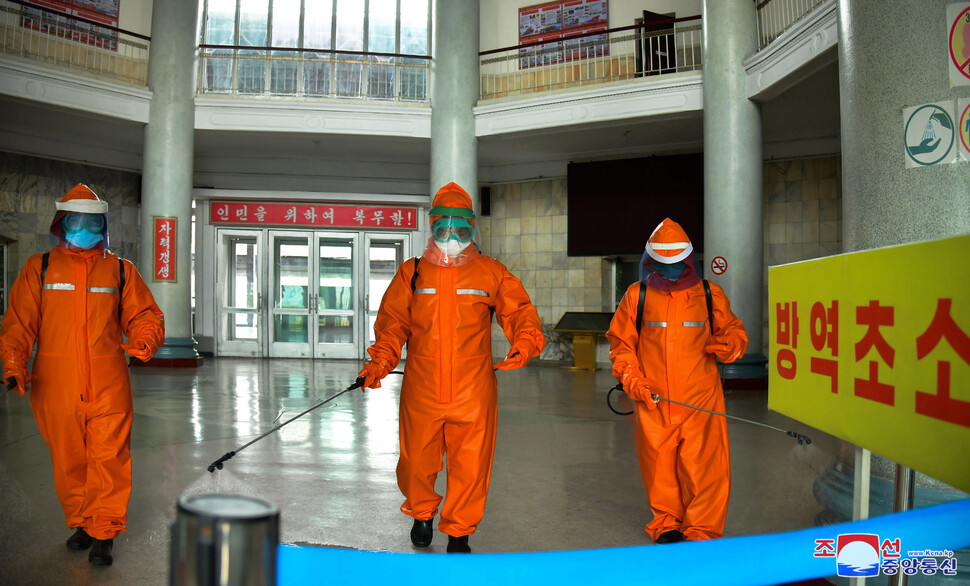
Quarantine workers disinfect Pyongyang Station on May 17, 2022 (Image: KCNA)
One night during the COVID-19 pandemic, while I was still living under quarantine in North Korea, I saw a group of people gathered around a large water tank authorities had publicly described as containing “special sterile disinfectant water.” Then I watched them refill it — with seawater.
That memory came back to me last week as I followed reports about hantavirus. My mind returned to North Korea’s quarantine system: outwardly strict and disciplined, but internally shaped by deception, shortages, and privilege.
North Korea responded to COVID-19 with unusual intensity. Authorities sealed the border, severely restricted movement, and tightened control over coastal areas, including the region where I lived.
On the surface, these measures appeared decisive. But the regime feared more than the virus itself. It feared the collapse of its long-promoted slogan, “We have nothing to envy in the world,” and exposure of its poor medical infrastructure and chronic shortages of medicine.
Under the banner of protecting the people, the authorities imposed what they called a “maximum emergency quarantine system.”
State media repeated quarantine slogans daily, while institutions and work units received a flood of extralegal orders. Movement was heavily restricted, and market traders who relied on day-to-day commerce saw their livelihoods devastated.
The controls were especially harsh in coastal communities. Fishing companies and related businesses were banned from going to sea. Anyone caught sneaking out on a raft or fishing boat to earn a living faced threats of severe punishment, imprisonment, or even execution.
Yet during the same period, the sea remained open to the powerful.
The production and transport of seafood for the so-called “No. 8 supplies” — goods reserved for a privileged elite that included senior Central Party officials in Pyongyang and the Kim family — continued uninterrupted. (“No. 8” refers to the system that manages goods for the leadership.)
These supplies included pine mushrooms, fruit, rice, wild blueberries from Mount Paektu, and a variety of seafood.
Boats designated to transport these goods received special permission to bypass quarantine restrictions entirely.
A virus, of course, does not distinguish between rich and poor. It does not avoid infecting a boat simply because it serves senior officials. From the perspective of COVID-19, a label reading “No. 8 supplies” meant nothing.
The contradictions did not end there.
On paper, all goods — especially “No. 8 supplies” — were supposed to undergo thorough disinfection. Officials kept logs, and inspectors conducted rounds to create the appearance of strict enforcement.
In reality, even the most basic quarantine materials were scarce. Proper disinfectant had long since run out amid chronic shortages and the border shutdown.
Managers improvised. Large disinfection tanks were filled with seawater drawn nearby.
Seawater may wash away visible dirt, but it cannot reliably disinfect surfaces contaminated with COVID-19. It was no substitute for approved disinfectants. Yet officials referred to it as “special sterile disinfectant water” with powerful sterilizing effects.
In reality, it was simply salt water with no meaningful quarantine function.
The system reminded me of The Truman Show — a world in which appearances mattered more than reality. North Korea’s quarantine system existed perfectly in slogans, paperwork, and staged inspections. At my workplace, the white “disinfectant” sprayed by workers in protective suits was seawater.
Even more revealing was how the rules changed for the elite.
Seafood destined for “No. 8 supplies” — supposedly among the goods requiring the strictest disinfection — was not sprayed at all. Officials worried that moisture might reduce freshness or leave a smell on seafood intended for senior Party leaders.
Outwardly, paperwork claimed the products had been thoroughly disinfected. In practice, authorities prohibited spraying entirely to avoid damaging food reserved for the powerful.
I still remember standing beside that tank late at night, holding my breath as workers glanced around to make sure no one was watching. They emptied the remaining liquid and refilled the tank with seawater.
At that moment, my belief in the “powerful disinfectant” promoted by the authorities collapsed.
It became clear to me that North Korea’s quarantine campaign was not a serious public health policy. It was a performance.
This was not simply the result of individual workers cutting corners or temporary administrative failure. It reflected a system in which officials were expected to demonstrate success regardless of whether resources existed, and where survival depended more on false reporting than truth.
The system that claimed to protect life was, in reality, designed first to protect power.

Kim Yumi, a North Korean defector, was born and raised in Haeju, South Hwanghae Province, a coastal military area. Growing up near a naval base, she was able to secretly watch South Korean news programs and TV shows, thereby uncovering the vibrant, democratic society of South Korea. Yumi and her husband made the brave decision to escape North Korea and seek a better future. Now in Seoul, she is actively involved in raising awareness about the realities of life in North Korea, especially on her YouTube channel, “@KimYumiTV.”
Latest posts by Kim Yumi (see all)
- For North Korean footballers, Japan is more than just an opponent - October 7, 2026
- Under the same full moon, two versions of the same holiday - September 25, 2026
- The freedom to ask: Where should we go today? - September 18, 2026