

A North Korean team wins a trophy in South Korea. The victory raised harder questions about freedom.
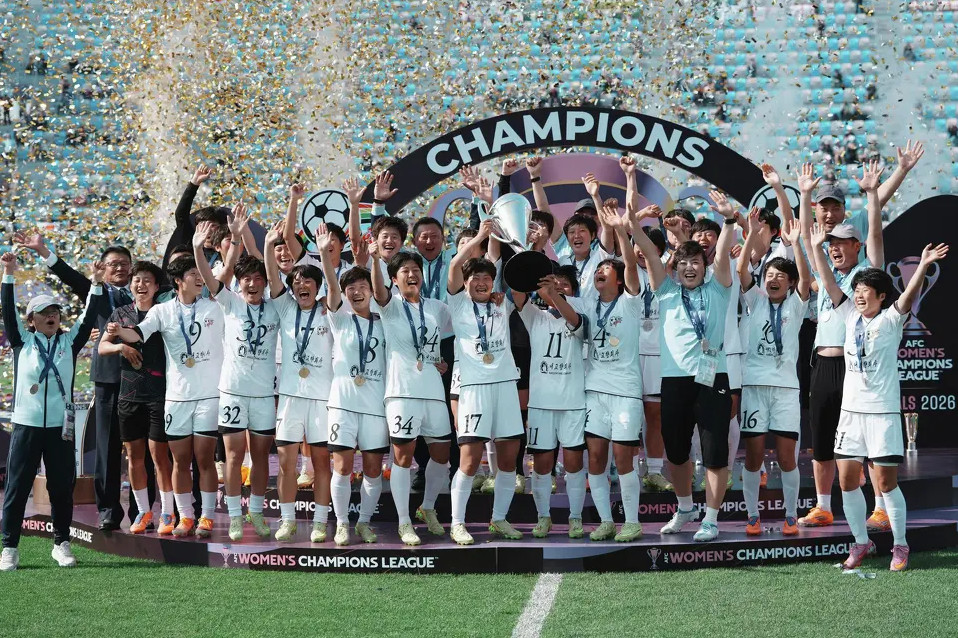
North Korea’s Naegohyang Women’s FC players celebrate after defeating Tokyo Verdy Beleza in the AFC Women’s Champions League final in Suwon, South Korea, on May 23. Photo: Lee Jin-man/AP
Sign up here.
North Korea’s Naegohyang Women’s Football Club lifted a trophy on South Korean soil.
On May 23, in the AFC Women’s Champions League final in Suwon, Naegohyang defeated Japan’s Tokyo Verdy Beleza 1-0 to claim the title. The mere fact that a North Korean women’s football team was competing in an international tournament hosted in South Korea was unusual. The news that it went on to win the championship was enough to attract widespread attention.
For me, having left North Korea only three years ago, the scene was more than a sports story.
Even after arriving in South Korea, news about home still brings back memories of the air there and the faces of the people I left behind. So when I saw the team lifting that trophy on South Korean soil, I felt both proud and heavy-hearted.
On one hand, I admired the players. Life as an athlete in North Korea is never easy. From a young age, they endure grueling training. Failure is rarely treated as a personal setback alone. Sports are not simply about individual dreams or talent. An athlete’s effort is wrapped in the language of national prestige, Party glory and loyalty to the homeland.
After the victory, Naegohyang’s coach thanked the Workers’ Party and the motherland for their support. That was according to established practice. Even extraordinary individual achievement must be explained through “the embrace of the Party” and “the grace of the leader.”
Yet as I watched the players celebrate, another thought occurred to me.
How freely were they able to see South Korea beyond the stadium? What did they think of the brightly lit streets, spectators freely taking photos with their phones, and people laughing and speaking without fear? To South Koreans, these scenes are ordinary. To many North Koreans, they can feel like glimpses of an alien world.
Even after three years in South Korea, there are still moments when everyday life here strikes me as surprising.
Back then, I could not freely watch what I wanted to, listen to what I wanted to, or go where I chose. A single word, song or television drama could become a political issue. After living in such a society, the freedom of South Korea is difficult to believe at first.
Of course, the fact that the North Korean footballers came does not mean they experienced the South Korea that its citizens know. The North’s sports delegations typically move under tightly controlled schedules when they are abroad. Where they go, who they meet, what they see and what they say are carefully managed.
Setting foot on enemy South Korean soil and freely experiencing South Korean society are not the same thing.
This was not an inter-Korean reconciliation event. Naegohyang was not playing a friendly match against a South Korean team. It was competing in an international club tournament organized by the Asian Football Confederation.
Rather than assigning excessive political meaning to the result, we should recognize both the skill displayed by athletes and the reality of the society that shaped them.
Inter-Korean relations today are far from warm. Pyongyang has become increasingly explicit in its hostility toward Seoul, while military tensions on the peninsula remain high. The regime does not encourage its citizens to imagine life in the South. Instead, it portrays it as hostile.
On one side, North Korean athletes were competing in a South Korean stadium. On the other, propaganda and control continue to make them view the South as distant and dangerous.
That is why I could not applaud the victory without reservation.
The talent displayed by the North Koreans was undeniable. Their speed, strength, organization and focus until the final whistle came from years of discipline and hard work. Their achievement deserves respect and celebration.
But that talent was developed in an environment very different from that experienced by athletes in free societies. In North Korea, sports, art and education are often subordinated to the purposes of the state. Even when an athlete scores a goal, the celebration is not primarily about the individual. The homeland, the Party and the leader come first.
I would also point out that the victory also highlighted the strength of North Korean women.
In North Korean society, women often shoulder the burdens of family, livelihood and state-imposed obligations at the same time. Women are frequently responsible for supporting their families through market activity while also fulfilling organizational duties and various mobilization campaigns demanded by the state.
Despite these challenges, North Korean women endure and persevere. Naegohyang’s victory showcased that resilience and potential.
Yet one question remains.
If those players could live freely, how different might their lives be? If they could choose what to say, what to see, where to go and what dreams to pursue—not only inside the stadium but outside it as well—how much more could they achieve?
If they could listen to the music they liked, watch the films they wanted to see, travel where they wished and meet whomever they chose, what possibilities might open before them?
I congratulate them on their victory. The sweat and effort behind it deserve genuine respect.
But celebrating their achievement should not mean celebrating the regime.
What we should recognize is not the propaganda of the state but the people who have survived within that system and developed their talents despite it. North Korean athletes, North Korean women and North Korean young people deserve the opportunity to see a wider world.

Kim Yumi, a North Korean defector, was born and raised in Haeju, South Hwanghae Province, a coastal military area. Growing up near a naval base, she was able to secretly watch South Korean news programs and TV shows, thereby uncovering the vibrant, democratic society of South Korea. Yumi and her husband made the brave decision to escape North Korea and seek a better future. Now in Seoul, she is actively involved in raising awareness about the realities of life in North Korea, especially on her YouTube channel, “@KimYumiTV.”
Latest posts by Kim Yumi (see all)
- The landmines were supposed to keep enemies out. Who were they really keeping in? - October 15, 2026
- For North Korean footballers, Japan is more than just an opponent - October 7, 2026
- Under the same full moon, two versions of the same holiday - September 25, 2026