

Blood alliance or mistrust? The uncomfortable update to China–North Korea relations
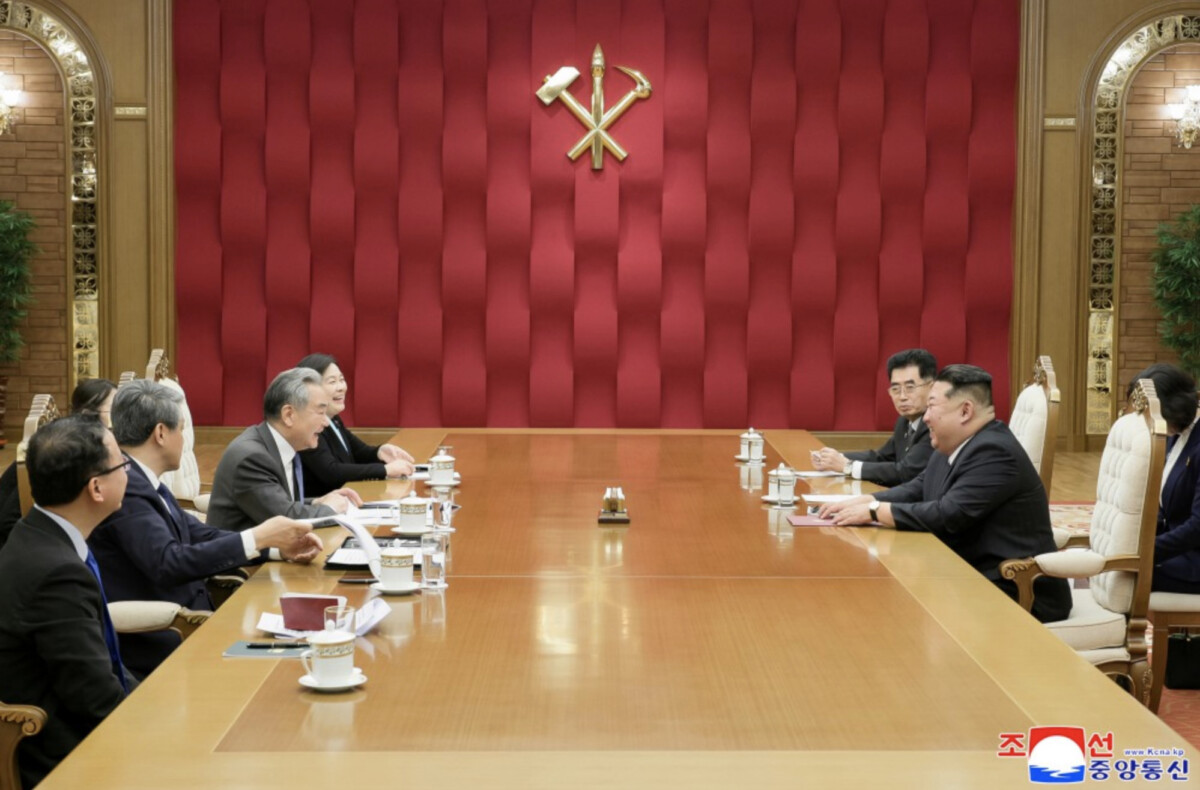
Kim Jong-un (right) shares a joke with Chinese foreign minister Wang Yi (Image: Korean Central News Agency)
China’s Foreign Minister Wang Yi met with Kim Jong-un in Pyongyang on April 10, in what analysts describe as a significant moment for the two countries amid shifting regional and global dynamics.
The importance of Wang’s visit, confirmed by North Korean state media, lies in its timing. It came a month ahead of a planned U.S.-China summit and at a time of intensifying strategic competition between the two powers. In this context, the Koreas once again emerge as a key variable.
China appears to be seeking to secure strategic leverage for future negotiations through closer communication with North Korea, while Pyongyang, in turn, seems intent on maximizing its geopolitical value within the broader context of superpower rivalry.
The two sides emphasized strategic cooperation and the development of bilateral relations.
While North Korea has traditionally expressed support for China’s core interests, particularly the “One China” principle, its posture reflects not so much shared values as strategic coordination driven by mutual necessity.
Indeed, experts increasingly refrain from characterizing the relationship as a traditional alliance, instead describing it as a more evolved, rational, interest-based partnership.
That said, despite the outward display of cooperation, the visit also highlights underlying tensions. In particular, the recent strengthening of military cooperation between Russia and North Korea complicates China’s position. As Pyongyang deepens ties with Moscow, Beijing’s influence correspondingly wanes.
In this context, Wang appears to have been seeking to prevent North Korea from tilting excessively toward Russia. China continues to view North Korea as a crucial geopolitical buffer, yet faces a structural dilemma: it must manage a partner that is becoming increasingly autonomous.
For its part, North Korea does not view its relationship with China as a simple “blood alliance.” While it remains economically dependent on its neighbor, it maintains a dual posture, simultaneously guarding against the expansion of Beijing’s influence. This underlying tension persists even as bilateral trade recovers in the post-pandemic period.
Ultimately, China remains an indispensable yet not entirely trustworthy partner for North Korea. For China, meanwhile, North Korea is a necessary but difficult-to-control actor.
At the same time, the global order is being reshaped toward multipolarity, driven by overlapping factors such as the war in Ukraine, U.S.-China strategic competition, and tensions in the Middle East. Within this environment, China–North Korea relations are taking on a more complex form, in which cooperation and mutual restraint operate simultaneously.
In the end, Wang’s visit illustrates the fundamental nature of China–North Korea ties: a relationship grounded in shared strategic interests but continually adjusted in the absence of full trust.
The two sides are engaged in an unstable strategic partnership characterized by mutual dependence as well as deep-seated mistrust—one that is likely to have lasting implications for the Koreas and the broader international community.

Taesung offers informed perspectives on North Korean society, grounded in years of experience within a key state-run institution. After defecting to South Korea in 2024, he now focuses on providing analysis of the country.
Latest posts by Kim Taesung (see all)
- Korea’s Unification paradox: Two states, one people — but for how long? - October 15, 2026
- A 52-year-old gunshot reopens South Korea’s historical divide - October 11, 2026
- A DMZ mine tests Lee Jae-myung’s North Korea policy - October 8, 2026