

Tactical weapons test signals more complex threats on the Korean peninsula amid growing Russia factor
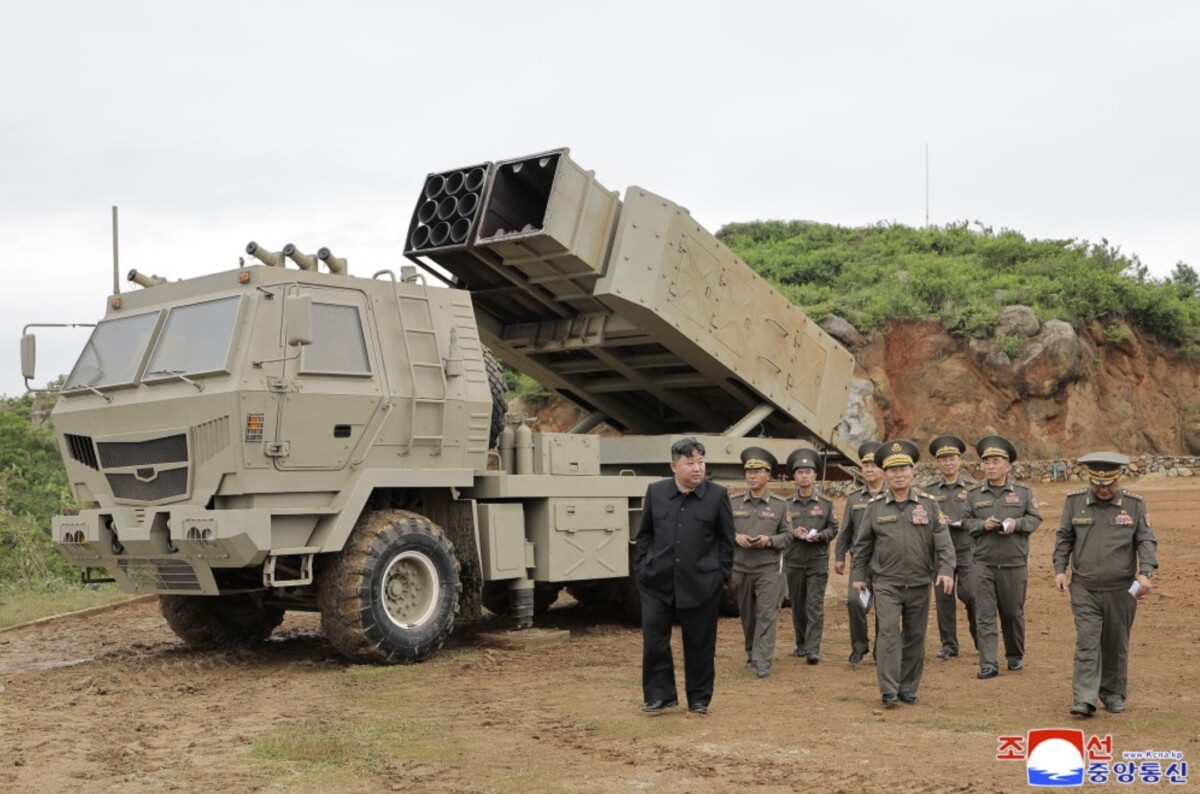
Kim Jong-un inspecting weapons systems, reported on May 27 [Image: KCNA]
North Korea’s latest test of advanced tactical weapons highlights a broader effort to modernize its artillery and missile forces, potentially creating more complex military challenges on the Korean Peninsula while raising fresh questions about the role of expanding cooperation with Russia.
The country’s Missile Administration and Academy of Defence Sciences conducted tests on May 26 of a newly developed lightweight multipurpose missile launch system and a multiple-launch tactical cruise missile weapon system.
According to KCNA, the tests formed part of a broader effort to modernize North Korea’s artillery and missile forces under its five-year defense development plan.
The report said leader Kim Jong-un personally observed the launches.
The tests reportedly evaluated the effectiveness of a “special-mission warhead” for a tactical ballistic missile, the reliability of an “ultra-precision autonomous guidance and navigation system” for an extended-range 240-millimeter guided multiple rocket projectile, and the accuracy of “artificial intelligence-guided” strikes by a tactical cruise missile.
The South Korean military assessed the launches as involving short-range ballistic missiles and multiple rocket projectiles fired from the Jongju area in North Pyongan Province.
The significance of the KCNA report lies not merely in the fact that North Korea conducted another weapons test. Rather, Pyongyang portrayed the event as evidence of progress in modernizing its artillery and missile forces.
It quoted Kim expressing satisfaction that “important, high-level national defense science and technologies” had been incorporated into practical weapons testing. He described the launches as “a clear signal of the renewal of our military power” and “a major technological advance” in strengthening combat capabilities.
Kim also claimed that the fire-control and automation systems of all launch vehicles had been “completely renewed” to meet the demands of modern warfare.
The weapons highlighted in the report fall into three main categories.The first is the lightweight multipurpose missile launch system. Based on an analysis of images released by North Korean state media, USNI News assessed that the platform appears capable of firing both tactical ballistic missiles and 240-millimeter guided rockets. The ballistic missile shown in the images is believed to belong to the Hwasong-11D series.
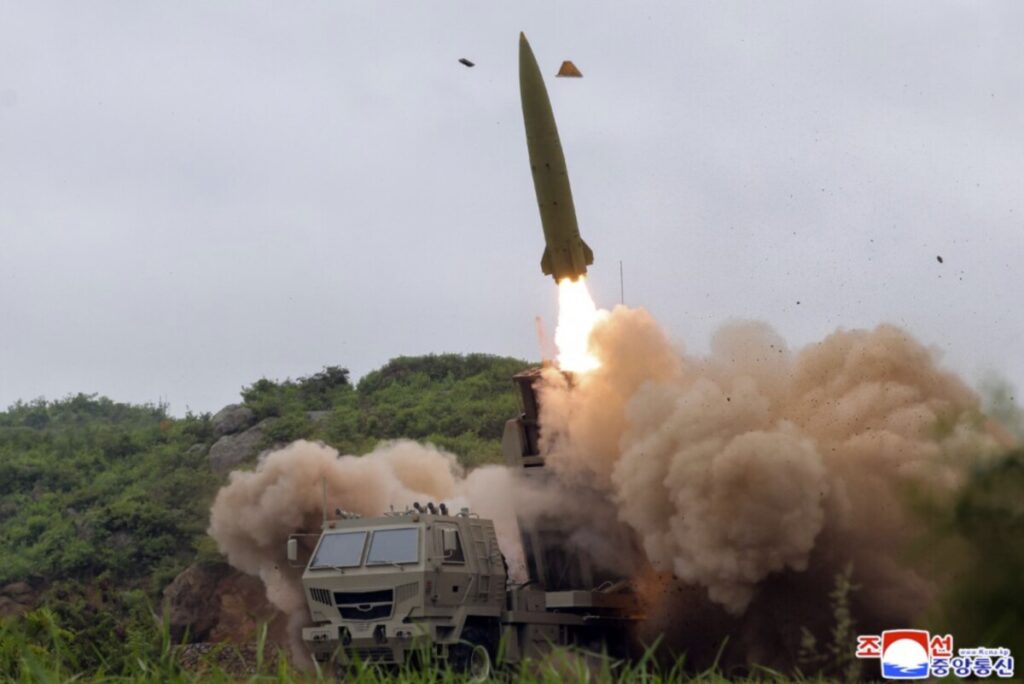
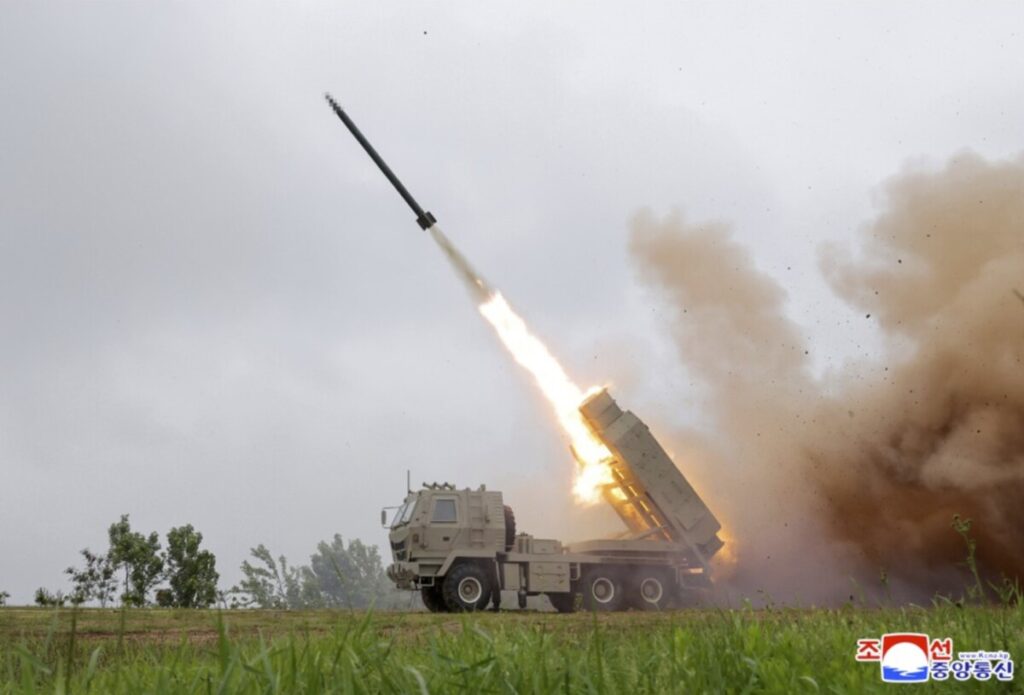
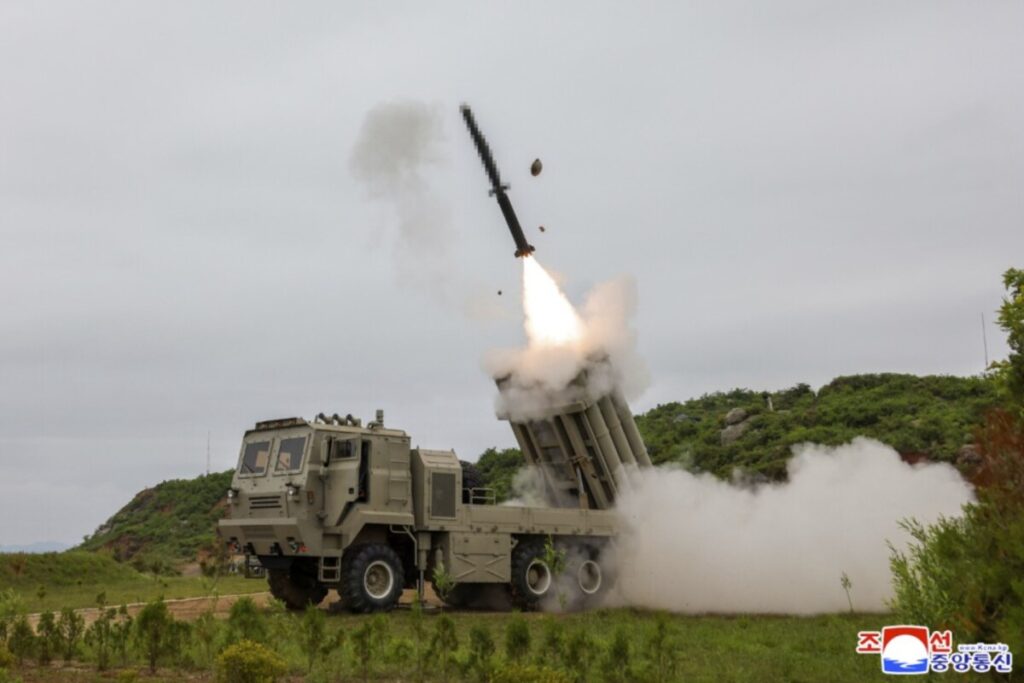
The second is the extended-range 240-millimeter guided multiple rocket projectile. North Korea claims the projectile is equipped with an “ultra-precision autonomous guidance and navigation system.”
Traditional multiple-launch rocket systems are designed primarily for saturation attacks and area suppression. Guided rockets, however, could enable North Korea to strike more specific targets, including military facilities, command posts, air bases and radar installations.
The third system is a tactical cruise missile with a reported range of about 100 kilometers. KCNA said the missile combines an “ultra-precision autonomous navigation system” with terrain-contour matching navigation and an “artificial intelligence terminal guidance function.”
According to state media, the missile is designed to conduct precision strikes against targets within a range of approximately 100 kilometers. The Associated Press, citing North Korean media, reported that the test involved an AI-guided tactical cruise missile, 240-millimeter precision-guided rockets and a tactical ballistic missile warhead test.
North Korea’s claims should be treated cautiously.
Terms such as “ultra-precision,” “artificial intelligence” and “completely renewed” are common features of its military propaganda. Publicly available information does not allow outside analysts to verify the capabilities of the cruise missile’s purported AI guidance system.
Nor is it clear whether the system could operate effectively under electronic warfare conditions or in environments where satellite navigation signals are jammed or degraded.
The International Institute for Strategic Studies (IISS) has assessed that North Korea has demonstrated ambitions to integrate AI into military systems, but continues to face significant technical hurdles in developing operationally reliable capabilities.
For that reason, North Korea’s reference to “AI guidance” is more likely to describe some form of automatic target recognition or terminal-stage course correction using imagery, terrain data or sensor inputs. It should not be interpreted as evidence that North Korea has developed a fully autonomous weapon capable of independent battlefield decision-making.
It is plausible that North Korea is developing 100-kilometer-class tactical cruise missiles and guided multiple rocket projectiles. Whether those systems can deliver the level of “ultra-precision” performance claimed by Pyongyang under real combat conditions remains unproven.
Even so, the test points to a broader trend in North Korea’s weapons development: the pursuit of more precise, automated and integrated tactical firepower.
Pyongyang is not focused solely on strategic systems such as intercontinental ballistic missiles. It is also seeking to combine short-range ballistic missiles, multiple rocket launchers and tactical cruise missiles into a coordinated force that could be employed in a conflict on the Korean Peninsula.
Such a combination could complicate defense planning for South Korea and the United States.
A mix of ballistic missiles, cruise missiles and guided rockets could be used to overwhelm missile defense systems, reduce warning and response times, and blur the line between conventional operations and tactical nuclear strikes.
One detail in the KCNA report is particularly noteworthy: the reference to deploying tactical cruise missiles to “long-range artillery brigades in the southern border area.”
This suggests North Korea may be seeking to expand missile operations beyond rear-area strategic units and integrate them into forward-deployed artillery formations.
Each system serves a different purpose. Short-range ballistic missiles can challenge defenses through speed and maneuverability. Cruise missiles can fly at low altitudes and follow indirect flight paths, making detection more difficult. Guided rockets can be launched in large numbers to saturate and exhaust interception systems.
The significance of the test, therefore, lies not in any single weapon but in North Korea’s apparent effort to build a more complex and integrated tactical strike architecture.
Russia remains an important part of the equation.
There is no public evidence conclusively showing that the specific technologies tested on May 26 were transferred directly from Russia. However, North Korea’s growing military cooperation with Moscow may be improving the overall environment for Pyongyang’s weapons development.
The Center for Strategic and International Studies’ Beyond Parallel project has noted that North Korea–Russia military cooperation has expanded significantly since 2022. It has also identified possible Russian assistance related to North Korea’s 2023 launch of its Malligyong-1 military reconnaissance satellite as a major development.
The Royal United Services Institute has similarly assessed that North Korea’s defense industry is increasing its pace and scale with the benefit of Russian fuel supplies and financial support. The institute has also noted Pyongyang’s growing investments in artificial intelligence, space technologies and integrated military systems.
Even so, it would be premature to conclude that the 240-millimeter guided rocket or the 100-kilometer-class tactical cruise missile showcased in this test is a direct product of Russian technology.
North Korea has spent years developing its own short-range ballistic missiles, large-caliber multiple rocket systems and cruise missiles. Russia’s contribution may be less about transferring specific weapon designs and more about providing fuel, funding, components, technical cooperation and operational feedback.
This single test does not mean the military balance on the Korean Peninsula has suddenly shifted in North Korea’s favor.
South Korea and the United States continue to hold substantial advantages in intelligence, surveillance and reconnaissance; precision-strike capabilities; air and naval power; missile defense; and command-and-control systems.
However, the burden on South Korean and U.S. forces could increase if North Korea succeeds in integrating short-range ballistic missiles, guided rockets, tactical cruise missiles and tactical nuclear capabilities into a more coordinated strike network.
Such a force would be designed not only to inflict damage but also to overwhelm defenses and create uncertainty during the opening stages of a conflict.
Ultimately, the May 27 KCNA report suggests that North Korea is seeking to make its tactical firepower more precise, more automated and longer-range. Its claims regarding “AI guidance” and “ultra-precision strikes” remain unverified and should be viewed partly through the lens of propaganda.
The broader trend, however, is real. North Korea is attempting to transform its forward-deployed artillery and missile forces into a more mobile, precise and integrated combat force.
Military cooperation with Russia may be helping Pyongyang accelerate that effort by expanding the resources available to its defence sector. The key takeaway is not that North Korea has unveiled a single new weapon, but that it is broadening its options for deterrence, coercion and attack in the early stages of a conflict by strengthening both its nuclear forces and its conventional precision-strike capabilities simultaneously.

Taesung offers informed perspectives on North Korean society, grounded in years of experience within a key state-run institution. After defecting to South Korea in 2024, he now focuses on providing analysis of the country.
Latest posts by Kim Taesung (see all)
- Trump wants Kim back at the table. This time, Kim holds the cards. - August 28, 2026
- In North Korea, a newspaper editorial is never just an editorial - August 12, 2026
- North Korea posts third straight year of 3% growth, fueled by Russia arms trade - August 3, 2026