

The freedom to ask: Where should we go today?
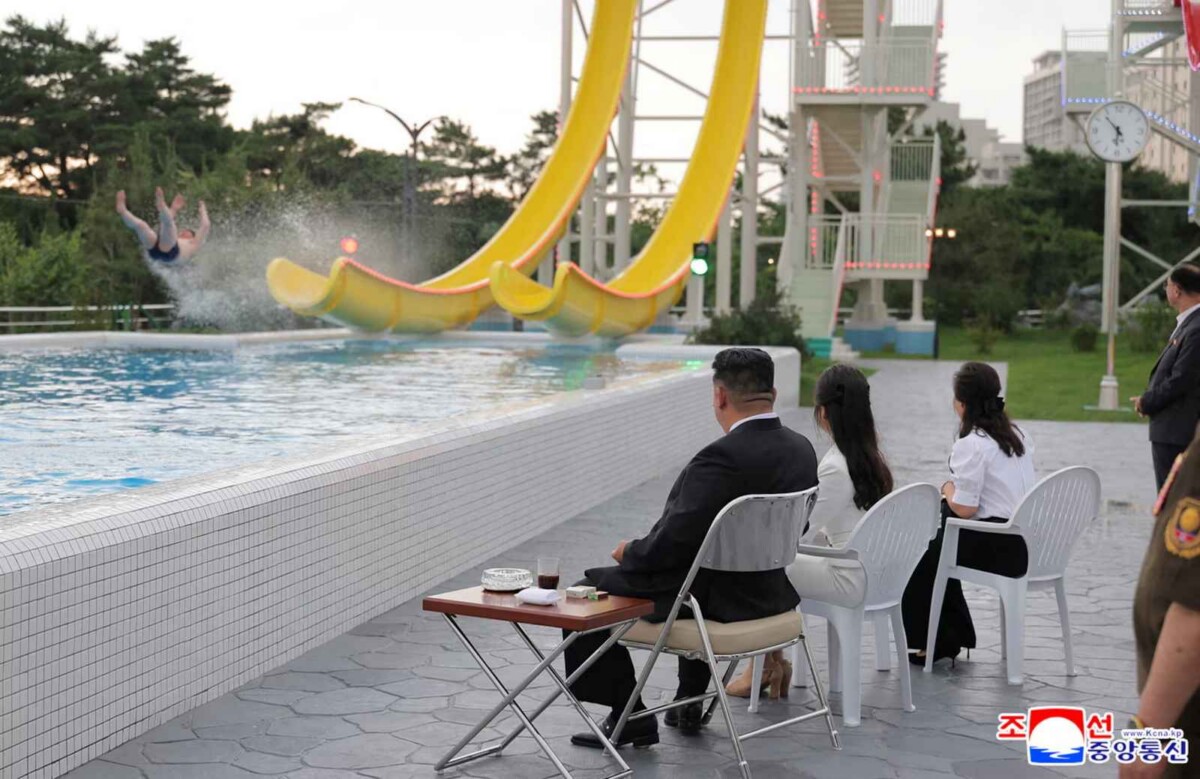
A June 2025 photo of Kim Jong-un at a resort poolside with his wife Ri Sol-ju and their daughter Kim Ju-ae. (Image: KCNA)
When I was a child in North Korea, I once wanted to visit my uncle.
It sounds like an ordinary thing for a child to want. But visiting him was not simply a matter of getting on a bus and going.
I needed a document from my school. I had to prepare my birth certificate, tell my teacher where I was going and why, and get permission.
I remember wondering: Why should I have to explain why I want to visit my uncle?
At the time, I did not understand that this was one of the quiet ways in which life in North Korea was controlled. You learned early that even ordinary decisions could require permission.
That memory has come back to me recently as I see photographs of the new coffee shops, amusement parks, shopping malls and resorts appearing in North Korea.
I am genuinely pleased to see them.
Having lived there until just three years ago, I hope my friends and neighbors back home can enjoy these things. I want them to be able to take their children swimming, drink coffee with friends and spend a weekend somewhere other than home.
But I find myself thinking about something that cannot be photographed.
The Wonsan Kalma Coastal Tourist Area, which opened in 2025, has hotels, a water park and other leisure facilities, with capacity for around 20,000 people.
That is a remarkable change from the North Korea I knew.
But a new building tells us only that a building has been built. It does not tell us who can enter it, who can afford it or whether an ordinary family can decide on a Saturday morning to go there.
For adults, traveling between regions in North Korea traditionally required permits, with additional authorization needed for some restricted areas. Recent international human rights reports indicate that restrictions on movement remain in place.
That is why I sometimes imagine an ordinary family living in the mountains of North Hamgyong Province looking at a photograph of Wonsan and asking:
“The weather’s nice. Why don’t we go to Wonsan today?”
It is a simple question.
But in North Korea, it is not necessarily a simple choice.
There is another memory from my childhood that has stayed with me.
At lunchtime, you could learn a great deal about a family simply by looking inside a child’s lunchbox.
A relatively well-off child might have white rice with meat or an egg. A child from a struggling family might have corn rice with a spoonful of soybean paste.
Some children turned away and ate alone because they did not want anyone to see what they had brought.
Poverty showed in their clothes, too. Fabric became thin after years of use. Clothes were sometimes difficult to wash properly because there was not enough soap. Other children sometimes avoided those who looked poor.
Those children had done nothing wrong. They had not chosen their circumstances.
Yet poverty followed them everywhere, into their lunchboxes, their clothes and their friendships.
That is why I look at the new consumer culture in North Korea with two feelings at once.
I am happy to see more choices becoming available.
But I also wonder who can make those choices.
A coffee shop is not simply a coffee shop if only a small part of the population can afford to use it. A resort is not the same thing as a family holiday if most families cannot freely travel there.
The question is not whether North Korea has more things.
It is whether more North Koreans have the ability to choose among them.
I began to understand the importance of this after arriving in South Korea.
The biggest changes were not necessarily the dramatic ones.
They were often tiny.
One day, I walked into a coffee shop and sat down. Then I suddenly wondered: Why did I come in here?
The answer was almost embarrassingly simple.
Because I wanted coffee.
I had not been sent there. I did not need to tell anyone where I was going. I did not need permission.
I wanted coffee, so I came in.
At first, I did not think of that as freedom. Freedom sounded like something much bigger – the right to speak, the right to vote, the right to worship, the right to travel abroad.
Of course, those things matter enormously.
But freedom also lives in much smaller decisions. Where should I eat? Should I go to the park? Should I stay home? Should I take my children somewhere this weekend? Should I visit a friend?
These questions are so ordinary that we barely notice that we are answering them ourselves.
A few days ago, I watched families at a playground in Seoul. Parents were sledding with their children, falling over, getting back up and laughing. Some seemed even more excited than their kids.
No one had told them to go there. They had simply decided to spend the day together.
Watching them, I realized that one of the great freedoms of life is the freedom to enjoy yourself for no particular reason.
North Korea is changing. There are more consumer goods, more leisure facilities and more visible signs of prosperity than there were when I lived there.
I do not want to deny that change, and I certainly do not want North Koreans to lose it.
I want there to be more coffee shops, not fewer.
I want more swimming pools, more restaurants and more places where families can spend time together.
I want young people to have more opportunities to imagine different futures.
But buildings and products are only part of the story.
The deeper question is whether people’s choices are expanding along with them.
A smartphone can give someone new ways to communicate and make a living, but it does not necessarily give that person access to the wider world.
A shopping mall can offer more products, but that does not necessarily mean everyone has the money to buy them.
A resort can offer a beautiful holiday, but that does not necessarily mean every family can decide freely to visit.
And a coffee shop can offer a cup of coffee without necessarily offering the freedom to decide when and where you will go.
That is why I am less interested now in asking whether North Korea looks more modern.
I want to know whether ordinary people’s lives are becoming more their own.
I sometimes think about the child who needed a document from her school to visit her uncle. She did not know enough to call that a restriction on freedom. She simply wondered why visiting her own family had to be explained.
Years later, living in South Korea, I discovered that freedom could mean something as unremarkable as walking into a coffee shop because I wanted a cup of coffee.
Or deciding to take my family to a park.
Or changing my mind and going somewhere else.
These are tiny freedoms.
But when you have lived without them, they do not seem tiny at all.
So when I see photographs of the new North Korea, I do not want to ask only how many coffee shops have opened, how many hotel rooms have been built or how many people can fit into a new water park.
I want to ask a simpler question.
Can an ordinary family wake up on a Saturday morning and say: Where should we go today? And then simply go?
That is the change I am waiting to see.
Not because I want North Korea to look more like South Korea. Not because every new building is meaningless. And not because I want to dismiss the genuine improvements that may be taking place.
I want something much more ordinary.
I want the child who once needed permission to visit his uncle to become part of a generation that does not have to explain every ordinary choice.
A generation that can decide where to go, what to see, what to read, whom to visit and how to spend a Saturday.
One day, I hope, a North Korean family will wake up, look outside and ask: Where should we go today?
Kim Yumi, a North Korean defector, was born and raised in Haeju, South Hwanghae Province, a coastal military area. Growing up near a naval base, she was able to secretly watch South Korean news programs and TV shows, thereby uncovering the vibrant, democratic society of South Korea. Yumi and her husband made the brave decision to escape North Korea and seek a better future. Now in Seoul, she is actively involved in raising awareness about the realities of life in North Korea, especially on her YouTube channel, “@KimYumiTV.”
Latest posts by Kim Yumi (see all)
- The freedom to ask: Where should we go today? - September 18, 2026
- When the past became hope - August 28, 2026
- Why is North Korea sending women to Russia? - August 20, 2026