

Korea’s Unification paradox: Two states, one people — but for how long?
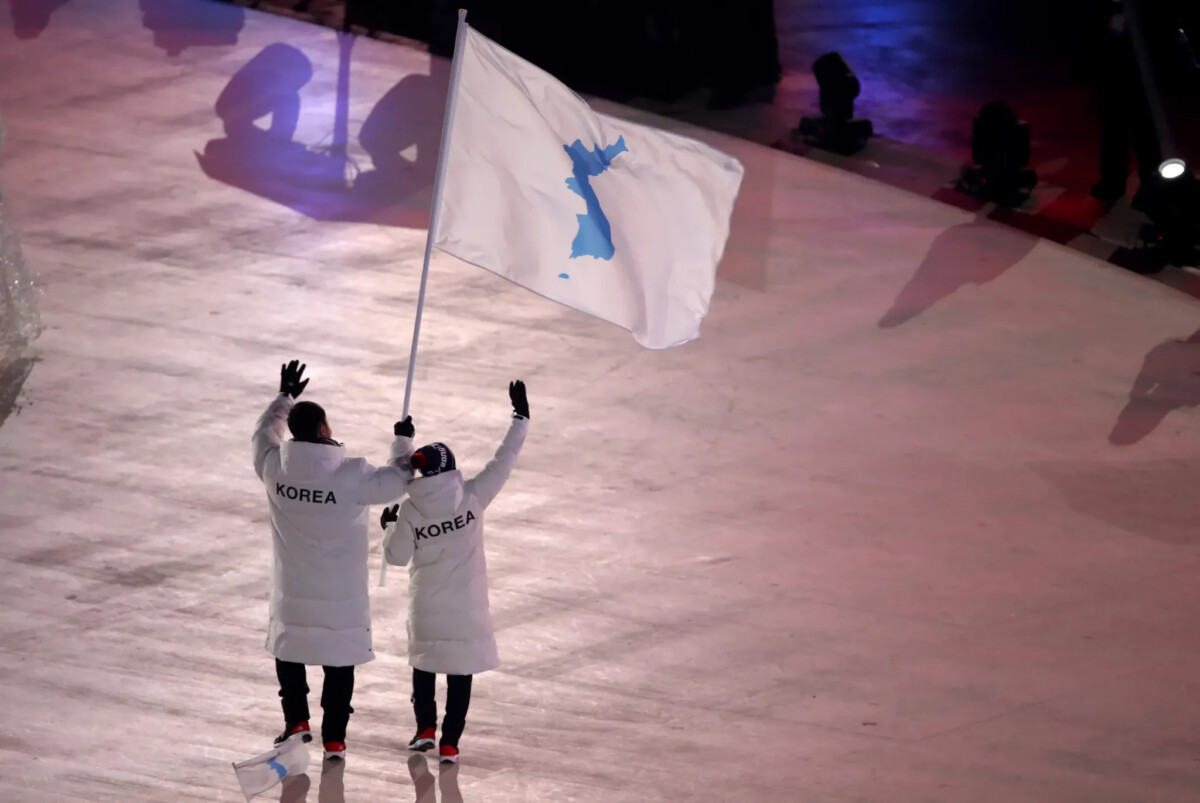
North Korean ice hockey player Hwang Chung-gum and South Korean bobsledder Won Yun-jong jointly carry the Korean Unification Flag at the opening ceremony of the 2018 PyeongChang Winter Olympics, symbolizing hopes for unity. Photo: Sean M. Haffey/Getty Images.
For generations, Korean reunification was regarded as an unfinished obligation of history. The peninsula was divided, but its people remained one nation. Reunification was not a question of whether, but when.
That assumption is unraveling.
North Korean leader Kim Jong-un has abandoned reunification as a national objective, redefining South Korea as a hostile foreign state. In the South, younger generations increasingly question whether political unity is necessary or desirable.
A September 2026 survey found that only 39 percent of South Koreans consider reunification necessary. According to the poll, commissioned by the Institute for Peace and Unification Studies at Seoul National University, for those in their 20s, the figure was just 25.2 percent.
Yet research involving North Koreans suggests a striking contrast.
In a poll of 87 defectors in 2018, the institute found that 95.4 percent of them considered reunification necessary when they were living in the North. Another study conducted inside North Korea found that 34 of 36 respondents shared that view.
Neither small, nonrepresentative study establishes what North Koreans think today. But the findings raise a critical question: Has Pyongyang abandoned reunification because its people no longer want it, or because the prospect of unity threatens the regime itself?
Two competing perspectives now frame the debate. One argues that stepping back from reunification could reduce hostility and eventually make unity possible. The other insists that lasting peace, denuclearization and freedom for North Koreans ultimately require a unified Korea.
Both reflect the failures of decades of policy. But neither can afford to ignore the people living north of the border.
President Lee Jae-myung’s liberal government has placed peaceful coexistence at the center of its North Korea policy, departing from the previous conservative administration’s emphasis on freedom-based unification.
In February 2026, his government established three principles: respect for North Korea’s political system, rejection of unification through absorption and avoidance of hostile acts.
Its May unification white paper proposed moving toward peaceful coexistence between two effectively separate states while preserving eventual unity as a goal.
The distinction is politically sensitive. South Korea’s Constitution still defines its territory as the entire peninsula and mandates peaceful unification.
Unification Minister Chung Dong-young has maintained that recognizing two states in practice does not mean treating the Koreas as foreign countries or abandoning national unity.
The debate reflects a longstanding political divide.
Liberal leaders, including former presidents Kim Dae-jung and Moon Jae-in, generally emphasized engagement and economic cooperation as paths to reconciliation. Conservative governments placed greater weight on deterrence, denuclearization, human rights and political change in the North.
Lee’s predecessor, Yoon Suk-yeol, advanced a freedom-based unification doctrine in 2024. His People Power Party, which is now in the major opposition force, subsequently criticized Lee’s two-state approach as potentially undermining South Korea’s constitutional commitment.
These political traditions are not absolute: Liberal administrations have maintained deterrence, while conservatives have also pursued dialogue.
Their fundamental disagreement concerns the order of priorities. Should reducing hostility between governments come first, or must political transformation within North Korea remain central?
For Seoul, the dilemma is whether recognizing division as a political reality will help overcome it — or gradually legitimize its permanence.
NK Insider analyst Jun Hae-song argues that the relentless pursuit of reunification has paradoxically contributed to its failure.
For Pyongyang, unity under South Korea’s democratic system would almost certainly end the Kim dynasty’s political monopoly. Even economic engagement can therefore appear threatening.
Removing reunification from the immediate diplomatic agenda might ease that insecurity, creating room for cooperation and gradual transformation.
Jun has also questioned the effectiveness of repeatedly demanding denuclearization from a government that considers nuclear weapons indispensable to its survival. In an earlier essay, he raised the possibility that the international community may eventually have to acknowledge North Korea’s nuclear capabilities as an enduring reality, even without formally recognizing its nuclear status.
The argument challenges decades of diplomatic orthodoxy. But it contains an important uncertainty.
North Korea’s repression is not merely a response to external hostility; it is fundamental to the regime’s domestic control.
A northern leadership reassured that South Korea no longer seeks to absorb it may well become more receptive to engagement. It might also become more confident in maintaining permanent separation.
Coexistence could reduce the regime’s insecurity without expanding its people’s freedom.
And if ordinary North Koreans still desire reunification, accepting Pyongyang’s rejection of it risks treating the government’s preferences as interchangeable with those of its citizens.
Reliable nationwide polling is impossible inside North Korea, where citizens cannot freely express their political preferences. Nevertheless, surveys of defectors and small-scale interviews offer a picture more complicated than Pyongyang’s official position.
Seoul National University’s 2018 survey found that 90.8 percent of respondents had considered reunification very necessary while living in North Korea, while another 4.6 percent considered it somewhat necessary.
Their motivations were revealing: 41.4 percent cited shared ethnicity, 29.9 percent the prosperity of North Koreans and 13.8 percent the elimination of the threat of war.
Yet 57.5 percent believed reunification was impossible.
The distinction between aspiration and expectation matters. North Koreans could desire unity while doubting it would ever happen.
After Kim’s policy reversal, Daily NK reported in January 2024 that residents interviewed inside North Korea expressed confusion and disappointment. Some had associated reunification with improved living standards. Researchers at Unification Media Group documented similar reactions from contacts inside the country later that year.
Such accounts cannot establish how widespread these attitudes are, particularly following intensified government efforts to erase reunification from official ideology.
Nor should support for unity be confused with support for immediate absorption into South Korea. In the 2018 defector survey, 32.2 percent favored South Korea’s political system, while 29.9 percent preferred a compromise between the two systems.
These findings point to an essential distinction: aspiring to national unity does not necessarily mean endorsing a particular political blueprint.
Kim can remove reunification from textbooks, monuments and official doctrine. Whether he can remove it from his people’s aspirations is another question.
David Maxwell, a retired U.S. Army Special Forces colonel and Korea security analyst, argued at the International Forum on One Korea 2026 that policymakers have pursued their objectives in the wrong order.
His prescription was explicit: “Unification first, then denuclearization and peace; the path to unification is through information and human rights.”
Maxwell advocates maintaining credible military deterrence while preparing politically and economically for eventual unity.
The argument has moral force. A peace that stabilizes relations between governments without expanding freedom for North Koreans leaves the peninsula’s deeper human tragedy unresolved.
Hyun Jin Preston Moon, chairman of the Global Peace Foundation, contends that Kim’s abandonment of reunification reveals ideological weakness rather than strength. By renouncing competition over Korea’s national future, Pyongyang may have exposed the limits of its political legitimacy.
Yet the unification-first approach has its own paradox.
If Pyongyang regards unification as the end of its regime, making it the explicit objective of allied strategy could reinforce the insecurity that discourages openness.
A free and unified Korea may be a desirable destination. But that does not establish a peaceful route toward it.
The weakness of coexistence is its uncertainty about political change. The weakness of unification-first thinking is its uncertainty about how to achieve that change without confrontation.
The most consequential transformation may be occurring not in diplomatic negotiations but in how Koreans understand one another.
Jun examines whether South Korea’s emphasis on coexistence reflects a deeper retreat from national unity. He also explores how decades of separation have altered South Koreans’ perceptions of their northern counterparts.
North Korea is teaching younger generations to regard South Koreans as foreigners and enemies. In the South, younger citizens increasingly assess reunification in terms of economic insecurity, military risks and the anticipated costs of integration.
A 2024 survey by the Korea Institute for National Unification, reported in February 2025, found that only 30.6 percent of South Koreans believed reunification would benefit them personally, while 92.4 percent believed it would benefit North Koreans.
This asymmetry is revealing.
For South Koreans, reunification increasingly raises questions about what they might sacrifice. For North Koreans who hope for change, it may represent opportunities their existing system cannot provide.
But shared ancestry alone cannot sustain national unity indefinitely.
If the two populations cease to see themselves as members of a common community, reunification may become socially impossible long before it becomes politically achievable.
The United States introduces another uncertainty.
Jun examines whether President Donald Trump might pursue a broader settlement with Kim involving nuclear limits, normalization or a formal end to the Korean War.
Such an agreement could reduce tensions while leaving the fundamental political questions unresolved.
Meanwhile, Seoul’s efforts to reopen dialogue have met resistance. On Oct. 8, Kim Yo-jong dismissed a South Korean proposal for medical assistance as a political provocation.
The episode illustrates the limits of seeking coexistence when Pyongyang rejects engagement.
Yet the choice need not be between immediate unification and permanent division.
A more durable strategy would distinguish three objectives: preventing war, expanding human freedom and achieving political unity.
Preventing war is an immediate responsibility. Improving human rights and widening opportunities for contact are continuing obligations. Political unification remains a possible long-term outcome that would require peaceful processes and the freely expressed choices of Koreans on both sides.
This approach need not abandon reunification or demand that Pyongyang accept absorption as the price of dialogue.
But it requires recognizing that peace between governments and reconciliation between peoples are not necessarily the same achievement.
Korea has reached an unusual historical moment.
Its two governments are moving toward different understandings of the peninsula’s future, while public attitudes toward reunification are changing. Yet the aspirations of ordinary North Koreans remain difficult to measure and are largely excluded from decisions about their country’s future.
Korea’s future cannot be determined solely by the strategic calculations of Pyongyang, Seoul or Washington. Nor should reunification be pursued merely to fulfill a historical obligation.
Unification must earn its relevance as a credible promise of greater freedom, security and opportunity for the people who would live through it.
For South Koreans, that requires confronting the costs of integration honestly. For North Koreans, it means preserving the possibility of freely choosing their political future.
Peaceful coexistence may be a necessary starting point. But success should be measured not only by the absence of war, but also by whether Koreans become safer, freer and better able to determine their own destiny.
The greater danger is allowing today’s political necessities to extinguish tomorrow’s possibilities.
The ultimate question is no longer simply when Korea will become one nation again.
It is whether Koreans on both sides can preserve a shared future compelling enough that they would freely choose to become one.

Taesung offers informed perspectives on North Korean society, grounded in years of experience within a key state-run institution. After defecting to South Korea in 2024, he now focuses on providing analysis of the country.
Latest posts by Kim Taesung (see all)
- Korea’s Unification paradox: Two states, one people — but for how long? - October 15, 2026
- A 52-year-old gunshot reopens South Korea’s historical divide - October 11, 2026
- A DMZ mine tests Lee Jae-myung’s North Korea policy - October 8, 2026