

Kim Jong-un Is Here Again. When Can We Go Outside?
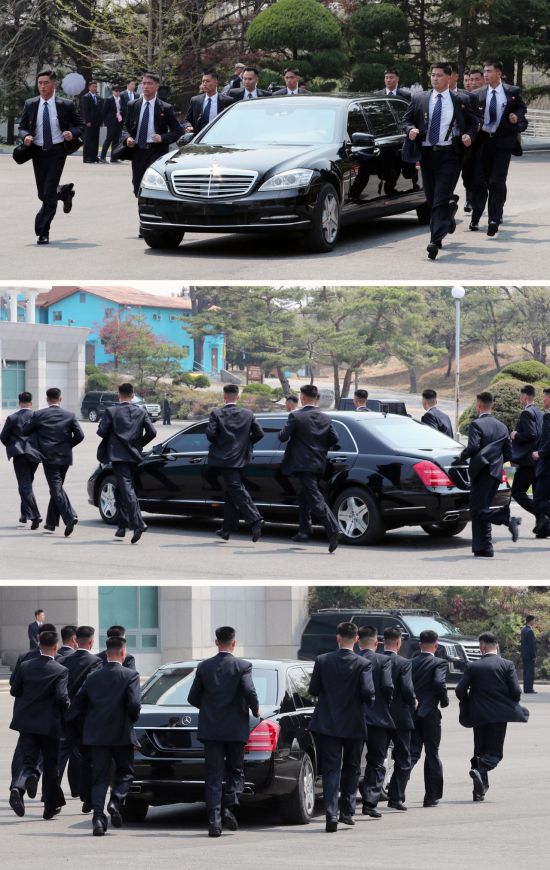
The scene as the leader arrives. Image courtesy of Yonhap News
“The General is here!”
In North Korea, is this welcome news—or the beginning of another period of fear and tension?
In state media, scenes of Kim Jong-un’s visits are invariably filled with overwhelming emotion. Residents rush forward shouting “Manse!” (“Long live the leader!”), while soldiers burst into tears. The spectacle suggests that meeting the supreme leader is the greatest happiness anyone could experience.
But the three visits by Kim Jong-un that I witnessed firsthand were very different. There were no cheers, only silence. No excitement, only fear.
Recent media reports say that restrictions on residents in and around Sinuiju, the border city in North Pyongan Province, had been tightened before and after Kim’s sudden visit to China. Accommodation inspections and security crackdowns had been underway since October 20, and on October 23 and 24, residents living near the New Yalu River Bridge were reportedly barred from leaving their homes, even to work in their fields.
Residents were said to fear that becoming caught up in a security incident during a “No. 1 event”—an official event involving the supreme leader—could ruin their lives.
These reports brought back memories of my own experiences. I have been living in South Korea for three years now, but I still vividly remember Kim Jong-un’s three visits to the frontline area where I once lived.
When I first heard that he was coming, I was genuinely intrigued. I was curious about the possibility of seeing up close the supreme leader I had only ever seen on television.
The reality was very different.
Whenever Kim visited, civilians and soldiers alike were forbidden from moving around freely. Roads were blocked, and armed guards were stationed everywhere. Even someone who merely poked their head out of the front door was immediately ordered back inside.
I remember the atmosphere being so tense that I felt a wrong move could get me shot. Any curiosity I had felt earlier quickly evaporated. All I could do was stay indoors and wait.
On one occasion, I was supposed to travel with my school to take part in a provincial competition. But because Kim was visiting, all traffic was suspended and the event had to be postponed. Not a single car could be seen on the roads. Security was so tight that it seemed not even an ant could get through.
That was when I began to question what was happening.
“So the leader has come. Why should that mean people can’t go to school or do their jobs?”
I could not understand why a leader who claimed to serve the people would visit a community if it meant they were confined to their homes.
During his first visit, residents were still curious and excited. By the second and third, their reactions had changed.
“He’s here again.”
“When is he going to leave this time?”
The sea was our livelihood. Fishermen had to go out every day. But whenever Kim came, they were forbidden from going to sea, and normal life ground to a halt.
For the leader himself, each visit was brief. But for us, it could determine whether there would be enough food on the table that day. How could we be expected to welcome him wholeheartedly?
Then, after his third visit, something truly absurd happened.
Word spread that local officials had been reprimanded by their superiors. They had apparently been asked why residents had not rushed out to greet the supreme leader, shouting “Manse!”
The officials, in turn, took out their frustration on the residents.
“The General came all the way to our village! If people had run out shouting ‘Long live the General!’ do you think he would have simply left? How could people be so clueless?”
I was dumbfounded.
Armed bodyguards had ordered everyone to stay indoors. How on earth were we supposed to run outside?
When we pointed this out, an official retorted:
“Even if there were security guards, do you really think they would have stopped people running out shouting ‘Long live the General!’?”
Well, that was indeed a question to puzzle over. We had stayed inside because we had been told not to come out. Now we were being scolded for failing to rush outside.
We began whispering among ourselves.
“Who in their right mind would have run outside? One wrong move and you could end up with a bullet through your head.”
“He surrounds himself with bodyguards because he’s afraid of being killed, then gets angry because people stay quiet.”
The situation was so ridiculous that I did not know whether to laugh or be angry. Yet no one dared express their frustration openly.
That was what a North Korean “No. 1 event” meant in my experience.
Until then, I believed that the people shown on television crying and cheering for the leader were expressing genuine emotion.
After experiencing three of his visits firsthand, however, my perspective changed.
Of course, some people may genuinely be overwhelmed when they see him. But standing before the supreme leader is not simply a matter of meeting someone you admire.
How you look and behave carries enormous consequences. Your facial expressions and actions can affect not only your own future but also that of your family.
When everyone around you is shouting “Manse!” can you really remain silent? When everyone else is crying, would you dare stand there without showing any emotion?
In North Korea, cheers and tears are not necessarily expressions of loyalty. Sometimes, they are a way of protecting yourself and your family.
That does not mean Kim’s visits brought no benefits at all.
In our village, some families received special privileges, including opportunities for their children to join the Workers’ Party or to take leave. These benefits were connected to their role in transporting Kim safely by boat through rough seas to an island defense unit.
Membership in the Workers’ Party is a major milestone, one that can significantly shape a person’s future. For those who received such privileges, it must have felt like an extraordinary stroke of luck.
But only a select few benefited.
After Kim departed, most residents returned to the sea, battling rough waves to make a living. His visit was a special occasion, but it did nothing to ease the hardships of ordinary life.
Reading the recent report from Sinuiju, I wondered whether residents there might be feeling much the same way.
If the New Yalu River Bridge opens and trade with China expands, improving people’s livelihoods, that would certainly be welcome news.
But hoping for economic improvement is one thing. Having your daily life disrupted in the meantime is quite another.
What people need is an ordinary day—one in which children can go to school as scheduled, fishermen can head out to sea without fear, and residents can open their front doors without worrying about the consequences.
Perhaps what North Koreans are really waiting for is not the day Kim comes to visit, but an ordinary day when they can live in peace, without fear or the need to constantly watch what they say and do.

Kim Yumi, a North Korean defector, was born and raised in Haeju, South Hwanghae Province, a coastal military area. Growing up near a naval base, she was able to secretly watch South Korean news programs and TV shows, thereby uncovering the vibrant, democratic society of South Korea. Yumi and her husband made the brave decision to escape North Korea and seek a better future. Now in Seoul, she is actively involved in raising awareness about the realities of life in North Korea, especially on her YouTube channel, “@KimYumiTV.”
Latest posts by Kim Yumi (see all)
- A plea to escape North Korea — and the fear that it might be a trap - November 9, 2026
- Kim Jong-un Is Here Again. When Can We Go Outside? - November 2, 2026
- The landmines were supposed to keep enemies out. Who were they really keeping in? - October 15, 2026