

Under the same full moon, two versions of the same holiday
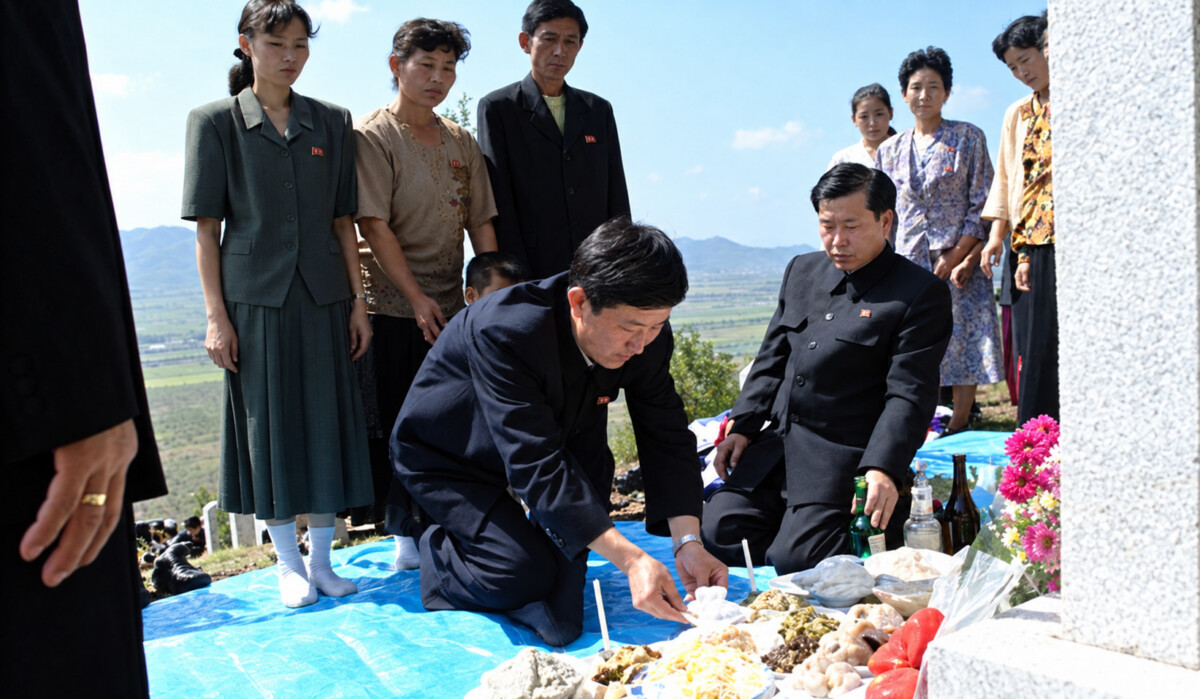
Family members perform a Chuseok ancestral ceremony in North Korea. Photo courtesy of Yonhap News
South Korea’s roads were already growing crowded ahead of the traditional Chuseok harvest festival holiday.
Traffic worry is an integral feature of the three-day holiday when people try to make it to their hometowns and villages. They scramble to get train tickets, prepare gifts for their parents and discuss with family members what they will eat together. This year, the holiday runs from Sept. 24 to 27.
I have now lived in South Korea for three years, and scenes like these are gradually becoming familiar to me.
But whenever Chuseok approaches, the first thing that comes to mind is not Seoul’s expressways, but the mountain paths of North Korea.
I remember women climbing the mountains with large basins of food balanced on their heads and bottles of alcohol in their hands. Some people strapped food to the backs of bicycles. Others caught rides on motorcycles. But most simply walked.
The Chuseok I remember in North Korea was a strange holiday.
Some people looked forward to it. Others dreaded its arrival.
Children waited eagerly for Chuseok.
On that day, they could eat better food than usual and see uncles, aunts and other relatives they had missed. Most of all, they were happy simply to have a day off.
When I was in school, being a student did not mean spending all day studying. After morning classes, we were often sent to help on farms, dig up wild chives or catch centipedes. Students were also mobilized to water flowers along the roads and help irrigate rice paddies.
Life was not much different for adults.
In the area where I lived, Sunday did not automatically mean a day off. If the weather at sea was good, people went to work even on Sundays. Ironically, an unexpected day of rest usually came only when rain or maritime warnings made work impossible.
That is why the single day of Chuseok was precious to both adults and children: it was a rare chance to put down their work and rest.
For the women of the household, however, Chuseok often meant even more work.
After coming to South Korea, I was surprised the first time I saw ready-made holiday food sets. You can buy songpyeon rice cakes and jeon pancakes, and, if you want, prepare almost an entire holiday table with food that is already cooked.
The Chuseok preparations I saw in North Korea were very different.
You had to start by finding the ingredients. You had to make a fire with wood or coal. If you wanted to make rice cakes, you had to pound the rice yourself. Almost every step, from beginning to end, required manual labor.
If Chuseok was a “day off” for husbands and children, for many mothers it was a long day spent in the kitchen from before dawn.
And yet, even being able to prepare holiday food was something some families could only envy.
For households short of food, even a single bowl of white rice to offer their ancestors was a source of worry.
There was barely enough rice for the living family members, but people still felt they could not visit their deceased parents’ graves empty-handed. Some would spend a few extra days trading in the markets to earn enough money. If they still could not afford much, they would take at least a bottle of alcohol to the gravesite.
“This is all I could bring you this year.”
No one told them they had to say those words, but some people would bow before the grave and silently ask forgiveness in their hearts.
For the poor, Chuseok was therefore not always a holiday of abundance. Sometimes it was a day that reminded them, once again, of just how poor they were.
And when I think of Chuseok in North Korea, what I remember most vividly is the sound of people crying in the mountains.
If you climbed a mountain on Chuseok, you could hear sobbing from different directions.
Some people cried out for their parents. Others mourned husbands or wives who had passed away before them. You could also hear the grief of parents who had buried their own children.
On ordinary days, people were so busy trying to survive that they kept their longing and grief buried deep inside. But on Chuseok, standing before a grave, those emotions could suddenly pour out all at once.
That is why Chuseok in North Korea remains in my memory as both a day when I ate delicious food and an intensely sad day.
Chuseok in South Korea is not entirely different. People here also remember their ancestors and miss family members who have passed away.
But the atmosphere I have experienced in South Korea feels somewhat different.
After visiting family graves, people return home, sit around the table together, eat and laugh. Some families travel. Others buy prepared food and keep the holiday simple. There is no single prescribed way that everyone must spend Chuseok. This year, too, many people will spend the holiday not only in their hometowns but also traveling or attending cultural events.
Watching this, I realized that even during a traditional holiday, people can have choices.
There is another difference that weighs more heavily on my mind.
In North Korea, Chuseok is a day when large numbers of people travel to visit family graves. But wanting to go somewhere does not necessarily mean you are allowed to go.
This year, reports from inside North Korea have said that access restrictions remain in place in parts of North Hamgyong and Ryanggang provinces near the border, preventing some residents who live elsewhere from obtaining travel permits to visit their parents’ graves during Chuseok. It has not been confirmed, however, whether the same situation is occurring across the entire country.
Reading that report left me with a strange feeling.
In South Korea, people worry because so many cars are heading home that the roads become clogged with traffic.
In North Korea, for some people, the road itself may be closed — even the road leading to the grave of a parent they long to see.
It is the same Chuseok and the same full moon, yet the reality beneath it is so different.
As I prepare to spend my third Chuseok in South Korea, I find myself thinking about things I did not fully understand when I was still in North Korea.
Why were children so eager for the holiday?
Why did mothers sigh as Chuseok approached?
Why was preparing a single holiday table such a heavy burden for poor families?
And why did so many people cry in the mountains on Chuseok?
I hope that someday Chuseok in North Korea will become a little less difficult.
I hope people will no longer have to feel ashamed because they cannot afford a bowl of rice to place before their ancestors. I hope mothers will not have to spend the entire day struggling in front of a hot stove. I hope children will be able to rest freely even when it is not Chuseok.
Above all, I hope that people will no longer need anyone’s permission simply to travel to see the family members they miss.
This year, as always, the Chuseok full moon will rise over both North and South Korea without distinction.
And I hope that someday, beneath that same moon, Chuseok for the people of North Korea will no longer be a day they look forward to simply because it is their one chance to rest, but a day they look forward to because they can see the people they miss and laugh together.

Kim Yumi, a North Korean defector, was born and raised in Haeju, South Hwanghae Province, a coastal military area. Growing up near a naval base, she was able to secretly watch South Korean news programs and TV shows, thereby uncovering the vibrant, democratic society of South Korea. Yumi and her husband made the brave decision to escape North Korea and seek a better future. Now in Seoul, she is actively involved in raising awareness about the realities of life in North Korea, especially on her YouTube channel, “@KimYumiTV.”
Latest posts by Kim Yumi (see all)
- Under the same full moon, two versions of the same holiday - September 25, 2026
- The freedom to ask: Where should we go today? - September 18, 2026
- When the past became hope - August 28, 2026