
North Korea loosens phone word restrictions — but ‘Korea’ and ‘unification’ remain banned
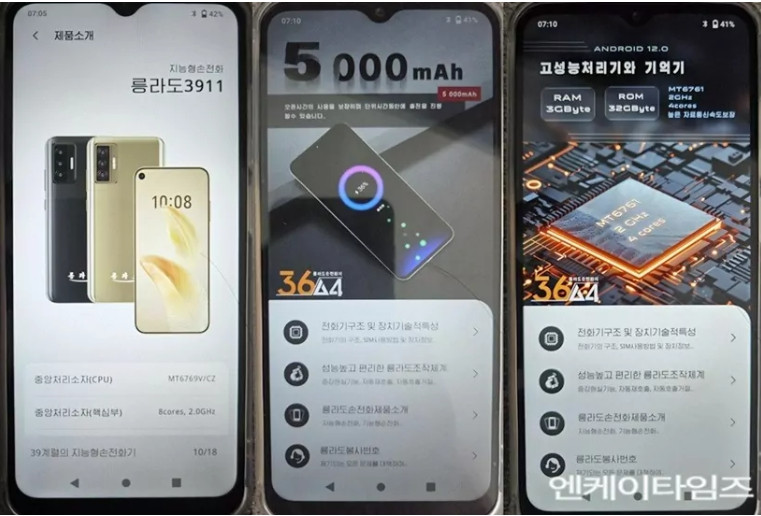
The Ryugyongdo 3911, a North Korean mobile phone manufactured in June 2026. Photo: NK Times
North Korea appears to have relaxed restrictions on some everyday South Korean expressions on mobile phones manufactured in June this year, according to an examination of a recently obtained handset.
Tests of the text-input function on the Ryugyongdo 3911, conducted by NK Times, revealed changes in how the phone handles expressions previously restricted on North Korean smartphones.
Terms such as “jagiya” (“honey” or “darling”), “saranghae” (“I love you”) and the loanword “stress” could be entered normally, without triggering a warning or being deleted. However, restrictions remained on terms including “unification,” “Republic of Korea” and “Korea.”
The results differ from the behavior observed on previously examined North Korean mobile phones. On a smartphone disclosed in 2025, entering “jagiya” triggered a warning or caused the word to be treated as prohibited, while “oppa” was automatically changed to another expression.
The abbreviation “namchin,” meaning “boyfriend,” was also automatically expanded to “namja chingu,” the full expression for the term. Rather than blocking the word, the system replaced the abbreviation with its spelled-out equivalent.
Restrictions on terminology related to inter-Korean relations and national identity, however, remain in place.
The word “Namhan” (“South Korea”) could be entered normally, but “Namjoseon,” formerly North Korea’s most common term for South Korea, could not be confirmed as usable. “Unification” and “Republic of Korea” also remained restricted, while the characters disappeared immediately when “Hanguk” (“Korea”) was entered.
The contrast between the newly permitted expressions and the continued restrictions on politically sensitive terms marks a notable change in the phone’s text-input rules.
The treatment of “Namjoseon” is particularly noteworthy in light of North Korea’s recent shift in its policy toward South Korea.
At a plenary meeting of the Workers’ Party of Korea Central Committee in December 2023, leader Kim Jong-un declared that inter-Korean relations should no longer be viewed as relations between members of the same nation, but as those between “two hostile states.” North Korea subsequently began dismantling organizations responsible for inter-Korean affairs and removing long-standing terminology and symbols associated with unification and national unity.
In a policy speech to the Supreme People’s Assembly in January 2024, Kim also called for North Korea’s policy toward South Korea to be codified in law in accordance with the concept of the two Koreas as separate states.
Since then, North Korean state media have increasingly used “Republic of Korea” instead of “Namjoseon.” Yet on the phone examined by NK Times, users were still unable to enter “Republic of Korea” or “Korea” freely in text messages.
The findings suggest a distinction between the terminology North Korean authorities use in official statements and the language they permit residents to use on their mobile phones. Even as the state adopts new terminology to describe South Korea, its text-input system continues to restrict ordinary users’ ability to enter certain national and political terms.
The phone also applies special formatting to the names of Kim Il-sung, Kim Jong-il and Kim Jong-un, displaying them in larger, bolder type than ordinary text. Of the three, Kim Jong-un’s name appears particularly prominent.
North Korea has long distinguished the names of its leaders from surrounding text in official publications, including Rodong Sinmun and Korean Central News Agency reports, by displaying them in larger or bolder type.
The same convention has appeared on official North Korean websites. Earlier versions of the Korean Central News Agency website used special formatting to make the names of Kim Il-sung and Kim Jong-il stand out from surrounding text. Kim Jong-un’s name received similar treatment after his succession to power became firmly established.
The formatting on the Ryugyongdo 3911 appears to extend this established convention from official publications and state media to the mobile-phone text-input system.
The findings suggest that North Korean mobile phones do more than automatically replace certain expressions or block politically sensitive words. They also reinforce the privileged status of the country’s leaders through the way their names appear on screen.
North Korean authorities may continue to revise prohibited-word lists and automatic replacement rules as their policy toward South Korea evolves and their social-control priorities change. Mobile phones provide another means of regulating not only what residents can communicate, but also the language they use to express themselves.

Han was born in 1989 in Taehongdan county, Ryanggang province, North Korea. She graduated from Hyesan Teacher's College in 2012, after which she worked as an elementary school teacher. She defected to South Korea in 2016 and works as a reporter at NK Times in Seoul.
Latest posts by Han Eun-su (see all)