

A DMZ mine tests Lee Jae-myung’s North Korea policy

An operation to clear a North Korean minefield in the southern part of the DMZ. Photo: the Republic of Korea Joint Chiefs of Staff.
On the morning of Sept. 21, 18 soldiers from South Korea’s 25th Infantry Division were clearing a new search route inside the Demilitarized Zone (DMZ) on the western front when a series of land mines exploded.
Three officers were injured, two seriously. One soldier suffered an injury that resulted in the amputation of his foot.
The soldiers were carrying out preparatory work for a joint inspection with the United Nations Command (UNC) in an area where North Korean troops had been installing mines and fences near the Military Demarcation Line (MDL). This is the strip which runs through the center of the DMZ, and separates the northern and southern halves of the no-man’s-land that itself functions to keep the two countries’ militaries apart.
In the immediate aftermath, the South Korean military could not determine whether the devices were old South Korean mines, North Korean mines that had drifted across the border or mines newly planted by North Korean troops.
Two weeks later, South Korea’s Joint Chiefs of Staff reached a much firmer conclusion.
On Oct. 5, the Joint Chiefs said that forensic analysis by the National Forensic Service, combined with an on-site investigation by the UNC, showed that the blast had been caused by resin-cased antipersonnel mines planted by North Korean troops south of the MDL.
The blast sites and an additional mine found nearby were located about 10 meters south of the MDL as recognized by the South Korean military and the UNC. TNT was detected on the uniforms of the injured soldiers, while brown fragments recovered from their bodies and clothing were found to be made of the same material used in North Korean resin-cased antipersonnel mines.
The additional mine was also buried underground. The UNC assessed that it had not drifted naturally into the area but had been deliberately emplaced at least 12 months earlier.
The Joint Chiefs described the location as a “typical North Korean minefield” and said the mines had been planted south of the MDL during what Pyongyang calls its “border fortification work.” The UNC also concluded that the emplacement violated the Armistice Agreement.
On Oct. 5, South Korean troops destroyed the mines in the area by controlled detonation. Defense Minister Kang Shin-chul called the operation “effectively unprecedented in the history of the DMZ” and, responding to criticism that the government’s response had been too passive, described it as a “resolute response.”
“All responsibility lies with North Korea,” he said.
The episode unfolded against the backdrop of a broader North Korean fortification campaign along the MDL that began in 2024. Pyongyang has been constructing minefields, fences and tactical roads, and the Joint Chiefs assesses that as many as 7,000 personnel a day have been mobilized for the work this year.
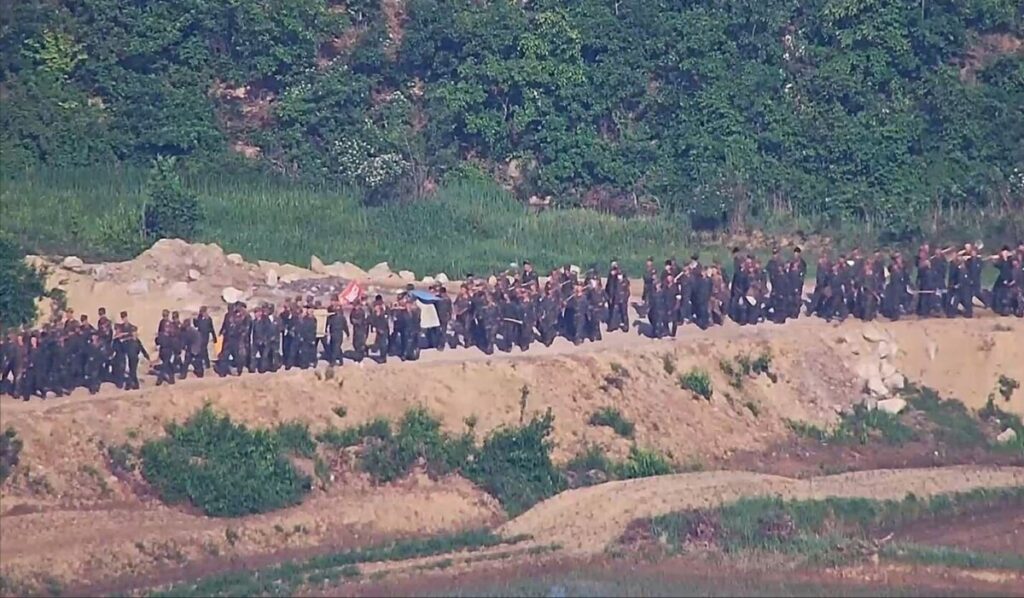
North Korean forces have recently been carrying out large-scale landmine-laying operations in the DMZ. / Undated photo: the Republic of Korea Joint Chiefs of Staff.
The South Korean military says North Korean crossings of the MDL have also increased, from nine in 2024 and 17 in 2025 to roughly 50 this year.
North Korea rejected the South Korean findings outright.
Kim Yo-jong, the sister of North Korean leader Kim Jong-un and a senior ruling Workers’ Party official, denounced the claims as “a farce staged by Seoul.”
On Oct. 2, she went further, mocking what she portrayed as a contradiction between the Joint Chiefs demanding an apology from North Korea and President Lee Jae-myung calling for lower inter-Korean tensions. She described the situation as “Part Two of the fabricated farce.”
Kim also said the purpose of North Korea’s border fortification effort was to “shut the door on the South forever,” a blunt rejection of Lee’s push to revive inter-Korean dialogue.
After the Joint Chiefs released its final findings, North Korea’s Foreign Ministry issued its own response, calling the South Korean investigation “a self-staged farce unilaterally fabricated and unilaterally concluded.”
At the same time, the ministry said it would not interfere with South Korean efforts to remove mines south of the MDL. But it warned that if South Korean troops or explosions crossed even “one millimeter” into territory claimed by North Korea, Pyongyang would respond immediately and forcefully.
In Seoul, the political argument was not only about what had happened in the DMZ. It was also about how the president chose to describe it.
Earlier, on Sept. 30, the UNC revealed that North Korean mines had been found south of the MDL and determined that their placement violated the armistice. That same day, Lee visited the Armed Forces Capital Hospital and met the injured soldiers. Yet in his Armed Forces Day address the next day, he did not directly mention North Korea.
“When I think of our soldiers who were injured in an unfortunate accident in the DMZ not long ago, my heart still aches.”
He then said his government would “consistently continue practical measures to reduce military tensions between South and North Korea,” while urging Pyongyang to restore dialogue.
At that point, while the Joint Chiefs’ final investigation, including the National Forensic Service analysis, had not yet been released, the UNC had stated North Korea had planted mines south of the MDL.
The opposition People Power Party (PPP) seized on that distinction. It characterized the episode not as an accident but as a North Korean provocation, accusing Lee of failing to explicitly hold Pyongyang responsible.
Jeong Jeom-sik, the PPP floor leader, said: “This was not an accident but a clear provocation by North Korea.” Party leader Jang Dong-hyeok also criticized the president for using the phrase “unfortunate accident” without directly assigning blame to North Korea.
The governing Democratic Party (DP) used stronger language than the president.
After the Joint Chiefs released its final findings, the party called North Korea’s mine emplacement a “clear violation of the Armistice Agreement” and “a provocation that threatens peace and stability on the Korean Peninsula,” while demanding an apology and the removal of the mines.
But the governing party rejected the opposition’s effort to cast the incident as evidence that Lee’s North Korea policy had failed. North Korea’s border fortification campaign began in 2024, before the current administration took office, and the mine that exploded was assessed to have been planted at least a year earlier.
The blast came as the Lee government was making the reduction of inter-Korean tensions a central policy objective.
The administration has suspended loudspeaker broadcasts toward North Korea and pursued measures intended to lower tensions in border areas, while presenting 2026 as a potential turning point toward what it calls “peaceful coexistence on the Korean Peninsula.”
So far, however, North Korea has moved in the opposite direction.
Pyongyang has rejected inter-Korean dialogue while continuing to fortify the MDL, test missiles and strengthen its nuclear forces. It has also deepened military cooperation with Russia.
One episode that has come to symbolize that shift involves two North Korean soldiers captured in Ukraine. The two men, taken prisoner while supporting Russian forces, expressed a desire to go to South Korea and were transferred there last month. The disclosure of the transfer also created diplomatic friction between Seoul and Kyiv.
Lee demanded a public apology from Ukraine, saying Kyiv had violated a confidential agreement.
In South Korea, critics drew attention to the contrast between the president’s forceful language toward Ukraine and his more restrained wording in the landmine case.
The two issues are different in nature, but they underscore a broader challenge for the Lee government: while Seoul is seeking to reopen channels with Pyongyang, North Korea is reducing ties with the South and expanding strategic cooperation with Russia.
Chun Chaesung, a professor at Seoul National University, and Lee Sang-jun, a researcher at the East Asia Institute, described the captured North Korean soldiers as direct evidence that North Korea-Russia military cooperation is operating on an actual battlefield. They argued that, separate from any diplomatic dispute with Kyiv, South Korea should continue intelligence cooperation on the combat experience of North Korean troops and on broader military ties between Pyongyang and Moscow.
The Lee government has not changed the basic direction of its North Korea policy since the mine incident.
Unification Minister Chung Dong-young said the episode showed why “fundamental peace” on the Korean Peninsula was all the more necessary.
Foreign Minister Cho Hyun, meanwhile, said that holding North Korea accountable and preventing escalation were “two sides of the same coin.” The government is also considering diplomatic measures through the United Nations and independent sanctions against North Korea.
The central question for the Lee administration is therefore not simply whether to pursue peace. It is how to sustain a peace-oriented policy when North Korea is not responding in kind.
North Korea’s border fortification campaign and its deployment of troops in support of Russia were not consequences of policies introduced by the Lee government. Both began earlier. Treating the latest incidents as simple proof that Lee’s North Korea policy has failed would therefore overstate the causal link.
But that does not remove the policy dilemma.
Governments are ultimately judged not only by the environment they inherit, but by how they adapt when that environment changes.
In this case, South Korea’s military and government agencies have spoken in relatively clear terms. The Joint Chiefs concluded that the mines were North Korean. The UNC found a violation of the Armistice Agreement. The defense minister said that “all responsibility lies with North Korea.” The governing party called the act a “provocation.”
The president chose a different register.
He described the episode as an “unfortunate accident” while reaffirming his intention to continue policies aimed at reducing military tensions between the two Koreas.
That contrast has become the central political question raised by the blast: Can the Lee Jae Myung government hold North Korea clearly accountable while also reducing tensions on the Korean Peninsula?

Taesung offers informed perspectives on North Korean society, grounded in years of experience within a key state-run institution. After defecting to South Korea in 2024, he now focuses on providing analysis of the country.
Latest posts by Kim Taesung (see all)
- A DMZ mine tests Lee Jae-myung’s North Korea policy - October 8, 2026
- From test to drill: North Korea signals hypersonic missile readiness - October 7, 2026
- Two North Korean prisoners, one diplomatic dispute: What was agreed between Seoul and Kyiv? - September 28, 2026