

Resolute, denuclearization, blah blah…. North Korea has heard this before
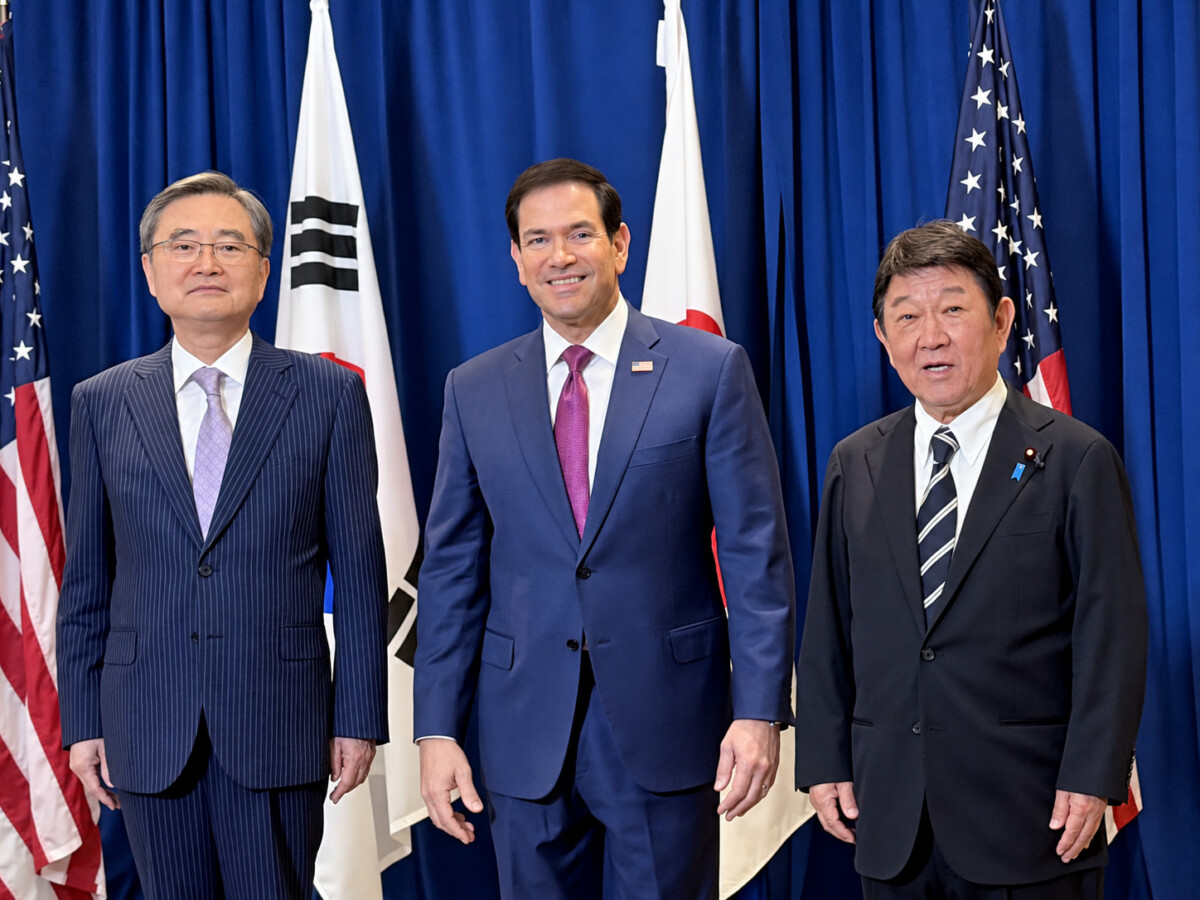
South Korean Foreign Minister Cho Hyun, U.S. Secretary of State Marco Rubio and Japanese Foreign Minister Toshimitsu Motegi meet in New York on Sept. 21, 2026. The three reaffirmed their commitment to the complete denuclearization of North Korea and called on Pyongyang to return to dialogue. / Courtesy of Yonhap News
Note: The views and opinions expressed in this article are those of the author and do not necessarily reflect the official position of either NK Insider or Human Rights Foundation.
There is something strangely familiar about the latest diplomatic news from the Korean Peninsula.
The foreign ministers of South Korea, the United States and Japan met in New York this week and issued a joint statement reaffirming their “resolute” commitment to the “complete” denuclearization of North Korea.
They also reaffirmed that “the path to dialogue remains open” and called on North Korea to resume dialogue.
The three countries, meanwhile, reaffirmed their commitment to defending South Korea and Japan, backed by America’s “unmatched military strength, including its nuclear capabilities.”
There is nothing particularly surprising here.
In fact, there is a simple way to understand the news value of the statement: search the archives.
You will find headlines remarkably similar to these almost every year for the past 30 years.
South Korea, the United States and Japan reaffirm their commitment to denuclearization.
They call on North Korea to return to dialogue.
North Korea refuses, or agrees and talks begin, only for them eventually to collapse.
Then, some months or years later, the same governments meet again, reaffirm their commitment to denuclearization and call on North Korea to return to dialogue.
And so we begin again.
Of course, diplomacy is not supposed to produce exciting headlines. Diplomats are not journalists. If repeating the same message helps prevent war, there is nothing inherently wrong with repetition.
But after a while, repeating the same thing and expecting a different outcome starts to look like evidence of a mental condition.
The problem is not that our diplomats lack creativity. It is that we are not walking in North Korea’s moccasins — trying to understand what it sees, what it fears and why it responds, or fails to respond, the way it does.
There is a certain disingenuousness in continually presenting the same formula as though it represents a plausible route to a breakthrough when nothing fundamental has changed — and when the crucial decision remains almost entirely in North Korea’s hands.
We call on North Korea to come back to dialogue.
But why should it?
We call for complete denuclearization.
But why should the regime that regards nuclear weapons as essential to its survival surrender them?
We say that the path to dialogue remains open.
But what exactly are we offering North Korea in return for walking through it?
To understand the problem, we need to ask three questions that rarely seem to be asked together: Why has the Korean Peninsula remained divided for nearly 80 years? What are our goals? And what can we actually do to advance them?
The first question has a familiar answer: the division is a zero-sum struggle between two hostile political systems, backed by competing great powers.
But that does not go far enough.
This is not simply a dispute between two sides that are reluctant to compromise. It is a conflict between value systems that are incompatible at the deepest level.
The Republic of Korea is a liberal democracy whose legitimacy rests on elections, constitutional government, individual rights and popular sovereignty. North Korea is a hereditary authoritarian system whose legitimacy rests on the supremacy of the Kim dynasty and the political system built around it.
The disagreement, therefore, is not simply over territory or security arrangements.
It is over what kind of political order should exist on the Korean Peninsula.
These two systems cannot merge to produce some happy hybrid version of Korea. One would have to give way to the other.
That means either one side gives up — which is what each side has always wanted — or both sides give up their claim to absorb the other.
That brings us to the second question: What do we actually want?
Here the language becomes rather slippery.
We talk about peace, stability, coexistence and dialogue. All of these are perfectly reasonable objectives. But underpinning them is another objective that ultimately takes precedence.
South Korea’s Constitution is quite explicit about it.
Article 3 defines the territory of the Republic of Korea as the Korean Peninsula and its adjacent islands. Article 4 states that the Republic “shall seek unification” and pursue a policy of peaceful unification based on the basic free and democratic order.
In other words, South Korea does not constitutionally regard permanent division into two sovereign Korean states as the final settlement.
The stated objective is unification.
We should not be fooled by the fact that today’s South Korean government speaks the language of peace and coexistence. President Lee Jae-myung may genuinely want to reduce tensions and establish a more stable relationship with Pyongyang. There is no reason to doubt the sincerity of such intentions.
But peaceful means do not necessarily imply different ends.
The South Korean constitutional vision remains one in which the peninsula eventually becomes one state based on a free and democratic order.
From Pyongyang’s point of view, that is not a minor detail.
Imagine being told by your adversary that it wants peaceful coexistence with you — while its constitution says that the entire territory you control belongs to it and that its ultimate objective is to achieve unification on its own political terms.
You might appreciate the offer of dialogue. But you would also wonder what the dialogue is ultimately for.
And that is the contradiction at the heart of our diplomacy.
Peace requires accepting the continued existence of the other side. Unification, by definition, does not. We can say that we want both, but at some point we have to decide which is the immediate objective and which is the hope for the distant future.
This is where our diplomatic language becomes misleading.
We speak as though North Korea is merely being unreasonable by refusing to sit down.
But from Pyongyang’s perspective, the stakes are existential.
The North Korean regime has spent decades telling its population that the South and the United States represent an existential threat. Its nuclear arsenal is not simply a weapons program. It is bound up with the regime’s conception of its own survival.
We may regard that conception as deeply undesirable.
But if our objective is to understand why negotiations repeatedly fail, we have to understand it.
Which brings us to the third question: What can we do?
Perhaps the uncomfortable answer is that we should change our objectives.
For decades, we have asked how we can persuade North Korea to accept the objectives we have already decided upon: denuclearization, eventual unification and the transformation of the peninsula into a fundamentally different political order.
What if we instead asked whether those objectives are themselves preventing the settlement we say we want?
This does not mean approving of North Korea’s system.
It does not mean accepting its human-rights record.
It does not mean pretending that its nuclear weapons do not exist.
And it does not mean abandoning the people of North Korea.
It does, however, mean considering whether our insistence on viewing North Koreans as citizens of a future unified Korea has actually done them much good.
Suppose, for example, South Korea were to put unification aside.
Suppose North Korea’s nuclear status were temporarily set aside rather than made the indispensable condition of a political settlement.
Suppose the two Koreas, with the United States and other parties, negotiated an actual peace treaty to replace the armistice that has technically kept them in a state of war since 1953.
And suppose that, as part of such a settlement, the United States eventually withdrew its forces from South Korea, perhaps relocating them to Okinawa or elsewhere in the region.
That would be an extraordinary change. It would not be risk-free.
But consider the irony.
Perhaps removing the external threat that the North Korean regime uses to justify its extraordinary political controls would ultimately do more to undermine that regime than another 80 years of containment and decades of sanctions and demands for denuclearization.
The North Korean government has long depended on the image of an enemy.
It has used the threat from outside to justify extraordinary political controls at home, telling its people that their poverty, restrictions and isolation are necessary because the country is under permanent threat.
If the threat disappeared, the regime would have to confront a much more dangerous comparison: North Korea and the world outside it.
And above all, North Korea would have to confront South Korea.
The South does not need to invade the North to demonstrate the superiority of its political and economic system. It already demonstrates it every day simply by existing.
This leads to a counterintuitive possibility.
Perhaps the road to the outcome many South Koreans ultimately want — the liberation of North Koreans from an oppressive political system — does not run through trying to force North Korea to change.
Perhaps it runs through making change unnecessary to the immediate pursuit of peace.
A peace treaty.
Normal relations.
Economic and human contact.
A reduction in military confrontation.
An end to the permanent state of emergency.
And patience.
The irony is that these things might eventually produce precisely the outcome that decades of overt pressure have failed to produce: a North Korean regime confronted not by an external enemy but by the ordinary aspirations of its own people.
That is not a strategy for regime change. It is almost the opposite.
It is the decision to stop making regime change the condition for peace.
After 80 years, perhaps we should acknowledge something that the latest diplomatic statement makes painfully obvious.
The problem is not that we have failed to find the right words.
We have been saying essentially the same words for decades.
The problem may be that we have never seriously asked whether the objective behind those words makes sense.
Another call for North Korea to return to dialogue will not change that.
But changing the question might.

Hae-song is a Seoul-based analyst and writer on North and South Korean affairs. Having grown up overseas, he has lived his working life in South Korea where he consults on South Korean political and economic issues and on North Korea and defector related issues.
Latest posts by Jun Hae-song (see all)
- Resolute, denuclearization, blah blah…. North Korea has heard this before - September 23, 2026
- Is Trump about to try to solve the Korea question? - August 28, 2026
- Is the day coming when the world admits North Korea has won? - July 27, 2026