

For North Korean footballers, Japan is more than just an opponent
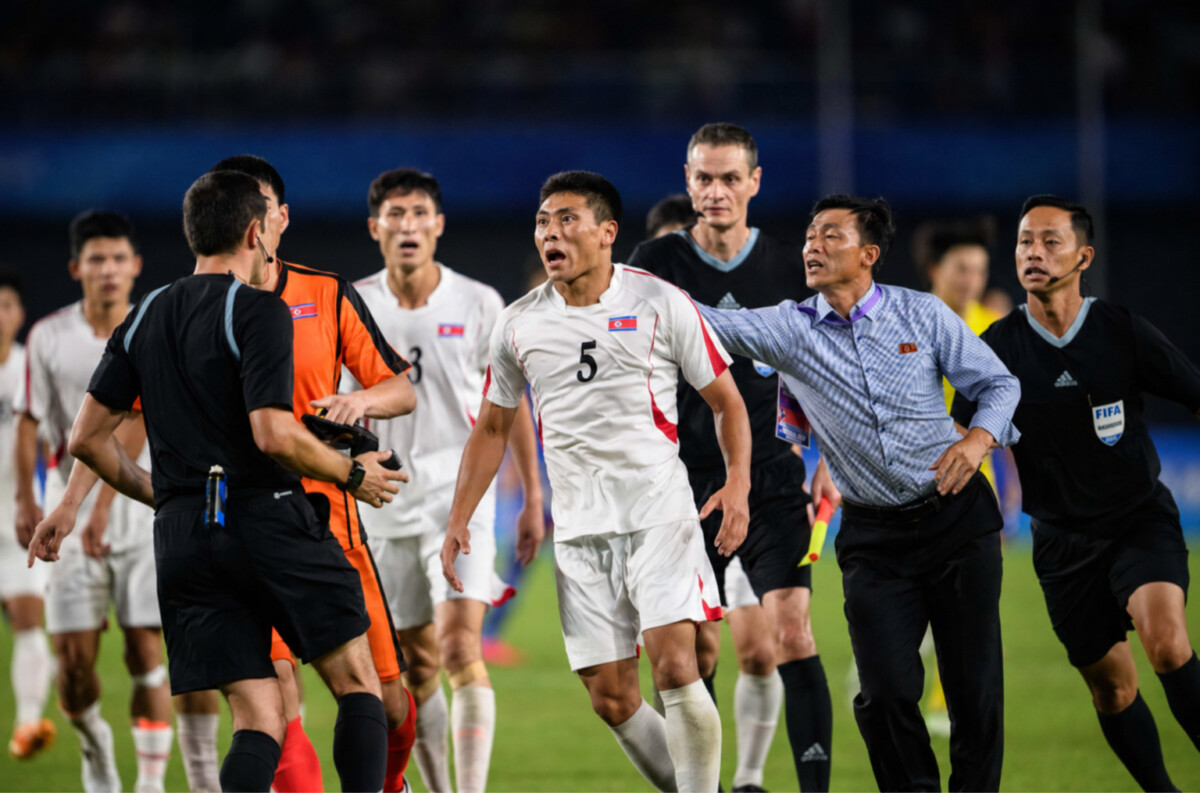
North Korea’s furious footballers aggressively confront referee Rustam Lutfullin after their Asian Games exit. Photo courtesy of Philip Fong/AFP
Watching North Korea’s recent men’s football match against Japan brought back memories of the education I received at school many years ago.
North Korea lost 1–0 to Japan in the quarterfinals of the 2026 Aichi-Nagoya Asian Games on September 26. More striking than the result was the reaction of the North Korean players.
Believing a foul had occurred in the buildup to Japan’s goal, they surrounded the referee in protest, and captain Kang Ju-hyok briefly led his teammates off the pitch. Physical confrontations and protests continued in the second half. After the final whistle, the North Korean players left the field without many handshakes with their Japanese counterparts.
There is no confirmation that any North Korean player assaulted a Japanese player during this match. But the scenes were not entirely unprecedented.
During North Korea’s match against Japan at the 2023 Hangzhou Asian Games, North Korean player Kim Yu-song received a yellow card after taking a water bottle from a Japanese staff member and raising his fist in what appeared to be a threatening gesture. Several North Korean players also protested heatedly to the referee after the final whistle.
Watching the two matches left me wondering: Does playing Japan mean something different to North Korean footballers than playing any other country?
I was born in North Korea and went through its school system. The Japan we learned about was not simply a neighboring country. The history of Japanese colonial rule was, of course, part of our education, but the lessons went further. Japan was portrayed as an enemy — a country people were expected to distrust and resent for generations.
Words such as “enemy,” “military imperialism” and “revenge” were familiar to us from childhood.
This was not material we memorized for an exam and then forgot. When the same messages are repeated from an early age, they become part of the way you see the world. One day, a young man raised on those lessons puts on his national team shirt and faces a Japanese player across the pitch.
Can such a match really be just 90 minutes of football?
I suspect not.
Of course, I cannot know what the players in this particular match were thinking. Nor is there evidence that North Korean authorities instructed them to play especially aggressively against Japan. Their protests may simply have reflected frustration with the referee’s decisions.
But representing North Korea carries a significance that extends beyond an individual player’s performance. Players are expected to compete for the honor of the country, not just for themselves. Victories are celebrated as achievements of the political system, while defeats can carry implications beyond the sporting arena.
Against Japan, the burden may be even heavier.
That does not mean we should watch such scenes and conclude that this is simply how North Koreans behave. Rather than attributing the players’ actions to their personalities or national character, we should consider the education they received and the expectations they carried onto the pitch.
Thinking about this brought to mind an encounter I had last May with North Korean women footballers at Incheon International Airport. When Naegohyang Women’s Football Club came to South Korea to compete in the AFC Women’s Champions League, I went to the airport to welcome the team.
I had left North Korea only a few years earlier. Seeing young women from the country I had come from arrive on South Korean soil made me genuinely happy. I was not alone in wanting to welcome them.
Yet when the players emerged from the arrivals area, I was taken aback. People waved and called out warmly, but the players mostly stared straight ahead and hurried past. They barely responded to reporters’ questions and made little eye contact with those waiting to greet them.
At first, I felt disappointed. But I could also understand their reaction.
From my own experience of life in North Korea, I knew how deeply people could be taught to regard South Korea as hostile. For athletes arriving as representatives of the state, even the smallest gesture might seem consequential: whom they looked at, whom they smiled at and what they said.
The contrast with the match against Japan was striking. At the airport in South Korea, the players appeared determined to reveal as little emotion as possible. On the pitch against Japan, they displayed their anger and protested forcefully.
To me, the contrast suggested something about the environment in which North Korean athletes compete: personal feelings may have to be suppressed in some circumstances, while the fighting spirit expected in the name of the state must be displayed in others.
Of course, we cannot know what each player was feeling. But the burden they carry onto the field may be greater than the pursuit of victory alone. Their political education, their responsibility to represent the country and the expectation that they defend national honor may all accompany them into the stadium.
None of this excuses aggressive behavior.
Japan’s colonial rule of Korea must not be forgotten. But the imperialism of the past must be distinguished from the Japanese players competing on the pitch today. Remembering history does not require treating the person in front of us as an enemy.
It was only after leaving North Korea that I gradually came to understand this distinction myself.
Sport should be fiercely competitive. For 90 minutes, players should give everything they have. But when the match is over, they should also be able to extend a hand to their opponents.
A handshake does not mean forgetting history. Nor does it mean loving one’s country any less.
I hope that one day North Korean players will be able to step onto the pitch first and foremost as athletes, whether their opponents are Japanese, South Korean or anyone else. They should be free to celebrate when they win, feel disappointed when they lose, challenge decisions within the rules and shake hands when the final whistle blows.
Perhaps the most important change North Korean sport needs will not begin with another medal, but with something as ordinary as that.

Kim Yumi, a North Korean defector, was born and raised in Haeju, South Hwanghae Province, a coastal military area. Growing up near a naval base, she was able to secretly watch South Korean news programs and TV shows, thereby uncovering the vibrant, democratic society of South Korea. Yumi and her husband made the brave decision to escape North Korea and seek a better future. Now in Seoul, she is actively involved in raising awareness about the realities of life in North Korea, especially on her YouTube channel, “@KimYumiTV.”
Latest posts by Kim Yumi (see all)
- For North Korean footballers, Japan is more than just an opponent - October 7, 2026
- Under the same full moon, two versions of the same holiday - September 25, 2026
- The freedom to ask: Where should we go today? - September 18, 2026