

A 52-year-old gunshot reopens South Korea’s historical divide
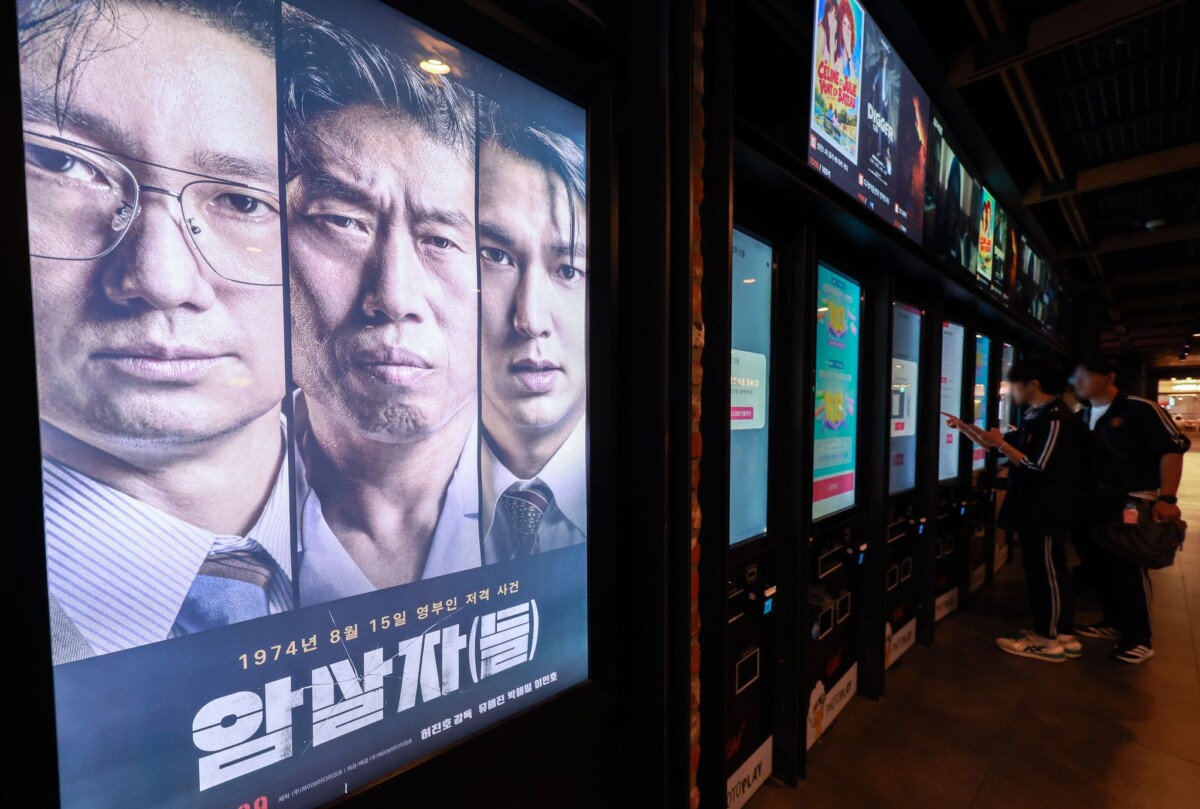
Moviegoers purchase tickets at a theater in Seoul on Oct. 2, as the film “Assassin(s)” reclaimed the top spot at the box office despite political controversy over alleged historical distortion. Photo courtesy News 1.
When the new film opened in South Korean theaters, it sparked a controversy that extends far beyond the cinema. The box-office success has also triggered an intense debate over its portrayal of history.
Conservative politicians accuse the film of distorting the truth. Some have called for a boycott, demanded that screenings be halted and even suggested summoning director Hur Jin-ho to testify before a National Assembly audit. Critics, meanwhile, argue that politicians are interfering excessively with the creative freedom of a film based on historical events.
Why the dispute? The film concerns the 1974 assassination of South Korea’s first lady, and the clue lies in its unusual title, The Assassin(s) (Amsalja(deul) in Korean). The optional plural in parenthesis raises a question that history has not answered: Was there a single assassin, or were there others?
On Aug. 15, 1974, then-President Park Chung-hee was delivering a Liberation Day speech at the National Theater in Seoul when gunshots rang out from the audience. Park survived, but his wife, Yuk Young-soo, was struck by a bullet and killed.
The gunman was Mun Se-gwang, a Korean resident of Japan who had traveled to South Korea.
Investigators announced at the time that Mun had been recruited by individuals associated with Chongryon, the pro-North Korean organization of Korean residents in Japan, and had attempted to assassinate Park on North Korea’s instructions and with its support. Mun was tried and executed later that year.
The gunman had been identified, his motive officially announced and the case brought to trial. What, then, could remain to be said about the incident more than half a century later?
That is precisely where The Assassin(s) begins.
The film asks whether the accepted account tells the whole story. A detective played by Yoo Hae-jin and journalists played by Park Hae-il and Lee Min-ho retrace the shooting and the subsequent investigation, gradually uncovering details that appear difficult to reconcile with the official version.
As the story unfolds, suspicion shifts from Mun Se-gwang toward South Korea’s own institutions of power, particularly the Korean Central Intelligence Agency (KCIA) and those higher up the chain of command.
The film does not explicitly conclude that Park himself ordered the incident. The filmmakers have likewise said that they do not identify any particular individual as the mastermind, describing the work as fiction that adds cinematic imagination to the historical record. Nevertheless, viewers are invited to consider whether elements within the South Korean state may have been involved.
At this point, the film moves beyond the territory of a mystery thriller and into politically contentious territory.
The conventional account has centered on a chain linking Mun Se-gwang, Chongryon and North Korea. The film raises the possibility of another: Mun Se-gwang, the KCIA and the inner circles of power in South Korea.
The question shifts from whether an outside force tried to kill the president to whether someone within the power structure was involved in a conspiracy.
In South Korea, that is no minor shift. Behind it lies the explosive fault line of national division.
In 1974, just 21 years had passed since the Korean War ended. North and South Korea were locked in intense confrontation, and North Korean infiltrations and covert operations against the South were genuine national-security concerns. In 1968, North Korean commandos had reached Seoul and come close to the Blue House in an attempt to assassinate Park.
Whether Mun was connected to North Korea and Chongryon was therefore central to how the assassination attempt was understood.
Yet the historical record is more complicated than it may first appear. The South Korean government concluded that Mun had received instructions from North Korea through Chongryon. Japanese authorities, however, placed greater emphasis on Mun’s individual actions rather than on an organized directive from North Korea or Chongryon. Differing interpretations of the case existed from the beginning.
The Assassin(s) enters this gap.
That is not to say that unanswered questions in the historical record prove that the KCIA or senior officials in the Park government were involved.
It is here that strong conservative opposition to the film becomes understandable.
Simply attributing that opposition to conservatives’ admiration for Park Chung-hee misses a deeper issue: fundamentally different ways of remembering modern Korean history.
One of the central themes in the conservative memory of the Park era is national security. The Korean War, North Korean covert operations, armed infiltrations, the 1968 raid and the military confrontation between North and South all form part of that historical narrative.
Within this view, South Korea defended itself against a genuine threat from North Korea while achieving industrialization and economic growth. When North Korea and Chongryon recede into the background of the Mun Se-gwang case and the possibility of KCIA involvement comes to the fore, some conservatives see more at stake than Park’s personal reputation.
The familiar image of South Korea under attack from North Korea gives way to the possibility of a South Korean state that deceived its own people and manipulated a major national tragedy.
Progressives, by contrast, tend to recall a different set of images from the 1970s: the Yushin system, the KCIA, emergency decrees, press censorship, human-rights abuses and the struggle for democratization.
From this perspective, acknowledging the threat posed by North Korea does not preclude scrutinizing the official pronouncements of an authoritarian government.
The film’s central question — whether the government told the public the whole story — therefore carries less shock value for progressives. Instead, it resonates with a broader willingness to reexamine official accounts produced by those in power.
Consequently, two people can watch the same film and see very different things. One may see a work that diminishes North Korea’s responsibility and casts South Korea as the perpetrator. Another may see a film questioning what an authoritarian state might have concealed.
That is the heart of the controversy.
South Korea’s left and right are not simply arguing over the artistic merits of a film. They are clashing over a more fundamental question: What kind of country was South Korea in the 1970s?
In one historical narrative, the threat from North Korea takes center stage. In the other, the repression of the authoritarian state does.
Yet both are part of modern Korean history.
The reality of North Korean covert operations does not justify the Yushin dictatorship or state violence. Conversely, condemning the authoritarian nature of the Park government does not erase the military threat or covert operations carried out by North Korea.
The question, then, is which parts of this complicated history the film emphasizes — and which it leaves in the shadows.
This brings us to another point of contention: historical distortion versus creative freedom.
A feature film is not a history textbook. Directors are free to explore gaps in the historical record, construct hypothetical scenarios and invent characters and narratives.
But historical films carry a responsibility that ordinary works of fiction do not.
When a film features a real president and first lady, a real assassin, the actual KCIA and a genuine historical event, fictional connections among them can eventually become accepted by audiences as historical fact.
Most viewers will never read the investigative records from 1974 or diplomatic documents exchanged between South Korea and Japan. They will watch a two-hour film. The more persuasive the storytelling, the easier it becomes to blur the line between what happened on screen and what has been established historically.
It is therefore inadequate to reduce the debate to either of two extremes: that anything can be imagined because it is a movie, or that any departure from the government’s account constitutes historical distortion.
The more important question is how clearly the film distinguishes between established facts, unresolved questions and the filmmaker’s own hypotheses.
This matters all the more because South Korea remains a divided country.
North Korea is not a vanished state confined to history books. It continues to exist across the armistice line. Any portrayal of its role in modern Korean history therefore carries implications for contemporary politics.
Park Chung-hee, too, is more than a president from the distant past. To some, he was the leader who transformed an impoverished South Korea into an industrial nation. To others, he was the dictator who suppressed democracy.
Ultimately, The Assassin(s) touches on two of the most politically explosive subjects in South Korean society: Park Chung-hee and North Korea.
Between them lie the KCIA and the Yushin system, Chongryon and anti-communism, the democratization movement and state violence — competing memories of modern Korean history.
That is why the gunshots that rang out at the National Theater 52 years ago still reverberate politically in 2026.
The controversy surrounding The Assassin(s) is less a conflict created by a single film than a revelation of divisions that have long existed within South Korean society. It pits a version of history remembered through the threat posed by North Korea against one remembered through the repression of state power. It also exposes the divide between those who remember Park as the architect of industrialization and those who remember him as a dictator.
South Korean society has yet to reconcile these competing memories within a shared understanding of its modern history.
That is why the question left by The Assassin(s) goes beyond who killed Yuk Young-soo.
It raises a larger question: Are South Koreans, in fact, remembering the same history of their own country?
That may be the real reason the film has become so contentious.

Taesung offers informed perspectives on North Korean society, grounded in years of experience within a key state-run institution. After defecting to South Korea in 2024, he now focuses on providing analysis of the country.
Latest posts by Kim Taesung (see all)
- A 52-year-old gunshot reopens South Korea’s historical divide - October 11, 2026
- A DMZ mine tests Lee Jae-myung’s North Korea policy - October 8, 2026
- From test to drill: North Korea signals hypersonic missile readiness - October 7, 2026