

Kim Il-sung’s long record of murder, kidnapping, and plunder in the decade before he came to power
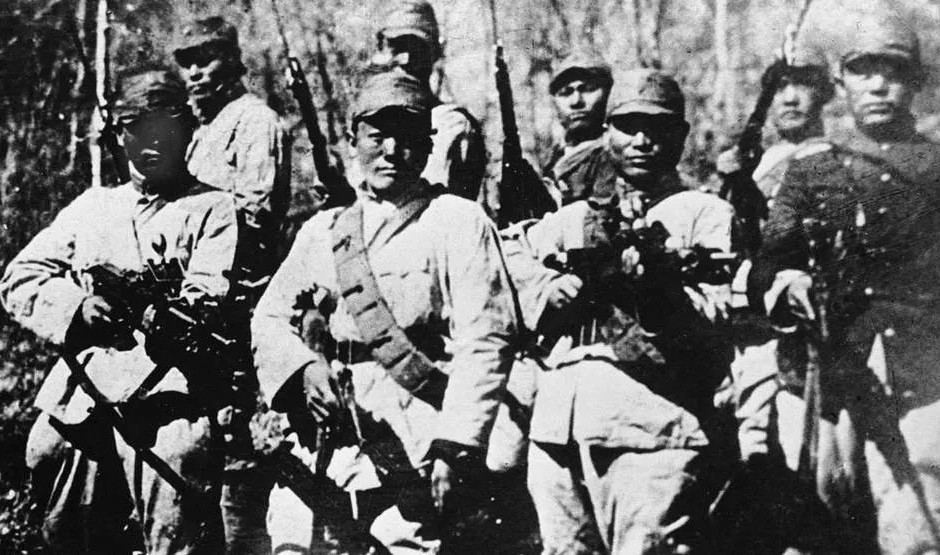
Soldiers of the Northeast Counter-Japanese United Army (Source: wikipedia)
Sign up here.
When it comes to his crimes against the Korean people, the record of the North’s founding dictator, Kim Il-sung, is long and varied.
Those familiar with his tyrannical rule are aware of the bloody political purges which he undertook from the late 1940s through the late 1960s. His first focus was on the repression and deprivation of supposedly “guaranteed” rights of Christians, Buddhists, non-communist nationalists, native religious and social groups, farmers, and large and small private businesspeople.
He then moved against rival communists. He acted to eliminate communists who had been active in the North during the Japanese occupation, and South Korean communists who had fled there after independence. He then targeted communists with close ties to the Soviet Union and Mao’s forces in China.
Finally, he even liquidated some members of his own guerrilla faction. The victims included longtime loyalists, as well as officials he saw as a threat to himself or to the rise of his son Kim Jong-il, or simply whose job performance did not please him in some way.
With the opening of archives after the fall of the Soviet Union, we now know that, in the late 1940s, Kim and his cadres in the North, as well as the Soviets, ordered and funded a series of assassinations, guerilla raids, and armed uprisings in the South.
In 1950, of course, he launched the fratricidal war. From the end of that conflict until his death, he continued his war against his fellow Koreans, by establishing the notorious GULAG system of political prisons and concentration camps, by kidnapping people from the South and overseas, and by mismanaging the North’s command economy to such an extent that it faced a horrible famine which could have been avoided even after support from the Soviet bloc had ended.
From the 1960s through the 1980s, Kim ordered infiltrations of guerrillas, who murdered South Koreans who had the misfortune to come into contact with them.
The late 1970s to the late 1980s, in particular, saw several deadly terrorist bombings targeting the South. Defectors from the North, within the South and elsewhere, were assassinated, as were some South Korean diplomats abroad.
A little-known aspect of the murderous nature of Kim and his communist colleagues, however, dates from over a decade before his coming to power in the aftermath of World War Two. Kim in fact began his long career of murder, abduction, and plunder in the mid-1930s, when he and his comrades were guerrillas serving under the Chinese Communist Party and fighting the Japanese forces in occupied Manchuria.
This history has of course been thoroughly concealed by state propagandists. Rather than portray him as one of several junior Korean officers leading bands of Chinese and Korean guerrillas in relatively small hit-and-run raids against the Japanese, they transformed Kim into the “Peerless, Ever-Victorious General” who led a fictional “Korean People’s Revolutionary Army.”
He was even alleged to possess superhuman powers. It was also preposterously claimed that he and his band single-handedly defeated Japan and liberated the northern part of the peninsula. The dirty truth, however, is a matter of historical record.
In Manchuria in the late 1930s, Kim was neither a “Robin Hood” robbing from the rich and giving to the poor, nor an independence fighter totally focused on the battle with Japanese troops. He sometimes had fewer than 50 men under his command, and at other times nearly 300. Their raids on remote police outposts were daring, but hardly major battles.
A significant aspect of his “struggle” consisted of directly targeting Korean civilians in the region. While claiming to be fighting on their behalf, he in fact spent much of the time preying upon them. When they raided small villages in Manchuria and on a few occasions within Korea, Kim and his men would threaten the inhabitants and plunder their few possessions and foods.
They would also abduct youngsters and force them to serve in their units, while attempting to indoctrinate them. Many of these victims deserted as soon as they had the chance.
The relatively wealthy, the ordinary farmers, and the poor – all were forced at the point of a gun to give up their livestock, grain, and other possessions. Those who did not have anything of value were forced to issue promissory notes which the guerrillas would seek to collect upon their next raid.
One tactic was to take hostages and threaten to execute them unless and until their families paid ransom. Kim’s guerrillas warned that they would first cut off their ears, and then cut off their heads.
“There will be numerous ways to take care of the people in your village,” they warned.
One message put it quite bluntly that “if you love your money and goods you lose your men.” Another threat, mentioned by Kim in his biography, was to “give guns if you have guns, people if you have people, money if you have money, and good if you have goods.”
Given these brutal methods, it is not surprising that Koreans who were victimized in such a manner considered Kim and his guerrillas to be ordinary bandits rather than genuine independence fighters worthy of support.
As Professor Dae-sook Suh, the historian and biographer of Kim Il-sung, who is not biased against him, noted, “The resentment is understandable; there was constant pilferage, harassment, and threats by Communist bandits.”
One of the guerrillas, Choe Hyon, was older than Kim and held a higher rank Chinese Communist Party. In a threat issued “to all the householders” of one targeted Korean village, Choe declared that “we have been demanding and collecting supplies from the masses,” and ordered that “you, the householders, must gather three and a half sok [approximately eighteen bushels] of corn, beans and other grains, and not even one grain less than ten catty of salt within two days….If the supplies do not reach us within two days, you will be punished mercilessly.”
Even though he was almost illiterate, Choe became a top-ranking military official of Kim’s regime, and unlike so many others, was never purged. Some historians claim that it was he who actually led the raids against Japanese troops which later were well-publicized in the propaganda and attributed solely to Kim.
Some photos taken during their years as guerrillas were later altered by the regime to depict Kim at the center of a group including Choe, whereas in the original photo it was Choe who was at the center. Choe’s son, Choe Ryong-hae, held several high political and military posts under Kim Jong-il and Kim Jong-un, but was demoted by Kim Jong-un early this year.
It is not known how many Korean villagers were murdered by Kim for failing to supply his fighters. Kim and his guerrillas also offered protection to opium producers, while seizing their crops for resale. The abductions and dealings in narcotics presaged the North Korean regime’s later years of kidnappings of Koreans, Japanese, Europeans, and others, as well as the North’s illegal drug trade around the world by its diplomats overseas.
This criminality is reminiscent of the robberies committed by Stalin and the Bolsheviks in Georgia during the first years of the last century, the plunder and kidnapping of villagers by Mao and his communist rebels in and around their “base areas” during the early 1930s, and the executions and requisitions carried out by Che Guevara during his guerrilla days in Cuba in the 1950s and Bolivia in the mid-1960s.
All of these communist leaders made a habit of brutalizing and murdering the countrymen who they claimed to be “liberating.”
Lawrence Peck is a correspondent for NK Insider based in Seoul and Los Angeles. Having intensively researched and closely monitored the activities of pro-North Korea and other extremist groups and activists in the U.S. for over 25 years, he has been recognized in the U.S. and Korea as one of the leading American authorities on such topics, and has lectured, written extensively and been interviewed on such topics in the U.S. and Korea. He has a Bachelor of Arts degree in Political Science from the University of California, Los Angeles (UCLA) and a Juris Doctor degree from Loyola Law School of Los Angeles. He previously worked in Korea for several of the largest Korean business groups in the fields of intellectual property licensing and international business development. He also serves as an advisor to the North Korea Freedom Coalition of the U.S. Lawrence may be reached at the email address: [email protected]
Latest posts by Lawrence Peck (see all)
- Interview: The ordinary defector who fights for human rights in the U.S. - June 25, 2026
- Kim Il-sung’s long record of murder, kidnapping, and plunder in the decade before he came to power - May 25, 2026
- Illegal transfer of funds to North Korea and forcible repatriation of defectors: Will justice ever be served at the highest levels? - May 11, 2026