

Electricity, not slogans: What North Korean women really need
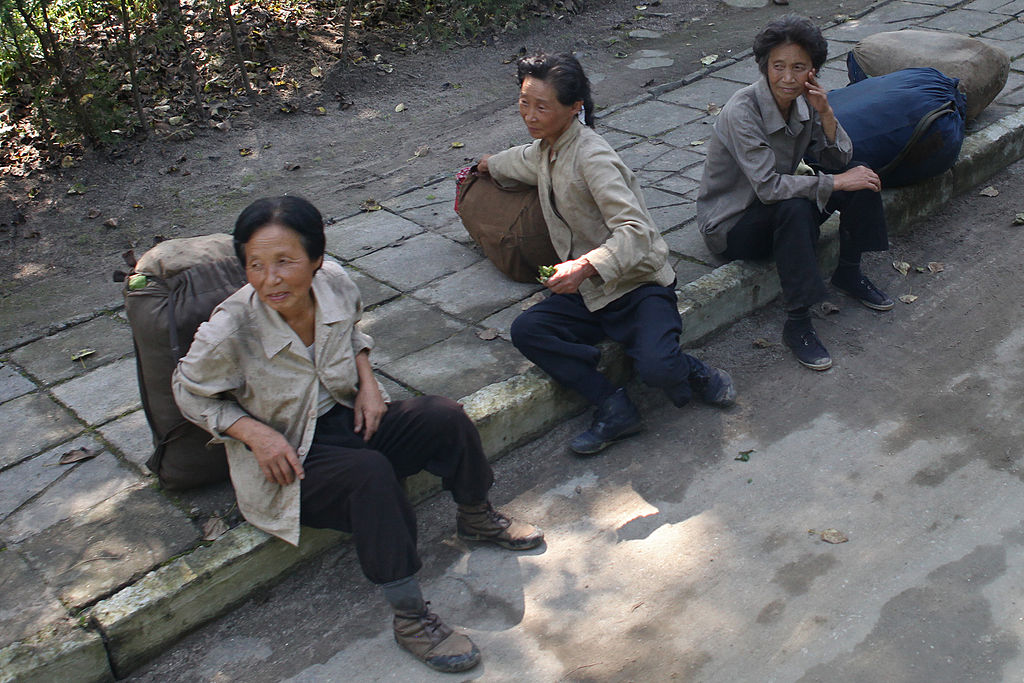
North Korean women live a harsh life (Source: Roman Harak, CC BY-SA 2.0)
If reunification happens one day and I am able to meet my childhood friends again, what will their faces look like?
A sorrowful question haunts me: will the hardships of life in North Korea have crushed them, causing them to wither and age far too soon?
Recently, North Korea has begun talking about women’s political rights. But what good are such rights in practice?
The most decisive reason I risked my life to escape North Korea was the countless inequalities I had been forced to endure simply because I was a woman. No, it was not mere inequality. It was a burdensome fate imposed on me for no other reason than having been born female.
The highest ideal North Korean society imposes on women is the Confucian façade of the “wise mother and good wife.” Devotion to the family and a life of obedience are held up as the foremost virtues a woman should pursue.
You can see this ideal expressed in stories about Kim Jong-suk, the wife of Kim Il-sung. North Korean women are taught to emulate the way she chased birds away at dawn so they would not wake him, or stood in the rain, shielding him from the downpour so that its sound would not disturb his contemplation.
Such stories reveal with painful clarity where women stand in North Korean society and what purpose they are expected to serve.
Whenever I think of my mother and grandmother, one image always comes to mind: crouched in front of the hearth, tending the fire while breathing in acrid smoke.
Even when I visited my grandmother as late as eleven at night, I would invariably find her sitting beside that narrow stove, cooking a meal for her grandchild. The sight was tender enough to make my heart ache, yet it also filled me with sorrow because it seemed to embody the inescapable life of a woman.
I, too, was a woman. That was the future awaiting me.
Cooking all day, washing clothes by hand, and cleaning—this was the life of mothers in households throughout North Korea.
My friends and I never wanted to live that way. No young person would willingly choose a life resembling that of a servant.
We dreamed of something freer, something more “hip.” Perhaps it was our longing for the unfamiliar world we had seen in South Korean dramas, or a desire awakened in us by the changing times.
Yet the moment even my freedom-loving friends stepped into marriage, they inevitably began to resemble the mothers whose lives we had so desperately wanted to escape: dry, exhausted faces, disheveled hair, and an endless routine like a wheel spinning in place.
As long as we had been born women, there was no escape.
That was because even the most basic conveniences, such as reliable electricity, did not exist there. We could not even dream of the washing machines, microwave ovens, and electric rice cookers that people in modern societies take for granted.
Whenever my grandmother saw how hopeless I was at cooking, she would click her tongue and say, “What will you do if your husband’s family throws you out?”
Had I remained in North Korea, her fear might well have become reality.
After settling in South Korea, I realized that this is a society that allows women to live truly human lives. This may apply to both men and women, but in women’s everyday lives in particular, the conveniences of modern civilization are nothing short of revolutionary.
North Korea loudly proclaims “revolution” in slogan after slogan. Yet the real revolution was unfolding quietly and confidently in the everyday life of its capitalist enemy.
When mountains of laundry are waiting at home, what woman has the time to participate in politics? For that to be possible, she would need someone else to take care of the household chores.
There is a saying in North Korea: “Women are one of the two wheels of the revolution.”
But that wheel is now stuck fast in the mud of crushing domestic labor.
My mother was a woman with an exceptionally independent and strong spirit.
Her favorite fictional character was Scarlett O’Hara from Gone with the Wind. She especially admired Scarlett’s courage and resourcefulness when she tore down velvet curtains and made herself a dress in pursuit of her goal.
Yet despite her independence and longing for freedom, my mother could become nothing more than a “hearth driver.”
That is how North Koreans disparagingly refer to themselves as they sit beside the hearth, tending the fire and cooking meals.
My mother desperately wanted her daughter to live a different life.
But did she know?
As long as I had been born in North Korea, no matter how hard I struggled, I was destined to follow the same path she had taken.
There is one thing women there commonly say:
“I wish I had been born a man.”
It was recently reported that North Korea convened a conference to strengthen the status of the Women’s Union—the Korean Democratic Women’s Union—while emphasizing the importance of education within the family.
Having failed to block the influx of South Korean dramas and other outside cultural influences through laws and crackdowns, the authorities likely intend to mobilize mothers, who stand at the center of the family, as instruments of control.
But it is doubtful whether those mothers will act as the government wishes.
Rather than spending time holding conferences and conducting ideological education, providing even a few hours of reliable electricity would be a far more effective way to gain the cooperation of North Korean mothers.
North Korean women are already struggling to catch their breath under the burden of domestic labor, yet the government continually mobilizes them for socialist construction.
There is another saying in North Korea:
“If Party members are the sparks, Women’s Union members are the flames.”
These days, however, Women’s Union members have twisted the saying into something different:
“If the Women’s Union is the spark, Party members are nothing but ash.”
Women’s lives have reached their breaking point, and public sentiment has grown so cold that they now compare the Party to a heap of burned-out ashes, useless for anything.
The time when people could be soothed by empty words of comfort or hollow slogans has already passed.
What these women need now is not political rights that exist in name only. They need real electricity, real technology, and the economic freedom that makes a dignified human life possible.
If reunification comes someday and I am able to meet my childhood friends again, I hope their faces will not be too deeply lined.
I hope we will not weep at the sight of how much we have changed.
I pray with all my heart that we will be able to smile brightly at each other again, just as we did so long ago.

Born in Chongjin in 1990, Jang Mi was not a studious child, but under her mother’s influence, she graduated from high school and went on to university to take math and science. She worked as a wedding video editor for seven years until her defection in 2019.
Latest posts by Jang Mi (see all)
- Is the Kim family still Big Brother? - September 6, 2026
- Electricity, not slogans: What North Korean women really need - August 3, 2026
- When seeing the world makes “My Country is the Best” harder to sing - June 9, 2026