

Is the Kim family still Big Brother?
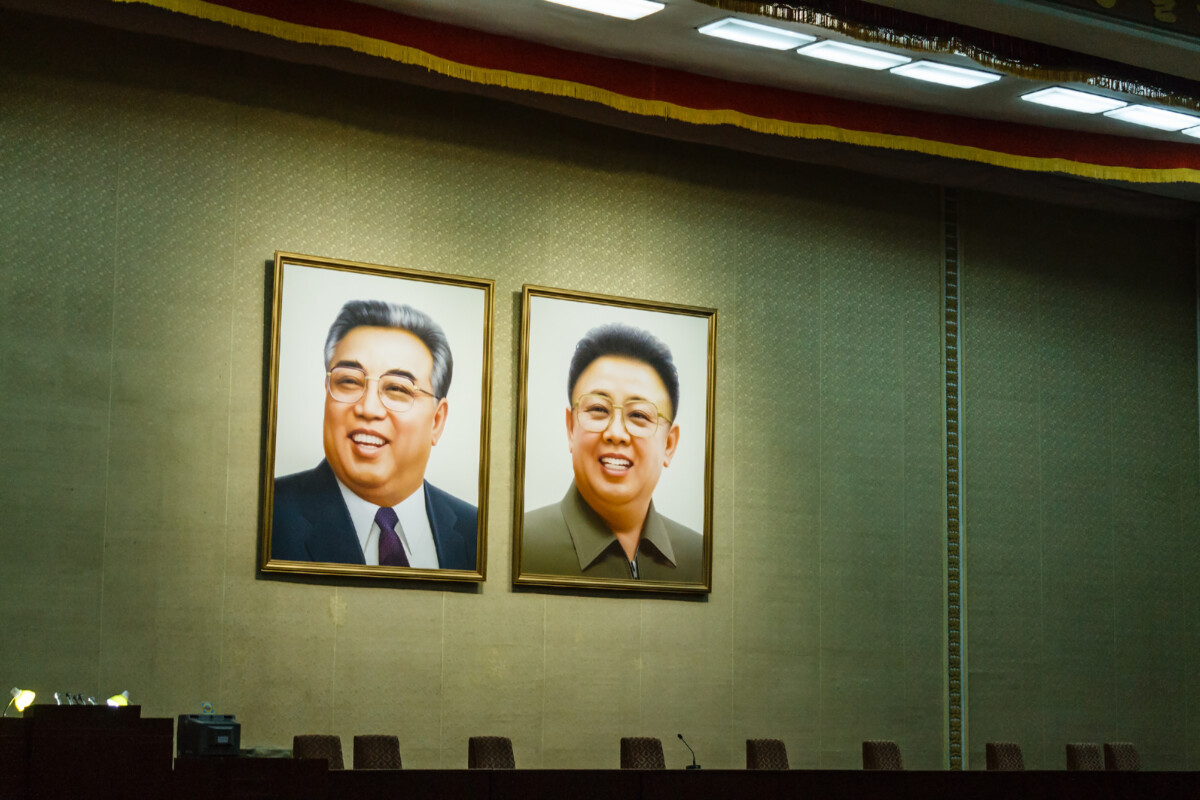
The Kim family is always watching us. (Image: iStock/Mieszko9)
In every home in North Korea, portraits of the Kim family hang on the wall.
Even while they were alive, they inspired fear and awe in us. In death, they continue to exert the same influence. Even after they are gone, we cannot escape their presence in our lives.
Think about it.
People who have no blood relation to us whatsoever occupy the most prominent place in our homes. Of course, emotionally speaking, they are supposed to be our fathers and mothers. But no real parent throws parties while their children starve, or has salmon roe flown in from abroad to eat all by himself.
And yet we devoted ourselves not only to honoring their presence, but also to protecting every symbol associated with them.
Wherever we go in North Korea, we encounter them – the Kim family – in the most prominent places.
Their images are on the streets, in our homes and even on the clothes we wear every day, creating the impression that they are always watching and monitoring us.
Those portraits hanging in every home are considered more valuable than anything else in the house. Under any circumstances, we are expected to protect them. Even if a flood sweeps away every piece of furniture in the house, or a fire reduces everything we own to ashes, the portraits must be saved.
If we fail to do so, a terrible punishment awaits us – internal exile, for example.
Let me tell you about my cousin. He grew up in poverty, but he was more selfless than anyone I knew and, in particular, deeply loyal to the Party.
One day, on his way home, he came upon a house engulfed in flames. The fire had broken out suddenly, and the family had fled in a panic. In their haste, they had failed to take the portraits with them.
They stood outside, helpless, frantic with worry. But with the house in flames and their lives at risk, no one dared go back inside.
My cousin did not hesitate. He rushed into the burning house and emerged carrying the portraits of Kim Il-sung and Kim Jong-il.
In his mind, just as he had always been taught, the safety of the portraits mattered more than his own.
His bravery and heroic deed were reported to higher authorities, and eventually an official came to see him. Looking at my cousin, who had escaped completely unharmed, the official said, almost regretfully: “If only you had died right there, you would have been Hero of Labor material…”
What they needed was a story that could be used to inspire the people: the portraits, and the glorious death of a boy who had sacrificed himself to save them.
The fact that my cousin had survived without so much as an injury actually made the story less useful.
In Ryanggang Province, there are many “slogan trees.” These trees are said to bear historic inscriptions written during Kim Il-sung’s years as an anti-Japanese partisan, expressing hopes for the liberation of the homeland and the defeat of Japanese imperialism.
Typical inscriptions include: “Twenty million compatriots, the Bright Star has been born” and “Long live General Kim Il-sung, the Sun of the Nation!”
It is highly questionable whether Kim Il-sung was already using this version of his name at the time, rather than his birth name, Kim Song-ju, or whether his son was actually called the “Bright Star” from the moment he was born.
But no one raises such questions.
These trees are treated as so sacred that military units are assigned specifically to guard them and take care of them.
One clear autumn day, a fire broke out among the slogan trees. The political commissar of the military unit responsible for them gave an extraordinary order: the soldiers were to shield the trees with their own bodies.
Scores of soldiers wrapped their bodies and arms around the trees. Some suffered third-degree burns. Some died.
Among them was a woman who was only a month away from completing her military service. Her face had been so terribly disfigured that I found it horrifying to look at.
Through state broadcasts, everyone in the country learned of her heroic deed. But when I thought about her ruined face and the pain she must have endured in those flames, I felt unbearably sad.
And I had another, more candid worry: “Will she ever be able to get married?”
Apparently, the government had already thought of the same thing. It publicly announced that it would spare no expense to restore her face and even promised to arrange her wedding itself.
As far as I know, she underwent facial surgery and eventually married.
But her face could not be restored.
Despite all this, though, at some point people’s loyalty to the Party and the state gradually began to fade. In their place, people increasingly turned to superstition. Why? Because life was so bleak.
My aunt was desperately poor, and she was especially fond of consulting fortune-tellers and shamans. One day, she came home with what she believed was the secret to becoming wealthy: she had to get rid of anything in the house that had belonged to anyone who was now dead.
Wanting desperately to improve her circumstances, she purged her house of everything that had even the slightest connection to someone who had died. As her house was already sparsely furnished, afterwards you could have swung a stick around inside without hitting anything.
But there was one thing she could not remove: the portraits of the two Kims.
This upset her deeply. She complained to me that because of those portraits, she would never be able to become rich.
“I really don’t understand,” she said. “Why do they make every household hang portraits of dead people?”
I was so alarmed by what she had said that I quickly silenced her. “Please be careful what you say. Do you want to bring ruin on the whole family?”
I am sure she was not the only person in North Korea who had begun to think this way.
A fortune-teller who had gained a reputation in North Korea for being particularly gifted once gave the following prescription to someone seeking a cure for an illness: cut down a pine tree growing beside a statue of Kim Il-sung, boil it and drink the decoction, then whatever is ailing you will disappear like melting snow.
You might wonder: who would dare damage a tree beside a statue of Kim Il-sung? In the past, such a thing would have been unthinkable.
But public sentiment had changed, and the sick person actually followed the fortune-teller’s instructions.
It showed just how far the prestige and authority of the Kim family had fallen.
The state tried to restore that authority by sentencing people who committed such acts to death.
But I wonder whether even that measure would have the result they expected.
Once authority has fallen so far, can it ever truly rise again?
Will my aunt, who blames the portraits for her poverty, ever change her mind?
Is the Kim family still Big Brother?

Born in Chongjin in 1990, Jang Mi was not a studious child, but under her mother’s influence, she graduated from high school and went on to university to take math and science. She worked as a wedding video editor for seven years until her defection in 2019.
Latest posts by Jang Mi (see all)
- When will the Koreas be reunited? - October 1, 2026
- Is the Kim family still Big Brother? - September 6, 2026
- Electricity, not slogans: What North Korean women really need - August 3, 2026