

In North Korea, a newspaper editorial is never just an editorial
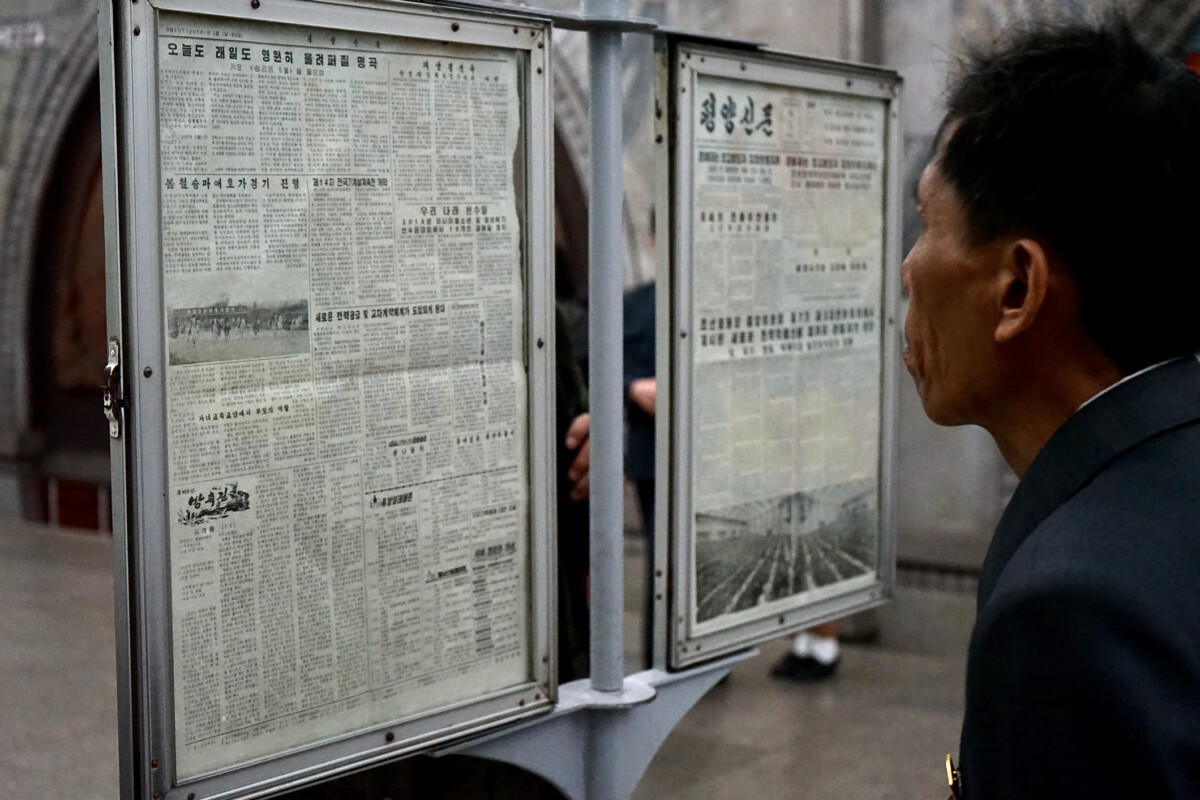
Newspapers are on display for Pyongyang Metro passengers (Image: iStock/DanZel)
Several years ago, when I worked at a state institution in Pyongyang, an order arrived from higher authorities to launch a new project.
The goal was ambitious, but we lacked the materials, electricity, manpower, and time to achieve it. One official cautiously pointed this out, saying, “Realistically, can this be completed by the deadline?”
Instead of explaining where the necessary resources would come from, the supervisor turned on him and said, “Comrade, do you lack the confidence to carry out the Party’s intentions?”
That ended the discussion.
For North Korean officials, this is routine. Questioning whether a plan is feasible can quickly become a question of political loyalty.
I was reminded of this when I saw that, on July 31, the party paper, Rodong Sinmun, had published a political commentary titled “An Era of Revolution” that claimed the government was simultaneously carrying out revolutions in construction, defense, regional development, agriculture, healthcare, and education. Cities and villages, factories and coal mines, schools and hospitals are all portrayed as being transformed beyond recognition.
The commentary’s real significance lay not in the achievements it celebrated.
It signaled that larger mobilization campaigns are coming, and that shortages of materials, electricity, time, or manpower will not be accepted as valid excuses.
Outside observers often dismiss North Korean propaganda as exaggerated rhetoric. Inside North Korea, however, propaganda becomes policy. Slogans become assignments, assignments become production quotas, and those quotas become the labor, materials, and sacrifices ordinary people are expected to provide.
The Rodong Sinmun commentary effectively fires the starter’s pistol.
Such commentaries are not personal opinion pieces. They translate party policy into language that officials and citizens are expected to study, repeat, and internalize.
Although the byline belongs to Seo Eun-chol, he is not writing as an independent commentator. The party set the political line, the propaganda apparatus turned it into slogans, and Rodong Sinmun transformed those slogans into obligations.
Anyone who has lived in North Korea understands that an article like this is not published simply because a journalist chose to write it.
That is why readers should ask not only what the regime is boasting about, but what it is preparing citizens to do.
The commentary highlights the Wonsan–Kalma tourist zone, regional factories, rural housing, greenhouses, hospitals, and advanced weapons as proof of success. Yet success never becomes a reason to ease burdens. Instead, it is used to justify new ones.
The article urges people to move “from struggle to even greater struggle,” to “advance continuously,” and not to become complacent over yesterday’s achievements.
Complete one task, and another immediately follows.
In most systems, success allows time to recover, evaluate, and plan. In North Korea’s revolutionary narrative, success proves only that even greater sacrifices are possible.
To give the system some credit, it is remarkably efficient at producing one commodity in unlimited quantities: slogans. Machinery may be scarce, electricity unreliable, and workers exhausted, but revolutionary confidence is always available on demand. Unfortunately, confidence cannot operate a crane, power a factory, or give an exhausted worker a night’s sleep.
Anyone who has worked in North Korea knows what happens once a project is labeled “revolutionary.” It becomes difficult to admit that there are insufficient materials, too little electricity, exhausted workers, or unrealistic deadlines. Raising practical concerns can be treated as questioning the Party itself.
Once policy failure is redefined as political disloyalty, institutions risk losing the ability to correct mistakes. In this context, reports become more optimistic than reality, shortages are concealed, and distorted information is then used to justify even more unrealistic targets.
Revolutionary slogans may motivate people, but they also prevent organizations from recognizing their own failures.
A functioning government normally announces not only objectives, but also budgets, resources, timelines, and implementation plans.
North Korea’s revolutionary slogans work differently. They elevate political goals while shifting the real costs onto lower levels of society.
The Party announces “earth-shaking transformation.” Provincial governments pass those orders to factories and institutions. Those institutions then demand labor, materials, cash, and “voluntary” contributions from workers and residents.
As directives move downward, they become increasingly concrete bills that ordinary citizens are expected to pay.
One revealing section identifies coal-mining districts as the next revolutionary front. Coal remains central to North Korea’s power generation and industrial economy, suggesting that the regime recognizes serious weaknesses in its energy base.
Yet the article never explains where the necessary equipment, electricity, or transportation capacity will come from. Instead, it emphasizes confidence, determination, ambition, and revolutionary spirit.
Material shortages are transformed into ideological shortcomings.
If machinery is lacking, the regime demands more loyalty. If electricity is lacking, it intensifies political campaigns. If construction falls behind, it investigates the attitudes of local officials rather than the flaws in the plan itself.
State failures become personal failures.
The commentary also rewrites the scorecard of Kim Jong Un’s rule.
Construction projects and policy successes are invariably attributed to his vision, decisions, and leadership. Failures, however, have no author.
Food shortages, medicine shortages, repeated mobilization campaigns, and unrealistic planning simply disappear from the narrative. When problems cannot be ignored, blame falls on sanctions, natural disasters, local officials, or insufficient ideological commitment.
Power and responsibility are deliberately separated.
Success belongs to the leader. Failure belongs to everyone else.
The article repeatedly invokes “the people’s aspirations,” yet citizens have no say over investment priorities or national policy. “The people” function largely as a rhetorical device used to legitimize decisions already made by the Party.
The regime claims that everything is done for the people. It then asks those same people to provide the labor, materials, loyalty, and sacrifice.
The leader’s revolution is described as love. The people’s revolution consists of sacrifice.
Why, then, is North Korea emphasizing an “era of revolution” now?
The country’s development agenda continues to expand, encompassing factories, hospitals, coal mines, rural development, education, and more. Yet there is little evidence that its resources, electricity supply, or transportation capacity have expanded at the same pace.
The commentary therefore normalizes greater mobilization, discourages officials from questioning unrealistic targets, and assigns responsibility in advance for future failure.
If the plans succeed, they become another achievement of Kim Jong Un. If they fail, someone will be accused of lacking sufficient revolutionary spirit.
This is one of the central functions of North Korean propaganda. It raises ambitions while shifting responsibility downward.
For that reason, the commentary should not be dismissed as empty rhetoric. North Korean propaganda rarely describes reality accurately, but it often foreshadows what the regime intends to do next.
Citizens are likely to encounter its consequences through new labor quotas, material contributions, workplace study sessions, and fresh mobilization campaigns.
In North Korea, propaganda does not end on the pages of a newspaper. Words become organizational life. Organizational life becomes labor obligations. Refusing those obligations becomes a political offense.
Its power lies not simply in persuading people to believe, but in compelling even those who do not believe to behave as though they do.
The commentary ends by urging citizens to “make their lives shine as a revolutionary generation in an era of revolution.”
It is a beautiful sentence.
But for those who have lived under the North Korean system, it carries a different meaning.
The plans have already been decided. The goals are beyond question. Resource shortages are not acceptable excuses. More work will be demanded. Responsibility for failure will fall not on those above, but on those below.
North Korea calls this an “era of revolution.” Those who have lived under the system know what it often means in practice: an endless machinery of sacrifice.

Taesung offers informed perspectives on North Korean society, grounded in years of experience within a key state-run institution. After defecting to South Korea in 2024, he now focuses on providing analysis of the country.
Latest posts by Kim Taesung (see all)
- North Korea is building new weapons and drones. Russia may be making them better - September 24, 2026
- North Korea drops ‘unification’ from party charter, boosts Kim Jong-un’s power - September 13, 2026
- Man jailed for spying on defectors and soldiers for North Korean agent - September 9, 2026