

North Korea–Russia alliance is being built on war, hard currency, and sanctions evasion
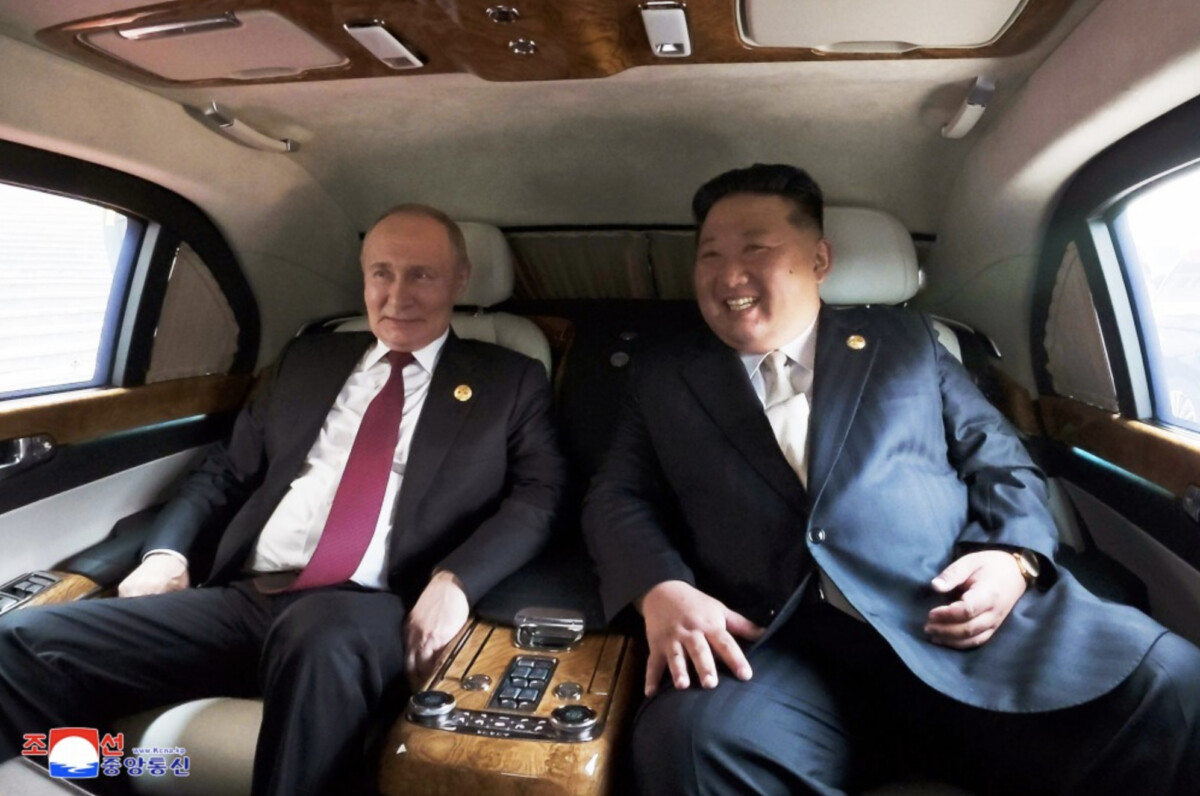
Putin and Kim Jong-un share a ride in Beijing last year. Image: KCNA)
Sign up here.
Relations between North Korea and Russia have evolved far beyond simple diplomatic cooperation in recent years. What was once a relationship centered on limited political ties and arms transactions is increasingly taking the shape of a strategic alliance forged around war.
A major turning point came in June 2024, when North Korean leader Kim Jong-un and Russian President Vladimir Putin signed the “Comprehensive Strategic Partnership Treaty,” which included a mutual defense clause pledging assistance if either side came under attack.
The depth of the relationship became even clearer in a letter from Putin to Kim published by the Korean Central News Agency (KCNA) on April 27. The letter coincided with the opening of a new museum in Pyongyang commemorating overseas military operations and directly referenced North Korean troops fighting alongside Russian forces in the Kursk region. What stood out most was Putin’s effort to connect the current military cooperation to historical ties.
“At the end of the Second World War, Soviet troops, together with Korean patriots, liberated Korea from Japanese colonial rule, and in the 1950s provided assistance in defending the independence of the Democratic People’s Republic of Korea in its struggle against foreign invaders,” he wrote.
The language reflects Moscow’s broader attempt to frame current military cooperation as part of a longstanding tradition of “joint struggle.” In effect, Russia appears to be reviving the narrative that the two countries have historically fought together against common enemies.
One notable aspect of the letter was Putin’s decision to avoid directly mentioning the United States in relation to the Korean War, instead using the phrase “foreign invaders.” The wording may reflect Moscow’s desire to avoid completely closing the door on future relations with Washington.
At the same time, both Moscow and Pyongyang continue to portray themselves as confronting a Western-led international order. In that sense, the phrase also echoes North Korea’s longstanding rhetoric surrounding a shared “anti-imperialist front.”
Putin reinforced the message at the conclusion of the letter, writing: “I am confident that we will continue to strengthen the comprehensive strategic partnership between the Russian Federation and the Democratic People’s Republic of Korea through our joint efforts.”
The statement captures the broader trajectory of current North Korea–Russia relations. What once appeared to be a temporary alignment of interests is increasingly resembling a long-term strategic partnership.
According to South Korean intelligence assessments, North Korea has supplied Russia with tens of millions of artillery shells, missiles and long-range artillery systems. In return, Moscow is believed to be providing Pyongyang with drone-related technologies, air defense systems, electronic warfare equipment, space-launch technology and missile guidance assistance.
North Korea’s gains from the relationship extend beyond military technology. Economically, Pyongyang is also securing significant practical benefits.
One major example involves labor exports. In 2025, Russia reportedly issued more than 36,000 visas to North Korean nationals, most of them categorized as “education visas.” Analysts, however, believe many of the recipients are in fact laborers working under the guise of students.
The arrangement allows North Korea to earn foreign currency while circumventing U.N. sanctions. For Russia, it helps ease labor shortages caused by the prolonged war and mounting economic pressure.
Human rights groups investigating the issue have reported that some Russian universities are effectively functioning as registration hubs for North Korean workers. Companies are said to provide funds labeled as scholarships, though the payments reportedly function more like wages.
The relationship is ultimately rooted in pragmatism. Russia needs artillery shells, manpower and labor, all of which North Korea can provide. Pyongyang, meanwhile, needs foreign currency, diplomatic support and technological assistance to cope with international isolation and sanctions.
At the same time, it would be inaccurate to conclude that North Korea has shifted entirely away from China. While some observers have suggested that ties between Pyongyang and Beijing are weakening, the reality appears more complex.
Even as North Korea deepens military cooperation with Russia, it remains heavily dependent on China economically. High-level exchanges between Pyongyang and Beijing have also become more active in recent months. In practice, North Korea appears to be using Russia to expand its strategic room for maneuver while continuing to rely on China as its primary economic lifeline.
One of the most significant military developments is that North Korean troops are now gaining firsthand experience in modern warfare. On the Kursk front, they have reportedly encountered large-scale drone warfare, electronic warfare and long-range artillery combat — forms of conflict largely unfamiliar to the Korean People’s Army.
The experience could mark a major turning point for North Korea’s military. The significance lies not only in the deployment itself, but also in the opportunity to learn directly from active battlefield conditions. Analysts believe such exposure could influence future North Korean military doctrine and tactics.
The same dynamic applies to the missile and space sectors. Russia remains one of the few countries capable of providing meaningful technological assistance for North Korea’s satellite launches, long-range missile development and launch vehicle programs. Many analysts believe Pyongyang’s recent acceleration in missile and satellite capabilities cannot be separated from expanding cooperation with Moscow.
Cyber operations also remain a critical part of the picture. North Korea is widely believed to generate substantial foreign currency through cryptocurrency theft and cyberattacks. International security institutions have repeatedly warned that Pyongyang’s cyber capabilities are becoming increasingly sophisticated, enabling the regime to bypass sanctions through digital means.
As ties deepen, the growing North Korea–Russia partnership is emerging as a major factor that could reshape the security landscape of Northeast Asia in the years ahead.

Taesung offers informed perspectives on North Korean society, grounded in years of experience within a key state-run institution. After defecting to South Korea in 2024, he now focuses on providing analysis of the country.
Latest posts by Kim Taesung (see all)
- In North Korea, a newspaper editorial is never just an editorial - August 12, 2026
- North Korea posts third straight year of 3% growth, fueled by Russia arms trade - August 3, 2026
- Zelenskyy says North Korea to send 30,000 more troops - August 1, 2026