

The gray years: My university education in North Korea
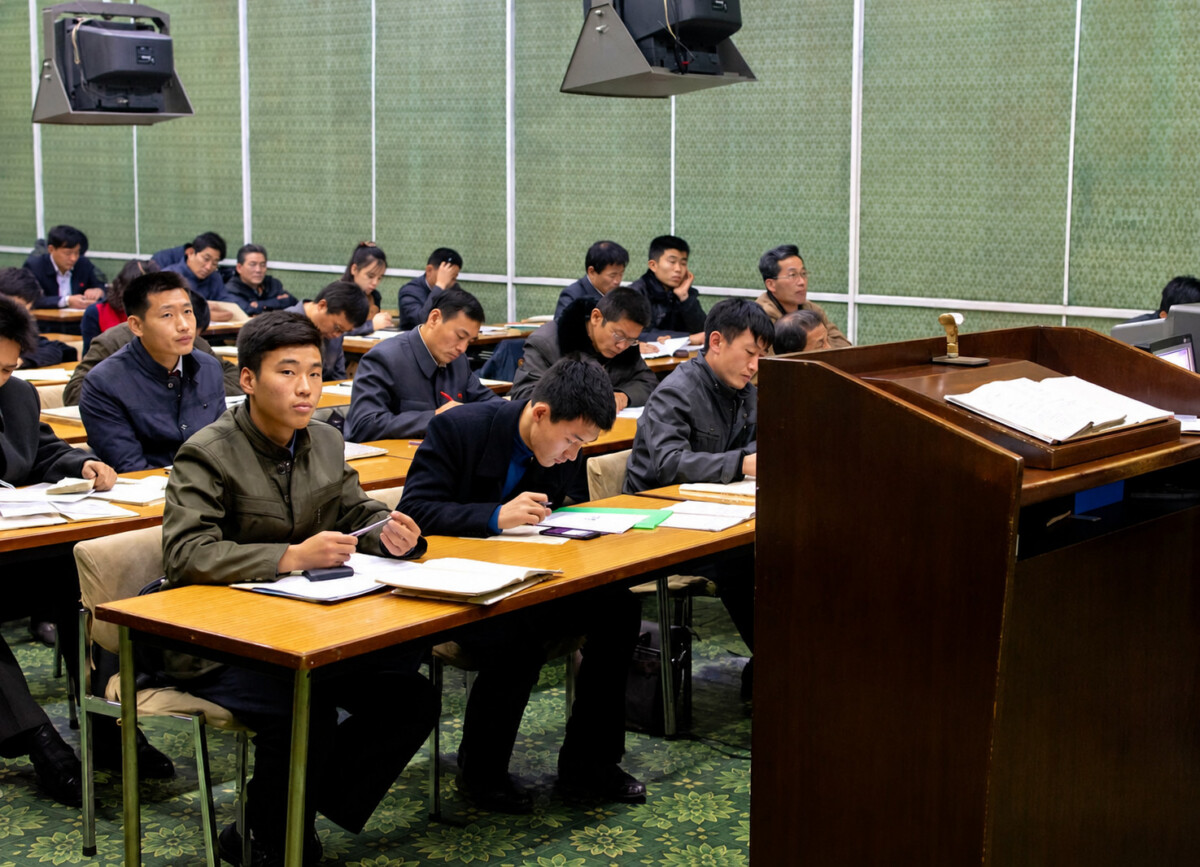
“Not a single person in that classroom truly believed the economic theories being taught by their professor.” Photo: © Mirko Kuzmanovic/Dreamtime
Everyone has a chapter of their youth that remains etched in their memory.
For some, it is a time of beautiful recklessness. For others, it is remembered as the bittersweet experience of first love or the intense bonds of friendship forged in the passion of youth.
For me, however, those years remain the darkest and most depressing chapter of my life, a faded memory painted in shades of gray.
This is the story of my university years.
Before entering university, we all have our own dreams and expectations.
We imagine ourselves dressed in fine clothes, confidently showing the world who we are. We dream of exciting romantic encounters, of immersing ourselves in academic pursuits, deepening our knowledge and eventually securing a prestigious job assignment that will allow us to build a promising future.
I was no exception.
But dreams are often sweetest before they become reality. The university I actually encountered mercilessly shattered the innocent hopes and ideals I had so carefully nurtured.
Looking back, what I remember most vividly about those years is the confusion and distrust.
I entered university determined to excel academically. Yet, paradoxically, those years became a time when I abandoned my studies of my own accord and began navigating the world through misguided beliefs and dishonest means.
There was a time, of course, when I stayed up all night, determined to succeed through hard work alone.
I had a friend with whom I studied and competed, and our rivalry brought out the best in me. No matter how hard I worked, however, he always received better grades. I envied his brilliant mind and what I assumed was his natural talent.
But as time passed and we came to understand each other’s academic abilities better than anyone else, I discovered a harsh truth.
He was no more academically capable than I was, yet he consistently received better evaluations.
I began to understand an unwritten rule of university life: studying hard was not necessarily the way to succeed.
Perhaps, deep down, I had simply been looking for a legitimate excuse to stop trying.
That was during my first year at university.
By my second year, I had begun exploiting my family’s wealth to bribe professors and buy better grades. Devoid of passion, sincerity or any genuine determination to build a future, I accumulated academic credits that amounted to little more than empty credentials.
There is a well-known anecdote that lays bare the realities of everyday life in North Korea.
University professors live in grinding poverty. The state fails to compensate them adequately for their work, leaving many struggling to maintain even the most basic standards of dignity and respectability.
Their poverty was impossible to hide. It showed through like an awl piercing fabric, visible in their threadbare suits and battered briefcases.
We respected our professors for their knowledge and dedication, but whenever we noticed their shoes, worn through and full of holes, we could not help feeling sorry for them.
Cruelly, poverty often diminished their standing in the eyes of others.
Most professors therefore tried desperately to conceal their financial hardship. One mathematics professor, however, was different. He made no attempt to hide his poverty, almost as though he were wielding it as a weapon against his students.
“If all of you insist on studying too well, you’re essentially saying you want us professors to starve to death.”
The classroom erupted in laughter.
Everyone tried to dismiss his remark as a harmless joke. Yet beneath the self-deprecating humor lay the profound sorrow of intellectuals struggling to survive under socialism.
True to his profession, the mathematics professor applied the relationship between inputs and outputs with remarkable precision. The grades on our report cards changed reliably and predictably according to the amount of money we paid in bribes.
Another unforgettable moment occurred during a political economy lecture.
The professor was explaining the differences between capitalist and socialist economies. He argued that capitalism, which generated wealth through imbalances between supply and demand and excessive competition, was inevitably doomed to periodic economic crises.
He passionately insisted that capitalism’s eventual collapse was therefore unavoidable.
At that moment, a student raised his hand and posed a pointed question.
“Doesn’t the fact that capitalism has survived and continues to function suggest that it has an inherent ability to overcome crises and recover from them? If recovery is possible, doesn’t that undermine the argument that capitalism must inevitably collapse?”
The professor’s expression immediately tightened.
With an awkward smile, he offered a hesitant reply.
“Well, you see, I’ve never actually experienced capitalism firsthand. Personally, I think the government should at least send us economics professors abroad on official trips so we can see it for ourselves.”
Once again, laughter filled the classroom.
This time, however, it was laughter born of disbelief and bitter irony.
Not a single person in that classroom truly believed the ideologically driven economic theories the professor was teaching.
The harsh realities we witnessed every day were far more convincing than any grand theory or propaganda proclaiming the superiority of socialism.
The socialist paradise promised by the regime existed nowhere in our lives. By then, we had all come to recognize, if only in silence, the immense wealth and material power of capitalist societies.
What earned students good grades and gave professors a more comfortable life was not ideology, but money.
We all understood the bitter truth: we had no choice but to carry on living while concealing this reality beneath the hypocritical facade of ideology.
My university years were a time of profound confusion and uncertainty about my values and beliefs.
The innocent conviction I had once held—that hard work would lead to academic achievement and that achievement would, in turn, bring the rewards one deserved—was deeply wounded during those years.
The greatest tragedy, however, was the fate of the most outstanding student in our department.
He studied harder than anyone else, staying awake night after night in pursuit of knowledge. Yet he had no money to bribe his professors, and he graduated with grades far lower than mine.
His fate after graduation was no better.
Unable to afford a bribe for the official responsible for assigning graduates to their jobs, he was sent to an obscure posting in one of the country’s most remote regions, a place everyone else desperately wanted to avoid.
The most brilliant and honest student in our department thus disappeared into the shadows of society.
Those were the years in which I learned how easily honest effort could be betrayed in a world ruled by injustice, and how mercilessly reality could expose the contradictions hidden beneath the mask of ideology.
Even now, whenever I think back on my university years, I feel a strange heaviness in my chest.
In my memory, those years will always be colored gray.

Born in Chongjin in 1990, Jang Mi was not a studious child, but under her mother’s influence, she graduated from high school and went on to university to take math and science. She worked as a wedding video editor for seven years until her defection in 2019.
Latest posts by Jang Mi (see all)
- The gray years: My university education in North Korea - November 5, 2026
- When will the Koreas be reunited? - October 1, 2026
- Is the Kim family still Big Brother? - September 6, 2026