

New destroyer signals North Korea’s push for a nuclear navy
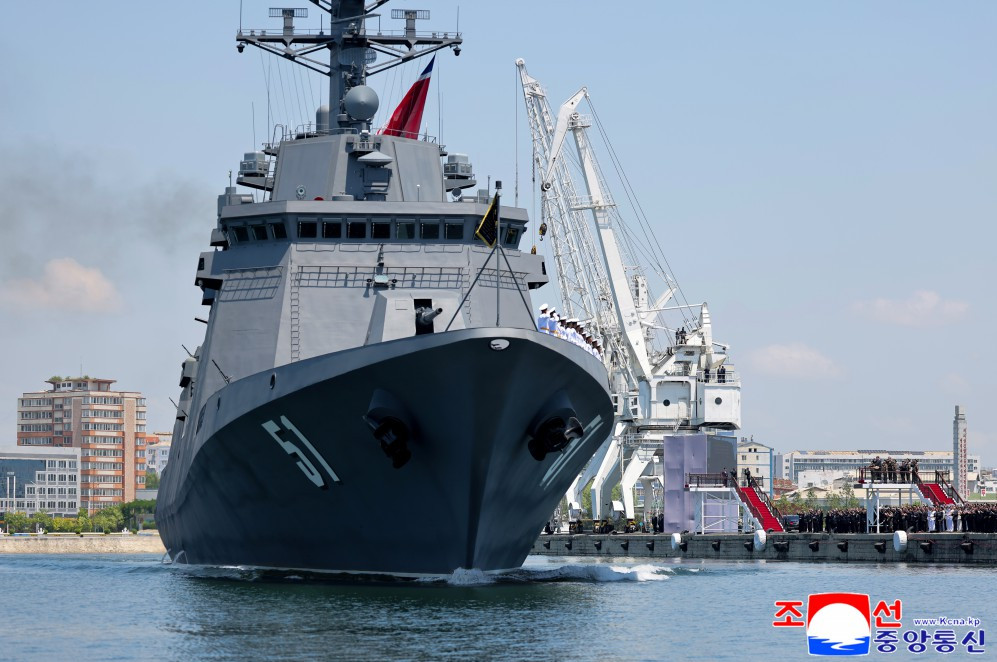
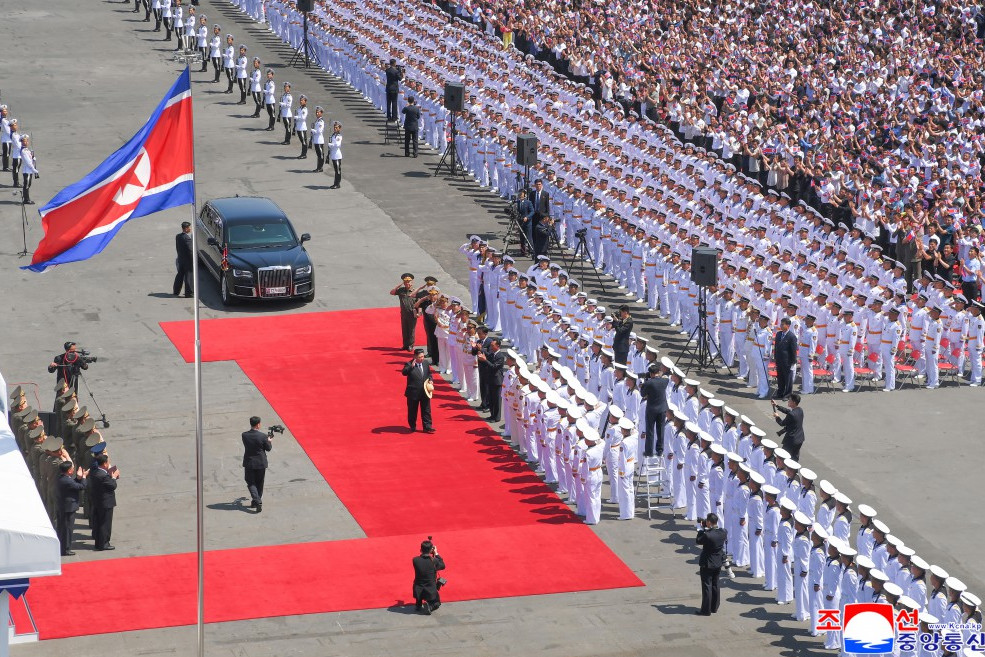
Kim Jong-un attends the commissioning of the destroyer Choe Hyon at Nampho port on June 23, 2026. Image: KCNA.
North Korea commissioned a new multipurpose destroyer on June 23 at Nampho Port, according to the state-run KCNA news agency.
The Choe Hyon, named after the late resistance comrade and defense minister under founding father Kim Il-sung, was immediately assigned to the West Sea Fleet.
In his speech at the commissioning ceremony, Kim Jong-un, the supreme leader and grandson of the country’s founder, claimed that “the era in which our navy existed as a force for coastal defense is now clearly a thing of the past.”
“The nuclear armament of the navy is proceeding along its course exactly as planned,” Kim said, in a speech that revealed an ambitious plan to build two surface ships of 5,000 tons or more every year over the next five years, and to launch a 10,000-ton-class strategic vessel.
This commissioning ceremony can be seen as a result of the “five-year plan for the development of defense science and weapons systems” that Kim presented at the Eighth Congress of the Workers’ Party of Korea in January 2021.
This plan led to the operational deployment of long-range cruise missiles, hypersonic missiles, solid-fuel ICBMs, military reconnaissance satellites, and other systems in line with those priorities, according to Japan’s Ministry of Defense.
38 North also noted that Kim at the time had set out goals including nuclear-powered submarines, underwater-launched nuclear strategic weapons, tactical nuclear weapons, hypersonic glide vehicles, and multiple-warhead technology.
The Choe Hyon, therefore, is not so much a showpiece that suddenly appeared out of nowhere but is an extension of the “diversification of nuclear forces” and the “strategic transformation of the navy.”
The commissioning ceremony sent three broad signals. First, North Korea’s navy is trying to move up in weight class from a small coastal force.
Second, this shift is not so much modernization as part of an expansion of sea-based nuclear forces linked to the five-year weapons-development plan.
Third, the missiles, air-defense systems, radars, and fire-control equipment believed to be installed on the Choe Hyon may be connected to Russian technical support, making the ship a potential new product of North Korea-Russia military cooperation.
Photos released by KCNA show that the new vessel belongs to a completely different weight class from the small fast attack craft and patrol ships that have traditionally made up the North Korean navy.
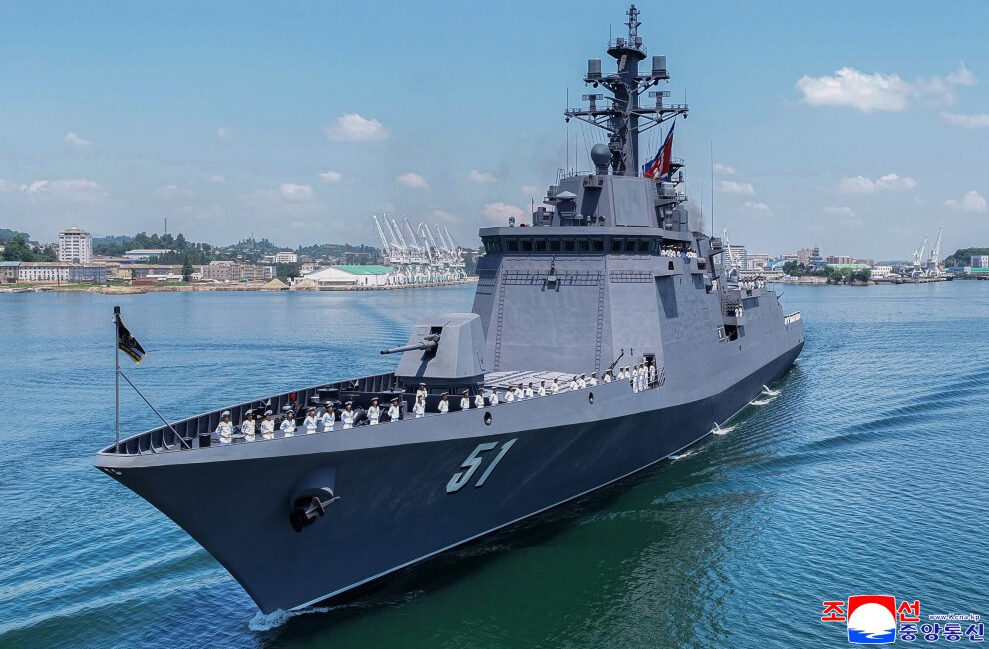
Visible features include a sloped stealth-style hull at the bow, a large mast, square panels that appear to be phased-array radars, a bow gun, an area presumed to contain vertical launch cells, and a flight deck at the stern.
CSIS’s “Beyond Parallel” project assessed the Choe Hyon class as the largest North Korean combat ship to date, saying that it appears to be equipped with a 127 mm-class gun, multiple vertical launch cells, close-in weapon systems, electronic-warfare equipment, and space for operating a helicopter or unmanned aircraft.
However, it should not immediately be regarded as being on the same level as the American Arleigh Burke-class, the South Korean Sejong the Great-class, or the Japanese Maya-class Aegis destroyers.
The external appearance is akin to a modern destroyer, but the core lies in the combat system: long-range detection and tracking, simultaneous multi-target engagement, and fleet-network integration. There is still no evidence that North Korea has secured that level of capability.
The Choe Hyon appears to be closer to a transitional vessel combining a Russian-style heavily armed frigate with a North Korean nuclear and missile platform than to a “North Korean Aegis ship.”
The possibility of Russian support remains a key possibility. Shortly after the Choe Hyon was unveiled, Lee Sung-joon, spokesperson for South Korea’s Joint Chiefs of Staff, said that, judging by the shape of the weapons and equipment, there was a possibility that North Korea had received technology, funding, and assistance from Russia.
RFA reported his remarks, noting that suspicions of Russian technical support were fueled by the ship’s supersonic cruise missiles, phased-array radar, and advanced naval equipment.
Business Insider also reported that military analysts had focused on the resemblance between the Choe Hyon’s air-defense system and Russia’s Pantsir series.
However, conclusions should not be drawn too quickly. There is no physical evidence that Russia handed over the entire ship design. At present, it is more realistic to believe that Russian-style technology or assistance may have been introduced in areas such as missiles, air-defense systems, radar, fire control, electronic equipment, and propulsion or operational advice.
The significance of the Choe Hyon becomes clearer when viewed alongside North Korea’s recent submarine-development trajectory. In September 2023, Pyongyang launched the Hero Kim Kun Ok, which it described as a “tactical nuclear attack submarine” and reported that the submarine had been assigned to a fleet responsible for waters between the Korean Peninsula and Japan.
Experts, however, believed that it was not a nuclear-powered submarine but rather a potential nuclear-armed platform converted from an existing diesel submarine.
Later, in 2025, North Korea released for the first time photos of what it called a “nuclear-powered strategic guided-missile submarine” under construction. AP quoted Moon Keun-sik, a submarine expert at Hanyang University in Seoul, saying the vessel appeared to be a 6,000- to 7,000-ton-class submarine capable of carrying around 10 nuclear-capable missiles.
CSIS explained that North Korea’s goal of acquiring nuclear-powered submarines was first officially set out in the five-year weapons-development plan announced at the Eighth Party Congress in 2021. In other words, North Korea appears to be trying to create two pillars of sea-based nuclear forces: nuclear submarines below the surface, and Choe Hyon-class destroyers on the surface.
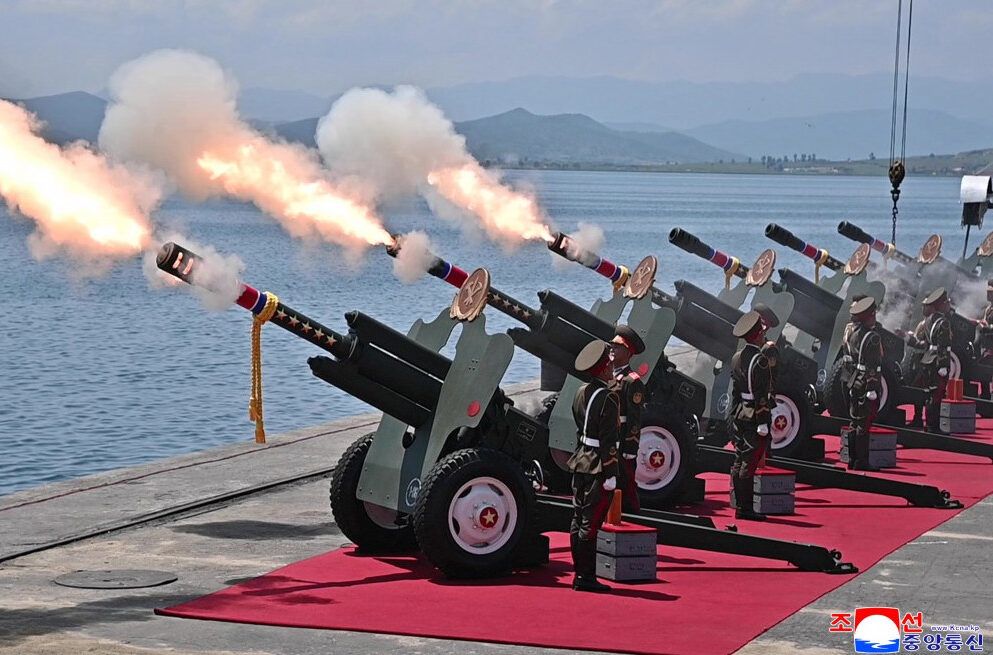
The gun salute depicted in the photos is not mere ceremony. The sight of guns ceremonially firing along a red carpet, with white smoke wafting toward the sea, says more than “a new warship has joined the navy.” It is staged to elevate the new vessel into a national strategic asset.
North Korean media reports said that the naval flag was raised as the ship’s horn was sounded and nine rounds fired. Compared with the earlier launch for the Hero Kim Kun Ok, which featured a Western-style ceremony in which Foreign Minister Choe Son-hui appeared to break a champagne bottle, gunpowder replaced the bubbly.
This is somewhat comic, but the message is serious. North Korea is now reinventing its navy for nuclear deterrence.
That does not mean the Choe Hyon should be overestimated. Large surface ships are exposed to satellites, patrol aircraft, submarines, unmanned aircraft, and electronic-intelligence collection networks. To conduct actual blue-water operations, a navy needs maintenance, supply, at-sea refueling, anti-submarine helicopters, trained crews, integrated command and control, and modern naval bases.
Kim Jong-un himself, in fact, suggested in his speech that the navy lacks sufficient bases for mooring large combat ships.
In addition, the Kang Kon, known as the second ship of the Choe Hyon class, suffered an accident during its launch at Chongjin in 2025, which 38 North said was an example of the limitations in reliably building, launching, and operating large combat ships.
In conclusion, the Choe Hyon is not a “fully formed naval capability” capable of matching U.S., South Korean, and Japanese Aegis destroyers. But it is a signal that North Korea is expanding the military five-year plan presented at the Eighth Party Congress in 2021 into sea-based nuclear forces.
The North Korean nuclear and missile platforms that South Korea, the United States, and Japan must detect and track in the future have now expanded beyond land and underwater systems to include surface ships as well.

Taesung offers informed perspectives on North Korean society, grounded in years of experience within a key state-run institution. After defecting to South Korea in 2024, he now focuses on providing analysis of the country.
Latest posts by Kim Taesung (see all)