

Two North Korean prisoners, one diplomatic dispute: What was agreed between Seoul and Kyiv?
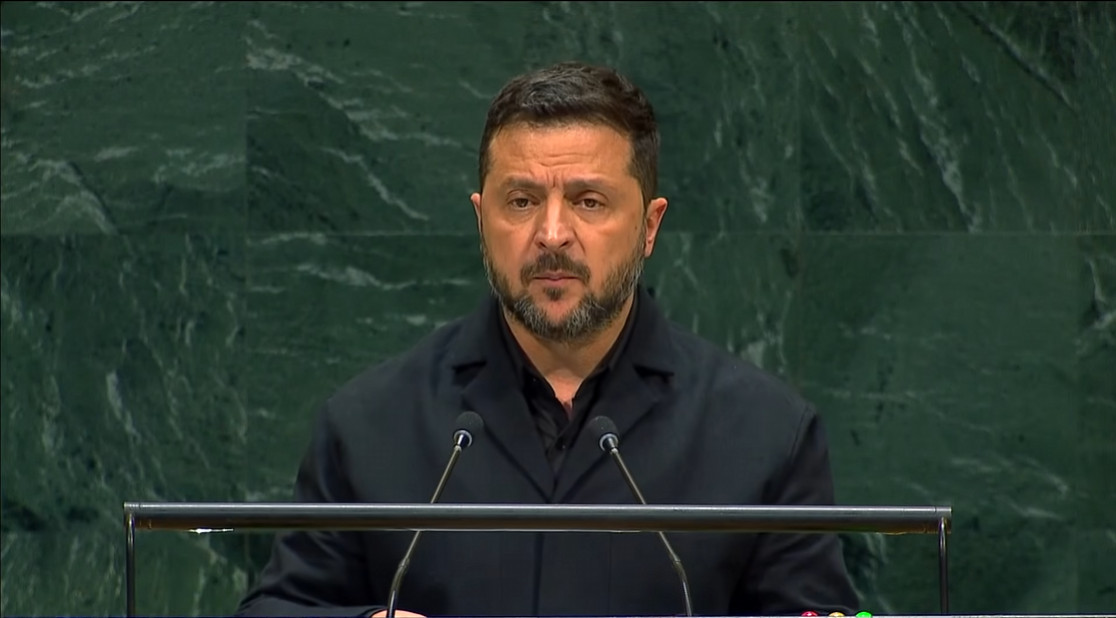
Ukrainian President Volodymyr Zelenskyy, addresses the UNGA in New York on Sept. 23. Still from UN Web TV.
The transfer of two North Korean prisoners of war from Ukraine to South Korea was supposed to be a humanitarian success. Instead, it has turned into a diplomatic dispute between Seoul and Kyiv over a basic question: What exactly did the two governments agree to keep secret?
The controversy erupted when Ukrainian President Volodymyr Zelenskyy revealed in a Sept. 23 address to the U.N. General Assembly that Ukraine had sent two North Korean prisoners of war to South Korea.
The disclosure caught media attention in Seoul because the South Korean government had not announced that the transfer had taken place.
President Lee Jae-myung then said Ukraine had broken a nondisclosure agreement. Ukraine has since denied that such an agreement existed.
Instead of cooling the dispute, the presidential Blue House escalated it on Sept. 27, expressing “strong regret” over Ukraine’s “unilateral disclosure” and subsequent denial of the confidentiality agreement. Seoul said the denial had seriously damaged bilateral trust and that it was considering additional measures if necessary.
The result is a dispute over an agreement that neither side has made public in documentary form.
What was the purpose of the nondisclosure agreement, and what was actually agreed?
There is little dispute that Seoul and Kyiv had been discussing the fate of the two soldiers for months.
The men were captured by Ukrainian forces in January 2025 after being deployed to Russia’s Kursk region with other North Korean troops supporting Moscow’s war against Ukraine.
Under international law, POWs are generally subject to rules governing their treatment and eventual disposition. But the situation of North Korean soldiers captured fighting for Russia is highly unusual. North Korean troops are reportedly expected to fight to the death, and captured soldiers and their families could face punishment or other consequences in North Korea.
It is therefore unsurprising that the two men later expressed a desire to come to South Korea.
At a July meeting in Ankara on the sidelines of the NATO summit, Lee and Zelenskyy agreed to handle the North Korean soldiers on humanitarian grounds while respecting their wishes, according to the South Korean government.
What happened after that is less clear.
South Korea says the two governments subsequently agreed that the transfer would be kept confidential. Lee said the decision was necessary because disclosure could create risks for the prisoners and their families and could affect diplomacy, national security and the security situation on the Korean Peninsula.
On Sept. 27, the presidential office added a new detail: It said Ukraine itself had requested confidentiality, partly because Kyiv could face domestic criticism for giving up the possibility of exchanging the North Korean soldiers for Ukrainian prisoners held by Russia.
Ukraine’s account is different.
After Zelenskyy’s disclosure, the Ukrainian presidential office said the transfer had been arranged through direct dialogue with Seoul. It also argued that Ukraine had disclosed the transfer, rather than the detailed circumstances surrounding it, and suggested that keeping the entire operation secret would have been difficult to justify.
Dmytro Lytvyn, a communications adviser to Zelenskyy, subsequently said there had been no confidentiality agreement.
That is the core contradiction. Seoul says there was an agreement to keep the transfer secret. Zelenskyy’s side says there was not.
And no publicly available document has settled the matter.
The dispute is complicated by the fact that Seoul was not completely unaware that Zelenskyy might refer to the two men.
A senior South Korean presidential official said Ukraine had notified Seoul in advance that Zelenskyy might mention the prisoners in his U.N. speech. But, according to the official, the notification was vague and did not make clear that Zelenskyy would disclose that the men had already been transferred to South Korea.
Seoul says it communicated its position that the transfer itself should remain undisclosed.
That distinction means the dispute is not simply about whether Ukraine gave Seoul advance notice. It is about what Seoul understood that notice to mean — and whether Kyiv considered itself bound by a previous understanding not to disclose the completed transfer.
The Ukrainian position appears to have been that there was a difference between concealing the operational details of the transfer and concealing the fact that the transfer had occurred.
Why was Seoul keeping the transfer secret?
The stated justification has consistently been humanitarian and security-related.
Before the transfer was publicly acknowledged, Seoul said it could not confirm whether the men had arrived because disclosure could pose risks to their safety and to the safety of family members still in North Korea.
After Zelenskyy’s disclosure, the presidential office again emphasized those principles rather than directly engaging every Ukrainian statement about the disputed agreement.
Lee also rejected suggestions that the government had kept the transfer secret simply to avoid provoking North Korea.
There is no public evidence establishing that motive.
Indeed, there was another reason for caution: The two men had become politically sensitive figures precisely because their fate involved several competing interests — their own wishes, the security of their families in North Korea, Ukraine’s war effort, Russia’s interest in captured personnel and South Korea’s legal and humanitarian obligations.
In such circumstances, secrecy can serve legitimate purposes. The harder question is when those purposes cease to justify secrecy.
The prisoners had already become part of a larger negotiation
The two soldiers’ fate has been politically sensitive since their capture.
Back in January 2025, Zelenskyy said Ukraine was prepared to hand the North Koreans over to North Korea if Kim Jong-un could facilitate the release of Ukrainian prisoners held by Russia. The proposal made clear that the two men could become bargaining pieces in the wider war.
Their later transfer to South Korea changed that equation.
According to reporting at the time, both men had expressed a desire to come to South Korea. South Korean officials have repeatedly emphasized that their wishes should be respected.
That principle was also reflected in the July agreement between Lee and Zelenskyy.
There have since been claims that Russia offered thousands of Ukrainian prisoners in an attempt to obtain the two North Koreans, with some reports putting the number as high as 3,000.
Those claims remain unverified. There is also no public evidence that South Korea promised Ukraine weapons, money or additional assistance in return for receiving the men.
Opposition lawmaker Yu Yong-weon has said he was not aware of any such separate assistance arrangement.
The latest South Korean statement suggests that the issue is becoming a question of bilateral trust, not merely a disagreement over communications.
On Sunday, presidential secretary Seong Ghi-hong said Ukraine’s denial of the confidentiality agreement was “false” and had seriously disrupted trust and bilateral friendship. He also criticized what he described as domestic attempts to politicize the sensitive issue in favor of Ukraine. Seoul said it could consider further measures if necessary.
That is a significant escalation from the government’s initial response.
The irony is that the most sensitive part of the affair may no longer be where the two prisoners are.
They are now in South Korea, after a long journey that began with their deployment from North Korea to Russia, continued through capture in Ukraine and ended with their transfer to the country they reportedly wanted to reach.
The immediate humanitarian objective appears to have been achieved.
Behind the diplomatic disagreement are two men whose lives have already been shaped by decisions made far beyond their control.
They were sent to fight in a foreign war, captured on a foreign battlefield and became the subject of negotiations involving Russia, Ukraine and South Korea.
The ultimate measure of the transfer will not be which government wins the argument over the wording of a confidential understanding.
It will be whether the two men can now live safely in South Korea and make decisions about their futures as individuals rather than as pieces in a much larger diplomatic and military contest.

Taesung offers informed perspectives on North Korean society, grounded in years of experience within a key state-run institution. After defecting to South Korea in 2024, he now focuses on providing analysis of the country.
Latest posts by Kim Taesung (see all)
- Two North Korean prisoners, one diplomatic dispute: What was agreed between Seoul and Kyiv? - September 28, 2026
- North Korea is building new weapons and drones. Russia may be making them better - September 24, 2026
- North Korea drops ‘unification’ from party charter, boosts Kim Jong-un’s power - September 13, 2026