
Outlook for 2026: Pro-North Korean and other far-left forces versus the U.S.-ROK alliance
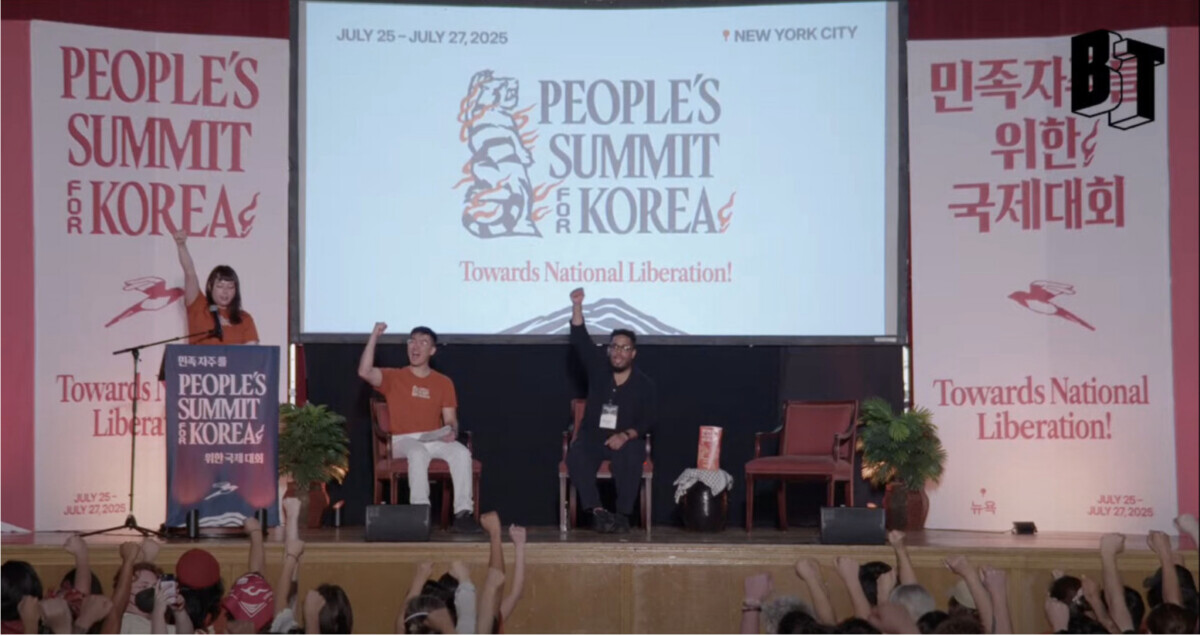
Opening ceremony of the People’s Summit for Korea (Image: BreakThrough News)
Pro-North Korean and other far-left forces in the United States were in somewhat of a “continuation” mode in 2025. They continued their Congressional lobbying, agitation/propaganda, and networking/outreach for alliance building, as well as internal education. But did not otherwise start any major new initiatives, nor make significant changes in their typical activities.
Some highlights were their struggles against impeached President Yoon Seok-yul in the months following the fiasco of his brief, failed attempt to impose martial law in December 2024. Then they mostly halted their protests after the June election brought to power a left-wing administration far more to their liking.
Only a few fanatically pro-North groups continued to condemn the new administration of President Lee Jae-myung.
Another highlight of the year was a major conference of pro-North, Marxist-Leninist, pro-terrorist, anti-American, and other extremist groups and activists in New York City, which included participants from South Korea. The event, the People’s Summit for Korea, was the largest gathering of pro-North forces in the U.S. for almost 25 years, and it clearly demonstrated the militant and extremist nature of the movement.
With the inauguration of President Donald J. Trump in early 2025, its lobbying efforts spearheaded as usual by front groups continued. But the movement took a somewhat “wait and see” approach, since it was unclear what the Trump administration’s policy with regard to the North would be.
It was noteworthy that certain leaders of hardcore groups, as well as front groups, continued to “re-educate” rank-and-file activists with regard to Kim Jong-un’s “two hostile states” policy and de-emphasis of unification announced in late 2023 and early 2024. That this effort by key pro-Pyongyang figures to explain and especially to justify the changes to their own activists and to “fellow travelers” continued in 2025, indicated that there may be lingering misunderstanding and disappointment regarding the abandonment of re-unification by Pyongyang.
The talks throughout 2024 and 2025 to promote the new policy were delivered in meetings across the U.S. by the most hardcore and openly pro-North leaders. However, at the end of 2025, Lee Jae-soo, leader of the Overseas Candlelight Action front group, also gave a talk in which he explained and justified the change. It will be interesting to see if such sessions continue.
The Korean American Public Action Committee (KAPAC) has been engaged in intensively lobbying in support of the misnamed “Peace on the Korean Peninsula Act” in the U.S House of Representatives, and plans to build further support for the bill in 2026. The bill provides major, unreciprocated, no-preconditions concessions to North Korea, and will harm U.S. national security as well as the U.S.-ROK alliance.
The group’s key leader, Choi Gwang-cheol, has announced a large KAPAC conference in Washington, D.C. this summer. It will include speeches by members of Congress who support the bill.
Choi and KAPAC are not pro-North per se, but some of the group’s advisors and active members are. In addition, the group has been allied with and participated in various events and campaigns with pro-North forces. Choi and KAPAC have very close ties to the left-wing of the ruling Democratic Party of (South) Korea (DPK), and President Lee Jae-myung. KAPAC was reportedly under investigation by U.S. authorities, apparently on the suspicion that it might be serving as an unregistered agent of the Lee government or the DPK.
Choi has held similar large KAPAC conferences in past years but held only a small press conference in 2025. Choi and others in KAPAC have been viciously smearing Korean American opponents of the bill, including Republican Congresswoman Young Kim.
At past Washington conferences, KAPAC members were dispatched in teams to lobby members of Congress and some who participated in these visits were pro-North activists.
It seems that Choi and his group plan on holding this major conference this year, because they hope and expect that the U.S. Democratic Party may win control of the House of Representatives in the 2026 midterm elections, which will potentially increase the chances of the bill passing, since it is supported almost entirely by Democrats.
Unfortunately, conservative Korean Americans who oppose the bill have not been sufficiently active in any efforts to counter KAPAC’s lobbying campaigns or alert the broader American public and Congress about its nature. Also, neither Korean conservative media nor Korean conservative politicians have made a really serious or sustained effort to warn the Korean public about it.
If the Democrats do win in 2026, KAPAC’s best friend in Congress, Democrat Brad Sherman, who introduced the bill, will play a leading role on the East Asia and Pacific Subcommittee of the House Foreign Affairs Committee.
Although based in South Korea, two pro-North leaders apparently have major plans for 2026 which involve pro-North forces in the U.S. Sohn Mee-hee, leader of the Our Schools group that supports the network of schools in Japan operated by the Pyongyang-controlled General Association of Korean Residents in Japan (known as Chongryon in Korean), announced a major plan to hold a similar conference in Seoul in 2026.
Sohn basically serves as a kind of unofficial representative of Chongyron in the South, and has indicated she intends to invite pro-North, Marxist-Leninist, pro-terrorist, and other extremist groups and activists from around the world to the upcoming event.
Also, Chung Yeon-jin, leader of the pro-North group Action One Korea, which operates in the South and in the U.S., gave a lecture in Seoul last summer in which she outlined plans for greatly increased collaboration between pro-North and other leftist forces in the two countries. She discussed her longstanding comradely relationships with Marxist-Leninist and other far-left groups and activists in the U.S., as well as new links with pro-Hamas groups and activists in the U.S. She announced plans for closer relationships with anti-Israel groups to more deeply involve them in Korean issues.
With pro-North and far-left forces in South Korea, as well as many in the ruling party, now advocating the abolition of the Korea’s National Security Law, under which North Korean spies and others who support the North and propagandize on its behalf have been prosecuted, we can expect pro-North and far-left forces in the U.S. to continue and increase their longstanding campaign against that law.
Pro-North forces surely back the Lee administration’s lifting of restrictions on public access to Pyongyang’s media. This may potentially include access to openly pro-North, anti-ROK, and racist websites in the U.S. that have until now been blocked.
Whereas in previous years, certain notorious pro-North activists in the U.S., but not all hardcore pro-North figures, have been denied entry into South Korea, it is possible that such bans could be lifted in 2026, but the extent to which such a move is implemented remains to be seen.
Under the Moon Jae-in administration, Seoul funded the pro-North Korean front group Women Cross DMZ to publish and send to Congress a report by pro-North and other far-left activists, which opposed economic sanctions and human rights pressure on the North. It is therefore possible that Lee may fund further anti-sanctions efforts by pro-North forces in the U.S., especially since Unification Minister Chung Dong-young has expressed opposition to sanctions.
A trend within South Korea after the inauguration of the Lee administration in mid-2025, which we can also expect to continue or even increase in 2026, involves departments and agencies of the government and the ruling party inviting far-left, Marxist-Leninist, and even openly pro-North foreign activists, as well as South Korean supporters of the North, to speak at government conferences.
There were several such cases in the second half of 2025, but they caused little controversy as the media mostly failed to report on them. For example, several foreign communists and supporters of the North were invited to speak at an event held at the National Assembly in August, which was hosted by the Democratic Party and pro-North groups. American communist Brian Becker, leader of the Party for Socialism and Liberation, gave a talk by video in which he defended the North and called for an end to the U.S.-ROK alliance.
In December, at an event hosted and sponsored by the governmental Peaceful Unification Advisory Council, the Overseas Korean Agency, and the Gyeonggi Province government, one of the invited speakers was the notorious pro-North, anti-U.S. activist Chung Yeon-jin, leader of the Action One Korea.
Similar incidents have occurred in the U.S. In 2018, for example, under the Moon Jae-in administration, South Korea’s Consul General in Los Angeles Kim Wan-joong attended a meeting of openly pro-North groups, and exchanged friendly greetings there with Roh Kil-nam, publisher of the pro-North, rabidly anti-American, and openly racist Minjok Tongshin website, and local communist party leaders. When this was exposed by your reporter, rather than being reprimanded, the Consul General was later promoted.
After the inauguration of the Lee administration, hardcore pro-North and anti-ROK groups, including those directly tied to the Kim Jong-un regime, such as the racist Korean American National Coordinating Council, were apparently allowed to show a film at a Consulate-run education center in Los Angeles. The film praised Chongryon. After your reporter wrote about this, the Consulate claimed it had not given permission and the film showing was moved to a different location. Precisely because these incidents were publicly exposed, the Lee administration may be more cautious in 2026.
However, Lee has abandoned caution regarding the Peaceful Unification Advisory Council. Known as “PyungTong,” this government-affiliated entity has branches and chapters across the world. As President, Lee himself is the chairman, and the executive vice-chair is a minister-level appointee. Its officials in the U.S. serve with the approval of the ROK government. It was therefore extremely concerning that the government recently approved the appointment of longtime Washington, D.C. area pro-North Korean activist Lee Jae-soo as the U.S. regional chairman, with an important supervisory role over U.S. branches.
During the Moon administration, Lee Jae-soo led the group’s D.C. area branch, but in this new role, he has a much wider area of responsibility, and will essentially be an unofficial representative of the South Korean government in the U.S. Besides leading the Overseas Candlelight Action group, Lee was also an official of the U.S. branch of the more openly pro-North, anti-American 6.15 Committee. This organization is so loyal to Kim Jong-un’s regime that in 2024 it changed its name to conform with the new “two hostile states” policy.
In the past, Lee has spread conspiracy theories denying that North Korea sank the ROK warship Cheonan. He also defended convicted sabotage planner and traitor Lee Seok-ki, but he may now try to re-invent himself as a mere “progressive” by covering up his extremist past. His appointment is a victory for pro-North forces, but it has gone unnoticed by the South Korean media.
In light of what pro-North and other leftist forces in the U.S. and the ROK have planned for 2026, and the damage which their efforts, if successful, will do to the U.S. national security, the South, the U.S.-ROK alliance, and the cause of liberty, it is essential that opponents of the Kim Jong-un regime be alert.
When the harmful nature of pro-North activities, and even the existence of pro-North forces, are denied or downplayed as irrelevant and unworthy of attention, whether by journalists, politicians, or Korea experts, such deeply misguided dismissiveness, be it well-intentioned, stubbornly arrogant, or motivated by sympathy for activists, only serves to empower and legitimize forces opposed to the U.S.-Korean alliance.
Only by anticipating what they plan for 2026, and monitoring their activities as they develop, can effective measures be taken to counter and expose them by those who cherish freedom and oppose Kim Jong-un’s dictatorship. As the old adage says, “You may not be interested in politics, but politics are definitely interested in you.” We ignore these political forces that seek to impose their will on and do serious harm to free people and free societies at our peril.
Lawrence Peck is a correspondent for NK Insider based in Seoul and Los Angeles. Having intensively researched and closely monitored the activities of pro-North Korea and other extremist groups and activists in the U.S. for over 25 years, he has been recognized in the U.S. and Korea as one of the leading American authorities on such topics, and has lectured, written extensively and been interviewed on such topics in the U.S. and Korea. He has a Bachelor of Arts degree in Political Science from the University of California, Los Angeles (UCLA) and a Juris Doctor degree from Loyola Law School of Los Angeles. He previously worked in Korea for several of the largest Korean business groups in the fields of intellectual property licensing and international business development. He also serves as an advisor to the North Korea Freedom Coalition of the U.S. Lawrence may be reached at the email address: lawrence.nkinsider@gmail.com
Latest posts by Lawrence Peck (see all)
- The threat of America’s isolationist faction and Korea’s autonomy faction to the U.S.-ROK alliance - February 25, 2026
- On Kim Jong-un’s “two hostile enemy states” theory and de-emphasis on unification policy - February 13, 2026
- Suppression of protests in Iran as viewed by pro-North Korean forces - January 24, 2026