

When will the Koreas be reunited?
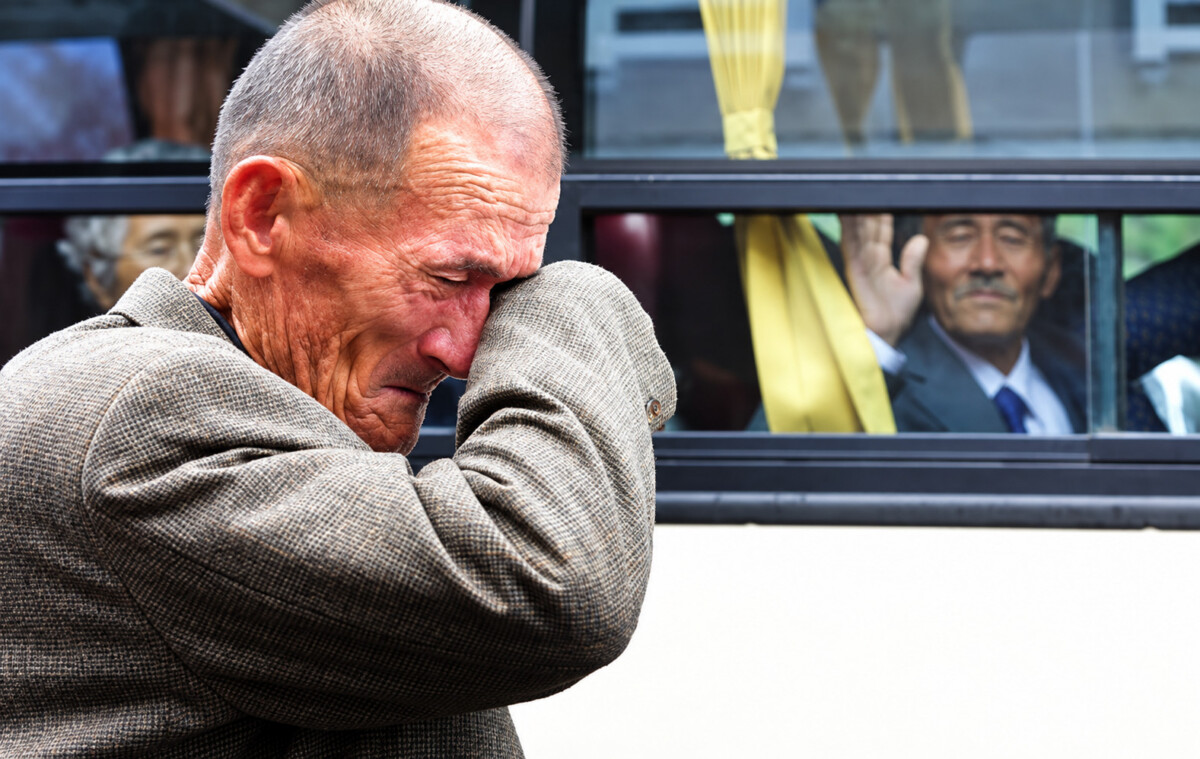
Brothers, one from South Korea and one from North Korea, say a tearful goodbye after an inter-Korean family reunion in 2010. Photo courtesy of Maeil Business Newspaper.
Whenever South Koreans meet someone from North Korea, there is one question they seem to ask, almost as if they had agreed on it beforehand:
“Do North Koreans really want reunification, too?”
The questions that follow are usually whether reunification will actually happen and, if so, when.
Even for someone like me, who lived in North Korea for so many years, these are difficult questions to answer with any certainty.
North Korea is a country whose very survival as a system often seems impossible, and yet it has endured for more than seven decades. It would not be surprising if the regime collapsed tomorrow. But neither would it be surprising if it survived in its present form for another 50 years.
North Korea has repeatedly demonstrated its ability to survive. When the Soviet Union collapsed, many expected North Korea to soon follow. Yet it has endured to this day.
So what will reunification look like when it finally comes?
At this point, it is worth looking back at the collapse of the communist regimes in Eastern Europe and the reunification of Germany. Did we foresee their collapse and reunification in advance? Did they not, too, arrive with astonishing suddenness?
I believe the same may be true of North Korea. What begins as a seemingly insignificant crack may spread beyond anyone’s control until, one day, reunification suddenly becomes a reality.
If I may venture a guess, reunification will come only when the consciousness of the North Korean people has matured enough for it to happen.
In the final years of the Soviet Union, the authorities deployed troops in an attempt to suppress citizens and prevent the collapse of communism. Tanks surrounded civilians, and the situation appeared to be on the verge of bloodshed.
But the soldiers could not bring themselves to turn their guns on their own parents, neighbors, brothers and sisters. When soldiers defied their commanders’ orders and chose for themselves where to point their weapons, the Soviet system finally collapsed.
In North Korea, the Kim family maintains a powerful grip over the military.
But I believe the moment of reunification will draw near when love for one’s own family becomes stronger than the Supreme Leader’s orders, and when human decency and reason become stronger than loyalty to a dictator.
And I believe that reunification brought about by such a change in people’s hearts would be the most ideal form of reunification.
It is difficult to call reunification achieved through war true reunification. There are no “minor sacrifices” that should simply be made for some greater cause.
Reunification of North and South Korea was a core policy that the North Korean regime upheld and emphasized throughout the era of Kim Il-sung. Those of us who were born and raised in North Korea were taught this from childhood, so it felt natural to regard reunification as something that should inevitably happen.
Recently, however, Kim Jong-un abruptly removed references to “reunification” from the North Korean Constitution. Perhaps this was because he himself had come to realize that reunification under North Korean leadership was no longer possible.
What matters to the regime is not the well-being of its people or the prosperity of the country, but solely the preservation of a hereditary dynasty now in its third generation. The pain endured by families separated between North and South, and the suffering caused by division, are of no concern to them.
My paternal grandfather was originally from South Korea.
When the Korean War broke out, he left his parents and younger siblings behind in the South and crossed into North Korea alone.
As he grew older, he would sigh with longing for his hometown and his family. Before he died, he left one final request: that he be buried in his hometown.
His children placed his remains in a grave, hoping that one day they would be able to take them back to his hometown. But 10 years passed, then 20, and there was still no meaningful change in inter-Korean relations.
After 20 years, his children, despairing that reunification would never happen in their lifetime, finally decided to cremate his remains.
Even in death, my grandfather never made it home.
My mother also escaped from North Korea, which means that, in her case, she left family behind in the North.
Half joking and half serious, she tells me that before she dies, she wants to visit her parents’ graves just once.
I do not know whether I will ever see the friends and cousins I left behind in North Korea again while I am still alive.
This is probably not just the story of my mother or my grandfather. It is the story of countless separated families, and it is the tragedy of the division of Korea itself.
How did we come to bear such a cruel fate of division?
I sincerely hope that the door to reunification will open as soon as possible, so that this immense sorrow and longing can finally be resolved.
When will that hope become reality?
Many young South Koreans today oppose reunification.
One reason is concern over the economic burden that reunification could create in the short term because of the enormous economic gap between North and South Korea.
Another is that many no longer feel that North Koreans are part of the same people.
In the eyes of young South Koreans, young North Koreans may seem as though they have completely different DNA. They listen to different music, enjoy different hobbies and aspire to different things.
Young South Koreans would probably feel far more at ease socializing with young Americans than with young North Koreans.
Another reason is that, unlike in the past, ethnic identity itself has begun to lose some of its importance. Today, people can freely cross borders and immigrate to other countries, making the question of which ethnic group one belongs to seem less important.
Now let us reverse the perspective and consider reunification not from South Korea’s point of view, but from North Korea’s.
North Korea clearly stands to gain a great deal from reunification, but not everything would necessarily be positive.
Once reunification occurs, South Korean capital would begin flowing into North Korea on a large scale. In that situation, most North Koreans would likely find themselves working as laborers or in low-skilled jobs.
Before reunification, North Koreans live within a social hierarchy made up of other North Koreans. The moment reunification occurs, however, the upper levels of that hierarchy would largely be occupied by South Koreans.
This is not merely a concern. It is a reality.
Even so, I am convinced that the synergy created when North and South Korea become one would exceed anything we can imagine.
Germany followed a similar path. Immediately after East and West Germany were reunified, the economic burden on West Germany was substantial. Yet reunified Germany went on to achieve remarkable results.
No one today would say that East Germany was merely an obstacle to building the Germany that exists now.
Likewise, it is impossible to predict in precise terms every economic and geographical advantage that would emerge if North and South Korea were reunited.
But together, the two Koreas would possess far greater potential and strength than they do apart.
For us, reunification holds a value that goes beyond economics.
And it carries with it a deeply held longing.
As the song Koreans sing on both sides of the border goes:
Our cherished hopes are for unification.
Even in our dreams, our wish is unification.
With all our hearts devoted to reunification,
Let us achieve reunification.

Born in Chongjin in 1990, Jang Mi was not a studious child, but under her mother’s influence, she graduated from high school and went on to university to take math and science. She worked as a wedding video editor for seven years until her defection in 2019.
Latest posts by Jang Mi (see all)
- When will the Koreas be reunited? - October 1, 2026
- Is the Kim family still Big Brother? - September 6, 2026
- Electricity, not slogans: What North Korean women really need - August 3, 2026