

The price of courting Kim Jong-un
Diplomacy with North Korea may be necessary for peace. But the pursuit of a dictator’s attention must never come at the expense of the dignity and freedom of his people.
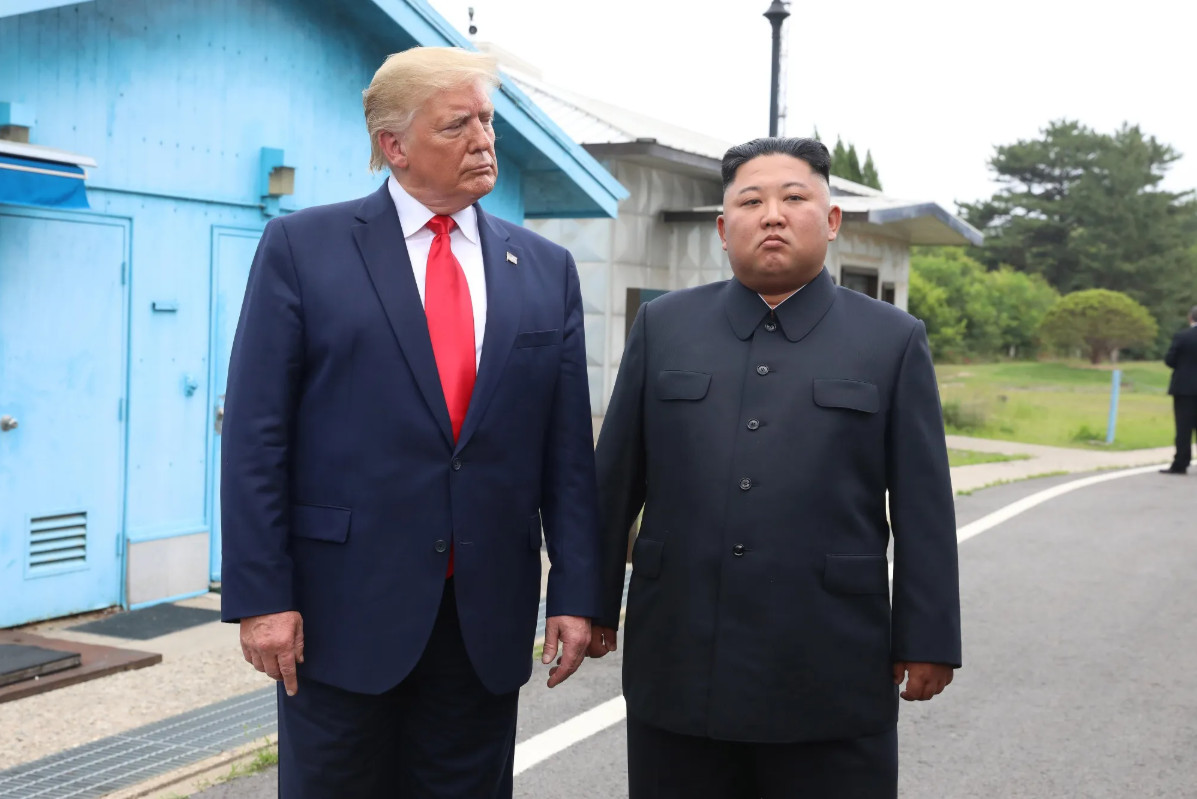
Donald Trump and Kim Jong-un at the Joint Security Area (JSA) between North and South Korea in June 2019. Source: Dong-A Ilbo/Getty Images
When Kim Jong-un introduced his young daughter to the world in November 2022, international observers began speculating about the future of North Korea’s ruling dynasty. Inside the country, however, a mother named Kim Yumi was contemplating a very different future.
For Yumi and her husband, the prospect of a fourth generation of hereditary rule meant that their children could inherit the same oppression, isolation, and ideological indoctrination that had defined their own lives. In May 2023, their family of nine risked their lives to escape North Korea by sea. They wanted their children to experience something they themselves had long been denied: freedom.
One family appeared to be preparing to pass down absolute power. Another was risking everything to ensure its children would not inherit absolute oppression.
That contrast offers an important lens through which to understand President Donald Trump’s reported efforts to reconnect with Kim Jong-un.
According to recent reporting by The Wall Street Journal, attempts to reach Pyongyang through established communication channels went unanswered, a presidential letter was returned unopened, and efforts to arrange a meeting during Trump’s November trip to Asia foundered over conditions Washington could not accept. A Trump administration official disputed the account of efforts to arrange a meeting.
Much of the coverage has framed these developments as an embarrassing diplomatic snub, particularly given Trump’s well-publicized expressions of affection for Kim during his first presidency. But the implications extend far beyond presidential pride. They concern diplomatic leverage, the moral authority of democratic leadership, and the fate of millions of North Koreans whose voices remain absent from these encounters.
Diplomacy without deference
There is nothing inherently wrong with an American president seeking dialogue with the ruler of a hostile, nuclear-armed state. Diplomacy is not conducted exclusively among friends, and preventing a catastrophic conflict on the Korean Peninsula is a responsibility no American president can afford to neglect.
Trump’s willingness to break with diplomatic conventions during his first administration opened direct channels of communication at a time of heightened military tensions. Although his three encounters with Kim did not produce a lasting denuclearization agreement, the potential value of direct engagement should not be dismissed.
But engaging a dictator is not the same as courting one. Diplomacy requires neither personal admiration nor the suspension of moral judgment.
When securing a summit begins to overshadow its substantive objectives, the balance of diplomatic leverage risks shifting. By repeatedly signaling an eagerness for a personal encounter, a democratic leader can confer political capital on an authoritarian ruler before negotiations even begin.
Kim need not dismantle a single nuclear weapon, release a political prisoner, or restore a single fundamental freedom to benefit from the spectacle of an American president seeking his attention. Even his refusal to engage can become a source of negotiating leverage.
The strategic environment has also changed considerably since the two leaders last met in 2019. North Korea has advanced its nuclear capabilities, deepened its military relationship with Russia, and become increasingly explicit in its demand for acceptance of its nuclear status.
Under these circumstances, presidential engagement is a diplomatic asset that should be exercised with clear objectives, credible expectations of reciprocity, and close coordination with democratic allies.
The success of diplomacy should be measured by what it achieves, not by whether a dictator agrees to attend.
The voices missing from the negotiating table
At a recent forum in Seoul, North Korean defectors recounted the disappearance of loved ones, the exploitation of soldiers, and the profound personal consequences of seeking information beyond the regime’s control.
Their experiences illuminate the political system that sustains North Korea’s military ambitions. A government that can mobilize its citizens without their consent, conceal the human cost of its policies, and suppress dissent without independent scrutiny can pursue military objectives while imposing extraordinary sacrifices on its population.
North Korea’s human rights crisis and the security threat posed by Pyongyang are not unrelated challenges. Both are shaped by the same concentration of unchecked power.
Yet the man who presides over this system enjoys the privilege of deciding whether to answer a call from the president of the United States, while ordinary North Koreans cannot freely make a phone call to the outside world.
That asymmetry deserves far more attention than the personal drama surrounding an unanswered presidential letter.
The domestic currency of international prestige
For authoritarian regimes, international recognition is not merely a diplomatic achievement. It can also become an instrument of domestic political control.
The 2018 Singapore summit offered a telling example. North Korea’s state-run newspaper prominently featured images of Trump and Kim shaking hands and standing side by side, celebrating the encounter while giving considerably less prominence to denuclearization.
In a country where access to independent information is severely restricted, the regime possesses extraordinary control over how such encounters are interpreted.
What Washington regards as diplomatic flexibility, Pyongyang can portray as submission. What an American president considers personal rapport, North Korean propagandists can present as international admiration. What is intended as an effort to reduce nuclear tensions can be recast as vindication of the regime’s military ambitions.
For decades, North Koreans have endured deprivation, forced labor, and the denial of fundamental freedoms under a government that invokes national security and regime survival to justify its policies. A 2025 assessment by the United Nations Human Rights Office documented a further deterioration of human rights, including intensified surveillance and harsher punishments for accessing unauthorized foreign information.
International prestige can furnish the regime with another justification for the sacrifices it imposes on its people. If nuclear weapons and political intransigence appear to command the attention of the world’s most powerful democracy, the regime gains material with which to portray its policies as successful and its demands for further sacrifice as necessary.
This does not mean diplomatic engagement inevitably produces greater repression. It means that its propaganda value and potential domestic consequences cannot responsibly be ignored.
The implications extend beyond North Korea. Other authoritarian rulers may draw their own lessons from diplomatic encounters that confer international prestige without securing meaningful concessions.
Democratic leaders must therefore consider not only what their gestures communicate across the negotiating table, but also how those gestures might be exploited by the governments on the other side.
The responsibility of democratic leadership
The president of the United States represents more than the military and economic power of his country. The office also carries a responsibility to uphold the principles that distinguish democratic societies from authoritarian regimes: individual liberty, human dignity, accountability, and respect for fundamental rights.
That responsibility does not disappear when confronting dictators. It becomes especially important when engaging them.
The leader of the free world should exemplify the freedoms that authoritarian rulers deny their citizens. Presidential diplomacy should not become a vehicle for personal admiration or political spectacle at the expense of those principles.
A serious approach to North Korea can pursue verifiable limits on nuclear and missile activities while maintaining pressure for human rights improvements. It can establish diplomatic communication while supporting independent information flows. It can explore security guarantees without granting moral absolution to those responsible for systematic repression.
Not every nuclear negotiation needs to resolve every human rights violation. Nor should the pursuit of immediate security objectives be held hostage to the resolution of decades of injustice. But silence on human rights should not become the price of admission to the negotiating table.
Engagement with North Korea must also extend beyond engagement with its ruler. North Korean escapees, human rights defenders, independent media organizations, and families separated by the regime offer indispensable insights into a country whose government works relentlessly to prevent its people from being heard.
A durable vision of peace must account for their aspirations, not merely the security interests of the government that silences them.
Two families, two futures
When Kim Jong-un presented his daughter to the world, international observers saw a potential successor. Kim Yumi saw the possibility that her own children would spend their entire lives under another generation of dictatorship.
Her family’s escape was an act of extraordinary courage, but the aspiration behind it was remarkably ordinary: that their children might grow up free to think, speak, dream, and determine their own futures.
No parent should have to risk death to secure such fundamental freedoms for their children.
The ultimate purpose of diplomacy on the Korean Peninsula should be to build a peace in which North Koreans, too, can live without fear. A handshake with Kim Jong-un may help advance that objective, but it must never become a substitute for it.
Kim Jong-un may refuse to answer the American president’s calls. But the democratic world must not allow its pursuit of his attention to drown out the voices of the people he refuses to let speak.
Their calls for freedom have gone unanswered for far too long.

Seongmin is the director of the Korea Desk at the Human Rights Foundation (HRF).
Latest posts by Seongmin Lee (see all)
- The price of courting Kim Jong-un - November 24, 2026
- Tyranny Tracker: identifying authoritarianism, illuminating freedom - March 10, 2026
- Exclusive: Documents and personal items found on the body of a North Korean soldier in Kursk Oblast region (1) - January 10, 2025