

Pyongyang moves to shut Swiss office as it builds bridges to Moscow and Beijing
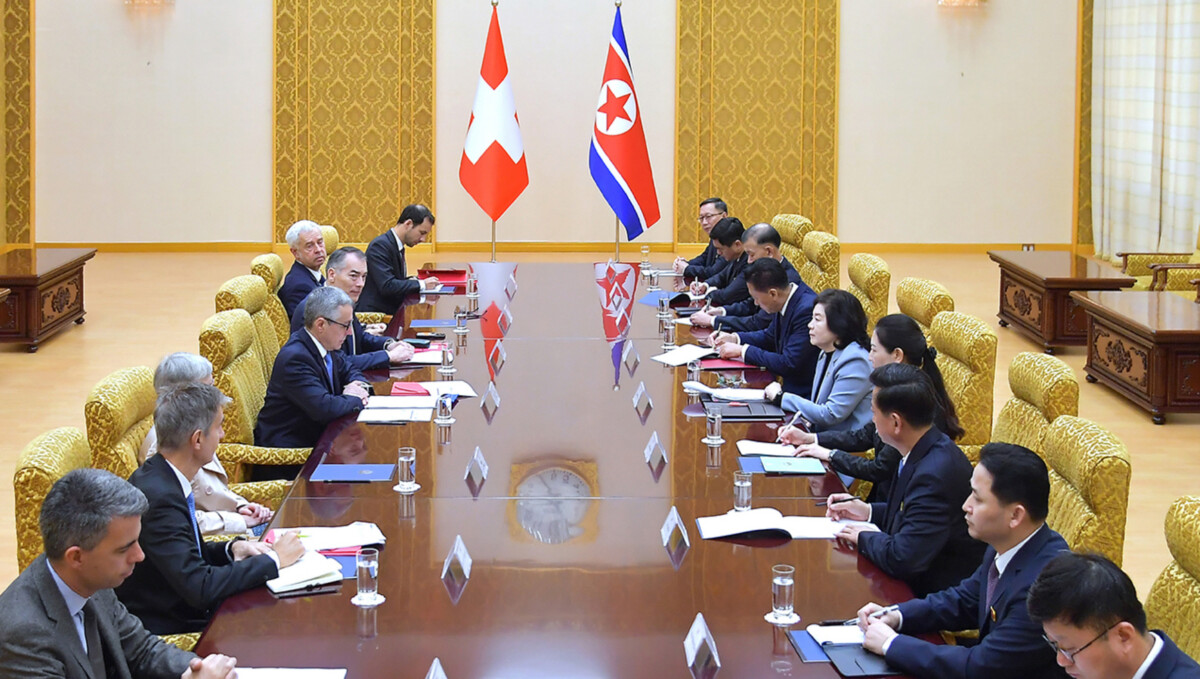
North Korean Foreign Minister Choe Son-hui (fifth from right) meets her Swiss counterpart, Ignazio Cassis (fourth from left), in Pyongyang on Oct. 30. Image: KCNA.
Kim Yo-jong, the powerful sister of North Korean leader Kim Jong-un, issued Switzerland a blistering rebuke on Tuesday after Bern joined the European Union and Britain in sanctioning a North Korean children’s camp over its alleged involvement in the transfer of children from Russian-occupied areas of Ukraine.
Kim, a senior ruling party official, accused the Swiss of sending “a treacherous and hostile signal,” describing their action as a “dirty act” and an example of “diplomatic duplicity.”
She called for a comprehensive reassessment of relations with Switzerland and said she would recommend that the Foreign Ministry consider withdrawing the Swiss diplomatic office from Pyongyang within days.
The confrontation escalated on Wednesday, when North Korea ordered the head of the Swiss diplomatic office to leave within 48 hours and demanded that Bern close the newly reopened facility.
It was a dramatic turn in relations, particularly given that Swiss Foreign Minister Ignazio Cassis had visited Pyongyang less than a month earlier to mark the reopening of Switzerland’s diplomatic office.
Formal diplomatic relations date back to 1974, and Switzerland would later become the country where Kim Jong-un received part of his education. It also hosted the 1994 U.S.-North Korea negotiations that produced the Agreed Framework and the Four-Party Talks on the Korean Peninsula in the late 1990s. Whenever Pyongyang needed to engage with the Western world, neutral Switzerland offered a valuable diplomatic channel.
At the heart of the current dispute lies the Songdowon International Children’s Camp in the east coast city of Wonsan.
Extensively modernized in 2014 at Kim Jong-un’s direction, the facility boasts swimming pools, waterslides and even an aquarium, making it one of the country’s flagship showcases for international visitors.
Since the outbreak of the war in Ukraine, however, the camp has attracted international attention for an entirely different reason.
At a U.S. Senate hearing in December 2025, concerns were raised that Ukrainian children from Russian-occupied territories had been sent to North Korea. Subsequent investigations identified at least two Ukrainian children who had been transferred to the Songdowon camp.
The European Union determined that the facility had been involved in transferring Ukrainian children, exposing them to pro-Russian ideological indoctrination and providing militarized education.
Britain placed the camp on its sanctions list in May this year, followed by the EU in September.
Against this backdrop, Foreign Minister Cassis visited Pyongyang on Oct. 29-30, marking the first visit to North Korea by a member of the Swiss Federal Council in 23 years.
Just weeks later, Bern joined the EU in imposing sanctions on Songdowon.
In portraying the move as an act of diplomatic betrayal, Kim Yo-jong invoked the UN Convention on the Rights of the Child, accusing Switzerland of violating children’s rights to participate in cultural activities and enjoy leisure and recreation.
Conspicuously absent from her statement, however, was any explanation of the circumstances under which Ukrainian children had ended up in North Korea.
The dispute appears to reflect some of the same strategic calculations behind Pyongyang’s recent lukewarm response to U.S. President Donald Trump’s efforts to arrange another summit.
Ahead of his Asian tour, Trump explored the possibility of meeting Kim Jong-un, but Pyongyang showed little interest.
This was a far cry from 2018, when Kim sought to elevate his international standing and secure sanctions relief through direct negotiations with the American president.
The war in Ukraine has fundamentally altered North Korea’s diplomatic calculus. Russia has come to depend on North Korean weapons and troops, while Pyongyang has gained a new avenue for acquiring military technology and economic assistance.
In 2022, Russia and China vetoed a UN resolution seeking additional sanctions against North Korea. In 2024, Russia went a step further, blocking the renewal of the mandate of the UN panel of experts responsible for monitoring the implementation of sanctions against Pyongyang.
Particularly revealing is the fact that North Korea has threatened to sever ties with a Western country not over sanctions targeting its own nuclear and missile programs, but over measures directed at Russia.
This illustrates just how important relations with Moscow have become to Pyongyang — a strategic partnership it is increasingly unwilling to compromise for the sake of maintaining diplomatic ties with the West.

Taesung offers informed perspectives on North Korean society, grounded in years of experience within a key state-run institution. After defecting to South Korea in 2024, he now focuses on providing analysis of the country.
Latest posts by Kim Taesung (see all)
- Pyongyang moves to shut Swiss office as it builds bridges to Moscow and Beijing - November 25, 2026
- Kim rolls out red carpet, signals he can do diplomacy without Trump - November 25, 2026
- North Korea’s weapons arsenal under one roof: Inside its new Defense Revolution Museum - November 3, 2026