

Kim rolls out red carpet, signals he can do diplomacy without Trump
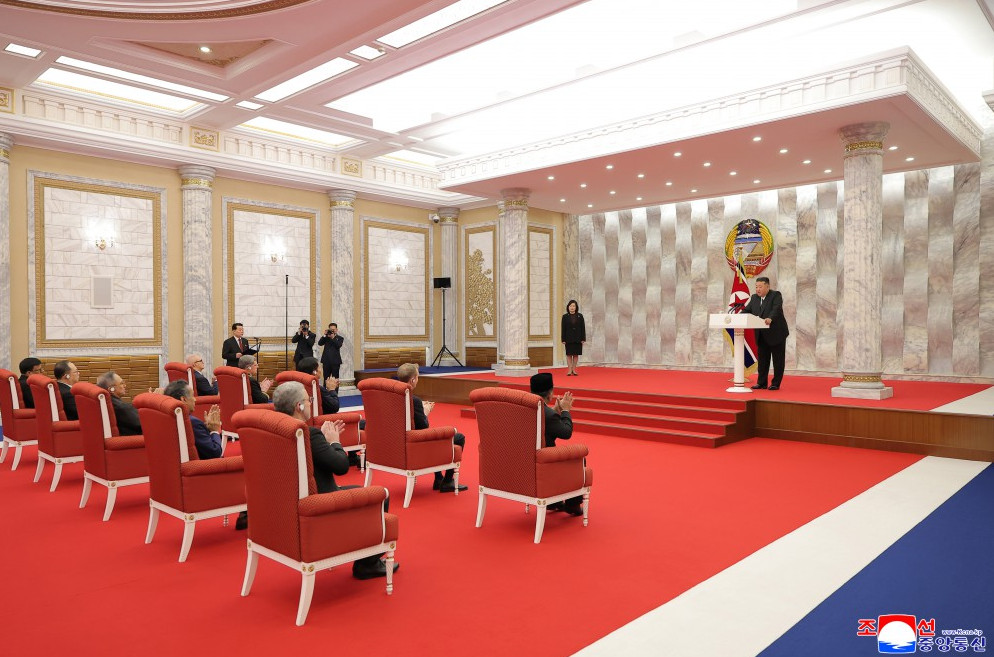
Kim Jong-un receives foreign ambassadors at a ceremony at the headquarters of the Central Committee of the ruling Workers’ Party of Korea. Image: KCNA.
A diplomatic credentials ceremony in Pyongyang on Nov. 22, at which Kim Jong-un personally received foreign envoys, highlighted the North Korean leader’s efforts to project the image of a normal state with newfound diplomatic confidence.
Ten newly appointed ambassadors sat below the podium inside a ceremonial hall adorned with marble columns, elaborate chandeliers and a red carpet. Red upholstered armchairs were arranged at regular intervals, while North Korea’s national emblem and flag occupied prominent positions at the front of the hall.
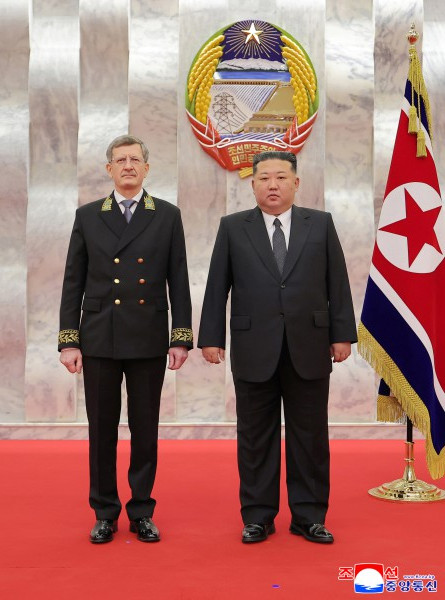
One by one, the envoys presented their credentials to Kim, president of the State Affairs Commission, before posing for commemorative photographs.
Even more intriguing was the timing. The ceremony took place just three days after U.S. President Donald Trump concluded his Asian tour, meeting Chinese President Xi Jinping and Russian President Vladimir Putin but failing to secure a meeting with Kim.
Image: Andrei Podelyshev, the new Russian ambassador to North Korea, poses with Kim Jong-un.
Against this backdrop, The Wall Street Journal interpreted the ceremony as an attempt by Kim to demonstrate that he could establish himself as a leader on the international stage without a summit with the American president.
It was the first time Kim had personally received credentials from foreign ambassadors. While his grandfather, Kim Il-sung, personally received new envoys until his death in 1994, his father, Kim Jong-il, who died in 2011, delegated the task to the chairman of the Standing Committee of the Supreme People’s Assembly, who served as the nominal head of state in external affairs.
It was neither a military ceremony nor a party congress. It was a diplomatic ritual routinely observed around the world. In North Korea, however, the occasion carried particular political significance: It marked the return of the supreme leader personally receiving diplomatic credentials for the first time in more than three decades.
Even more intriguing was the timing. The ceremony took place just three days after U.S. President Donald Trump concluded his Asian tour, meeting Chinese President Xi Jinping and Russian President Vladimir Putin but failing to secure a meeting with Kim.
Against this backdrop, The Wall Street Journal interpreted the ceremony as an attempt by Kim to demonstrate that he could establish himself as a leader on the international stage without a summit with the American president.
It was the first time Kim had personally received credentials from foreign ambassadors. While his grandfather, Kim Il-sung, personally received new envoys until his death in 1994, his father, Kim Jong-il, who died in 2011, delegated the task to the chairman of the Standing Committee of the Supreme People’s Assembly, who served as the nominal head of state in external affairs.
Kim continued his father’s practice. But following a constitutional amendment in March granting the president of the State Affairs Commission authority to receive diplomatic credentials, Kim exercised that power for the first time on this occasion.
The composition of the participating countries was equally noteworthy.
The gathering brought together North Korea’s traditional partners Russia and Vietnam, as well as Sweden and the Czech Republic, both NATO members, alongside Indonesia, Brazil, India, the Philippines, Thailand and Bangladesh.
Kim’s remarks to the assembled diplomats were equally revealing.
“The Democratic People’s Republic of Korea seeks neither hegemony nor expansion,” Kim declared. “High-handedness and coercion have no place in the foreign policy of the DPRK.”
The remarks are particularly striking given North Korea’s deepening military cooperation with Russia and its continued expansion of its nuclear and missile capabilities.
The terms “hegemony,” “expansion” and “coercion” also echo the diplomatic vocabulary frequently employed by China and Russia in their criticism of the U.S.-led international order.
Kim went on to emphasize that North Korea’s security environment demanded the “strength and capabilities” necessary to ensure security and confidence in peace.
Interestingly, neither the United States, South Korea nor nuclear weapons were explicitly mentioned in the speech.
Yet the underlying rationale Pyongyang has long used to justify its nuclear buildup remained intact: North Korea argues that its military expansion is not intended to threaten other countries or pursue territorial expansion, but represents the legitimate exercise of a sovereign state’s right to self-defense.
The speech can thus be read as an attempt to justify North Korea’s possession of nuclear weapons through the language of international diplomacy — without explicitly mentioning nuclear weapons themselves.
Kim did not pledge to develop relations with all countries unconditionally.
Rather, he expressed his willingness to strengthen friendship and cooperation with “all countries that respect our sovereignty and are friendly toward us.”
This conditional approach to diplomatic engagement became even more apparent just two days later in a statement by his powerful sister, Kim Yo-jong.
Following Switzerland’s imposition of sanctions on North Korea’s Songdowon International Children’s Camp over its alleged involvement in Russia’s transfer of Ukrainian children, Kim Yo-jong raised the possibility of closing the Swiss diplomatic office in Pyongyang.
Another striking feature of the photographs released by KCNA was the venue itself and the arrangement of the ceremonial space.
The ceremony took place not at the Foreign Ministry or a facility associated with the Supreme People’s Assembly, but at the headquarters of the Central Committee of the Workers’ Party of Korea.
The national emblem and flag — symbols of the state — were displayed at the heart of the ruling party’s headquarters, where Kim received foreign diplomats in his capacity as head of state.
The red carpet, upholstered armchairs, elevated podium, individual presentation of credentials and commemorative photographs were all visual devices designed to underscore both the dignity of the state and the authority of its supreme leader.
While the diplomatic ceremony adopted the conventions of a normal sovereign state, its venue and spatial arrangement reflected North Korea’s distinctive power structure, in which authority is concentrated in the ruling party and the supreme leader.
With Russia as a military patron, China as an economic lifeline, and the diplomatic backing of two permanent members of the United Nations Security Council, North Korea now has a wider range of diplomatic options than it once did.
Of course, receiving the credentials of 10 foreign ambassadors does not mean that North Korea’s international isolation has ended or that economic sanctions have been lifted.
Nevertheless, the ceremony can be interpreted as part of an active effort to cultivate the image of a country capable of conducting normal interstate diplomacy without waiting for relations with Washington to improve.
What Pyongyang seeks may not be recognition as a normal state through denuclearization, but rather acceptance and treatment as a normal state by the international community while retaining its nuclear weapons.
A summit with Trump did not take place. Yet Kim rolled out the red carpet in Pyongyang and opened a diplomatic stage of his own. Perhaps that was precisely the message he intended to convey.

Taesung offers informed perspectives on North Korean society, grounded in years of experience within a key state-run institution. After defecting to South Korea in 2024, he now focuses on providing analysis of the country.
Latest posts by Kim Taesung (see all)
- Pyongyang moves to shut Swiss office as it builds bridges to Moscow and Beijing - November 25, 2026
- Kim rolls out red carpet, signals he can do diplomacy without Trump - November 25, 2026
- North Korea’s weapons arsenal under one roof: Inside its new Defense Revolution Museum - November 3, 2026