

Why doesn’t South Korea support a North Korean government-in-exile?
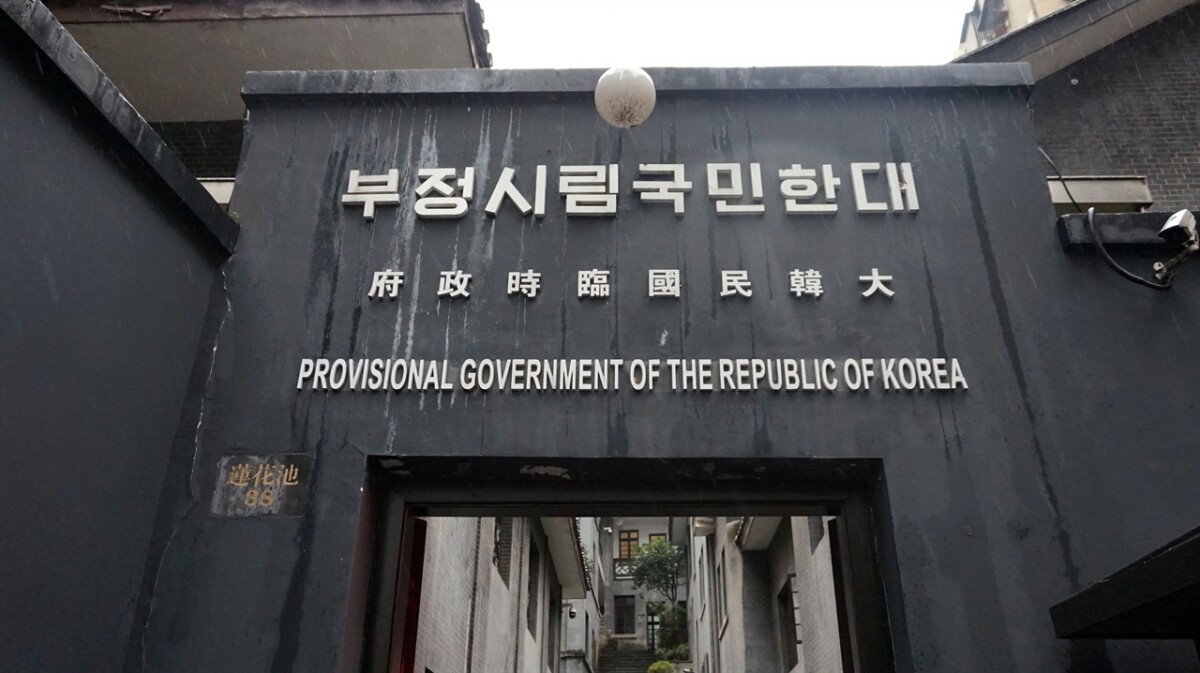
The final headquarters of the Provisional Government of the Republic of Korea, located in Chongqing, China. Image courtesy of Hwang Seok-hyun.
Why does Seoul not encourage North Korean defectors living in the South or in friendly countries to establish a government-in-exile?
To those familiar with the two Koreas, the answer is obvious. But before we get to it, let us consider the question, for it is one worth asking.
It is not as if the talent is not there. Among the tens of thousands of North Koreans living in the South, many have firsthand experience of the regime in Pyongyang. They include former diplomats, military officers, government officials and party cadres. Some occupied positions of considerable responsibility before fleeing.
Given South Korea’s commitment to reunification and the liberation of North Koreans from dictatorship, why has Seoul never seriously encouraged them to form a political alternative in exile?
The benefits would seem considerable. Such a body could give political expression to the 25 million North Koreans who have no meaningful say in how their country is governed. It could develop a democratic alternative to the Kim dynasty, articulate a vision for a free North Korea and provide a focal point for North Koreans inside and outside the country who want political change.
More importantly, it could be recognized by South Korea and, potentially, by those among its allies that do not have diplomatic relations with Pyongyang, notably the United States and Japan. This would give it an international standing that even coalitions of individual defector organizations cannot hope to achieve.
It would also provide a ready-made political institution should the regime in Pyongyang collapse or undergo fundamental change. Rather than having to improvise a political leadership in the middle of a crisis, the international community would have an established body with which to engage.
The answer to why Seoul has never seriously pursued the idea is that, constitutionally, it has little room to do so. It already considers itself the legitimate government of the entire Korean Peninsula.
Article 3 of the South Korean Constitution states that the territory of the Republic of Korea consists of the Korean Peninsula and its adjacent islands. Article 4 commits the country to pursuing peaceful unification based on the basic free and democratic order. In other words, South Korea does not regard North Korea as a foreign country whose government it can simply oppose by establishing an alternative administration. Its constitutional position is that the Republic of Korea is the legitimate government of the entire peninsula, even though it does not exercise effective control over the northern half.
Officially recognizing another government claiming to represent North Koreans would therefore be a remarkable contradiction.
But things change, and there is a good reason to raise this issue now. In January 2024, Kim Jong-un explicitly rejected reunification as a national objective and called for references to it to be removed from North Korea’s Constitution. The revised Constitution, made public in May this year, confirmed the change and formally defined North Korea’s territory as separate from the South.
Assuming Pyongyang maintains this position, Seoul’s claim will inevitably come under pressure. Right now, democratic South Korea insists that North Koreans are its citizens and that their territory belongs to it, while the people who govern them reject that proposition and the very idea of a common national future.
It is difficult to see how this arrangement can remain politically sustainable forever. At some point, South Korea may have to confront the possibility that its own constitutional and political position needs to change. And when that happens, might Seoul finally consider encouraging a government-in-exile committed to the creation of a future democratic and free North Korea?
There is, in fact, already an administrative structure in South Korea that makes some acknowledgment of its claim to the North. The Five Northern Provinces Administration, operating under the Ministry of the Interior and Safety, is, however, a throwback to an earlier administrative map. North Korea now has nine provinces, having divided several of the five historical provinces into separate administrative units.
Seoul also appoints provincial governors, as well as honorary mayors and county heads, ostensibly representing the towns and districts that remain beyond its control. These appointments serve a symbolic purpose, preserving the idea that the division of the peninsula is temporary and that these territories remain part of the Republic of Korea.
The arrangement has little to do with developing a political leadership among North Korean defectors or preparing them to assume responsibility for governing a future North Korea. Indeed, the institution belongs to an older conception of unification in which the North is essentially territory awaiting recovery by the South, rather than a society whose people might themselves develop a political vision and leadership.
There is an interesting historical irony here. Korea itself had a government-in-exile during the Japanese occupation of 1910-1945. Established in Shanghai on April 11, 1919, the Provisional Government of the Republic of Korea worked to restore Korean independence. It operated for 27 years, moving between locations in China, and became an important symbol of the independence movement, even though it never secured formal diplomatic recognition as the government of Korea.
The historical comparison is particularly interesting because of the continuing argument in South Korea over when the country was founded. Much of the political left regards 1919, when the Provisional Government was established, as the true birth of modern Korea. The right, meanwhile, places greater emphasis on August 15, 1948, when the Republic of Korea was formally established as a separate state in the South. The latter is the date officially recognized as the establishment of the present-day government. Yet the current Constitution explicitly acknowledges the Provisional Government’s legacy in its preamble, describing the Republic as upholding the cause of the government born out of the March 1 Independence Movement of 1919.
In other words, South Korea owes an important part of its own political legitimacy to a government-in-exile. It is therefore somewhat surprising that the idea of helping North Koreans establish a similar institution has attracted so little serious consideration.
It is not that nobody has tried. In March 2019, a group known as Cheollima Civil Defense, which subsequently adopted the name Free Joseon, declared the establishment of a provisional government for a future North Korea. It described itself as the legitimate representative of the people of the North and promised to work toward a country founded on human rights and humanitarian principles. Other groups of North Korean defectors and activists have also explored the idea of establishing a government-in-exile, including initiatives involving defectors based in the United States.
But these efforts have struggled to gain credibility. Some have been highly secretive, others have suffered from internal disagreements, and most have operated from third countries without the political legitimacy or institutional support that recognition by South Korea would bring.
Of course, there are good reasons for Seoul to be cautious. Supporting such an organization would antagonize Pyongyang, complicate relations with China and potentially increase the dangers faced by North Koreans and their relatives. It would also raise difficult questions about who has the authority to represent the people of the North. Defectors, however courageous or well-connected, cannot automatically claim a mandate from a population that has never been allowed to vote freely.
Nevertheless, these are arguments for proceeding carefully, not necessarily for refusing to consider the idea at all. A government-in-exile need not claim an immediate right to govern. It could begin as a representative political institution, bringing together defectors, former officials, human rights advocates and others committed to a democratic future. Its purpose would be to keep alive the possibility that North Korea’s future need not belong to the Kim family.
South Korea has spent decades preparing, at least rhetorically, for the eventual reunification of the peninsula. But perhaps it should also prepare for a different possibility: that North Korea will remain a separate state under an authoritarian government, while the people who have escaped it seek to build a political alternative.
If Seoul eventually abandons its claim to govern the North, what will it do with the millions of people who remain trapped under the Kim dynasty? Perhaps the time will come when the most meaningful expression of South Korea’s commitment to a free North Korea will not be to claim its territory, but to help its people find a political voice.

Hae-song is a Seoul-based analyst and writer on North and South Korean affairs. Having grown up overseas, he has lived his working life in South Korea where he consults on South Korean political and economic issues and on North Korea and defector related issues.
Latest posts by Jun Hae-song (see all)
- Why doesn’t South Korea support a North Korean government-in-exile? - November 24, 2026
- Kim Jong-un dies again: Reflections on the insatiable appetite for North Korean rumors - October 26, 2026
- Resolute, denuclearization, blah blah…. North Korea has heard this before - September 23, 2026