

North Korea rejects denuclearization and broadens the Indo-Pacific confrontation
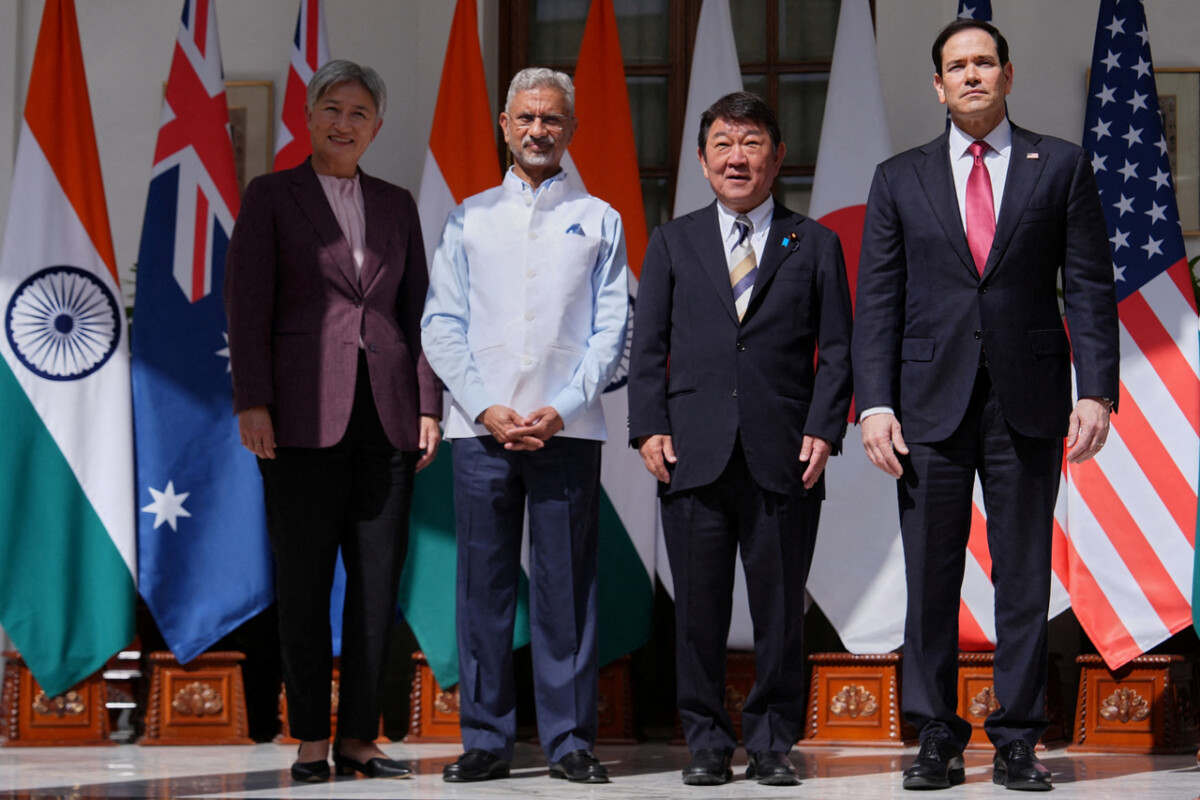
From left: Australian Foreign Minister Penny Wong, Indian External Affairs Minister Subrahmanyam Jaishankar, Japanese Foreign Minister Toshimitsu Motegi, and U.S. Secretary of State Marco Rubio pose before a Quad ministerial meeting in New Delhi on May 26. (Yonhap-Reuters)
North Korea has sharply condemned the Quad grouping of the United States, Japan, Australia and India, using a recent joint statement by the four countries to reiterate its rejection of denuclearization and frame the issue as part of a broader struggle against what it calls U.S.-led bloc politics in the Indo-Pacific.
The Korean Central News Agency (KCNA) reported on May 28 that a spokesperson for North Korea’s Foreign Ministry criticized the joint statement issued after the Quad foreign ministers’ meeting in New Delhi on May 26.
The statement “seriously distorted” the security challenges facing the Asia-Pacific region and exposed “hostile intent” toward specific countries, the spokesperson said.
The immediate trigger was the Quad’s reaffirmation of its commitment to the complete denuclearization of North Korea in accordance with United Nations Security Council resolutions.
The statement also urged Pyongyang to comply with those resolutions, condemned its ballistic missile and weapons programs as illegal, and expressed concern that North Korea’s cyber activities and overseas IT worker operations are helping fund prohibited weapons development.
Pyongyang reacted most strongly to the reference to denuclearization.
The Foreign Ministry spokesperson accused the Quad, led by the United States, of challenging North Korea’s “legitimate exercise of sovereign rights” under the pretext of denuclearization and described the grouping as a “political and diplomatic tool” serving U.S. ambitions for global dominance.
“We make it clear once again: there will absolutely and eternally be no ‘denuclearization’ of the Democratic People’s Republic of Korea,” the KCNA report quoted the spokesperson as saying.
The statement is consistent with North Korea’s long-term effort to entrench its status as a nuclear-armed state.
In recent years, Pyongyang has embedded its nuclear doctrine in law and constitutional provisions, redefining denuclearization not as a negotiating objective but as a question of regime survival and national sovereignty. At the United Nations in 2025, North Korea argued that demands to abandon its nuclear arsenal were effectively demands to surrender its sovereignty.
Pyongyang’s latest response appears to serve three strategic purposes.
First, it seeks to remove denuclearization from any future negotiating agenda. By accusing the Quad of promoting “bloc confrontation” while claiming to support regional stability, Pyongyang is signaling that it will reject dialogue frameworks premised on denuclearization. This assessment aligns with comments made by Singaporean Foreign Minister Vivian Balakrishnan following visits to both Koreas in May, when he observed that North Korea appeared focused on self-reliance and military deterrence rather than diplomatic engagement with the United States, South Korea or Japan.
Second, Pyongyang is attempting to reframe the North Korean nuclear issue as part of wider U.S.-China strategic competition. The Foreign Ministry spokesperson criticized the Quad’s positions on the South China Sea and East China Sea, claiming they were intended to justify Japan’s military expansion and Australia’s acquisition of nuclear-powered submarines. The spokesperson also attacked the Quad’s critical minerals initiative, portraying it as an effort by Washington to extend security competition into the economic sphere and dominate global supply chains.
The criticism reflects the Quad’s increasingly broad agenda. In New Delhi, the four countries announced cooperation in areas including critical mineral supply chains, maritime security, energy security and infrastructure development in the Pacific.
Third, North Korea is using the Quad issue to reinforce its alignment with China and Russia. By portraying the Quad as a U.S.-led “sub-alliance,” Pyongyang is positioning itself alongside Beijing and Moscow in opposition to what it characterizes as U.S.-led bloc confrontation. The strategy complements expanding North Korea-Russia military cooperation and its continuing efforts to strengthen strategic ties with China.
North Korea’s response highlights several challenges for the Quad and its partners.
Besides rejecting denuclearization as a legitimate subject for negotiation and recasting it as a hostile attempt to undermine its sovereignty, North Korea is linking its nuclear and missile programs to a broader Indo-Pacific security agenda encompassing cyber threats, maritime security, economic resilience and supply-chain competition.
At the same time, Pyongyang may seek to exploit differences among Quad members. Unlike a formal military alliance, the Quad remains a consultative framework whose members maintain varying strategic priorities. India, in particular, continues to emphasize strategic autonomy. By depicting the Quad as merely an instrument of U.S. policy, North Korea appears intent on testing those internal fault lines.
Yet Pyongyang’s argument also relies on selective interpretation. While the Quad statement addressed North Korea’s nuclear and missile programs, it also focused extensively on maritime security, development cooperation, energy security and supply-chain resilience. North Korea highlighted only those sections directed at its own activities while portraying the entire grouping as an instrument of “U.S. unipolar domination.”
This reflects a familiar pattern in North Korean messaging. Rather than engaging with denuclearization as a legal and security issue, Pyongyang reframes the debate as part of a broader struggle against U.S. hegemony, a narrative designed for both domestic and international audiences.
The significance of the May 28 statement lies in the fact that North Korea increasingly views the Quad itself as a strategic challenge.
In the past, Pyongyang’s criticism focused primarily on U.S.-South Korea military exercises, trilateral cooperation among Seoul, Washington and Tokyo, UN sanctions, and G7 statements. By directly targeting the Quad, North Korea is acknowledging the grouping’s growing role as an Indo-Pacific platform addressing not only China-related concerns but also North Korea’s nuclear ambitions, cyber operations and economic-security issues.
Ultimately, the statement should be viewed as more than a routine diplomatic protest. It represents a broader political message combining North Korea’s determination to preserve its nuclear status with its opposition to emerging U.S.-led security frameworks.
By declaring that denuclearization will “absolutely and eternally” never occur while simultaneously condemning the Quad as an instrument of U.S. hegemony, Pyongyang is signaling that recognition of its nuclear status, sanctions relief, military deterrence and closer ties with China and Russia will remain higher priorities than any return to denuclearization negotiations.
For the Quad and its partners, the central challenge is that North Korea is no longer treating its nuclear issue as a narrowly Korean Peninsula problem. Instead, it is placing the issue within the wider context of Indo-Pacific strategic competition and portraying regional multilateral cooperation as evidence of hostile bloc politics.

Taesung offers informed perspectives on North Korean society, grounded in years of experience within a key state-run institution. After defecting to South Korea in 2024, he now focuses on providing analysis of the country.
Latest posts by Kim Taesung (see all)