

The value of a being a Party member
(Part Two)
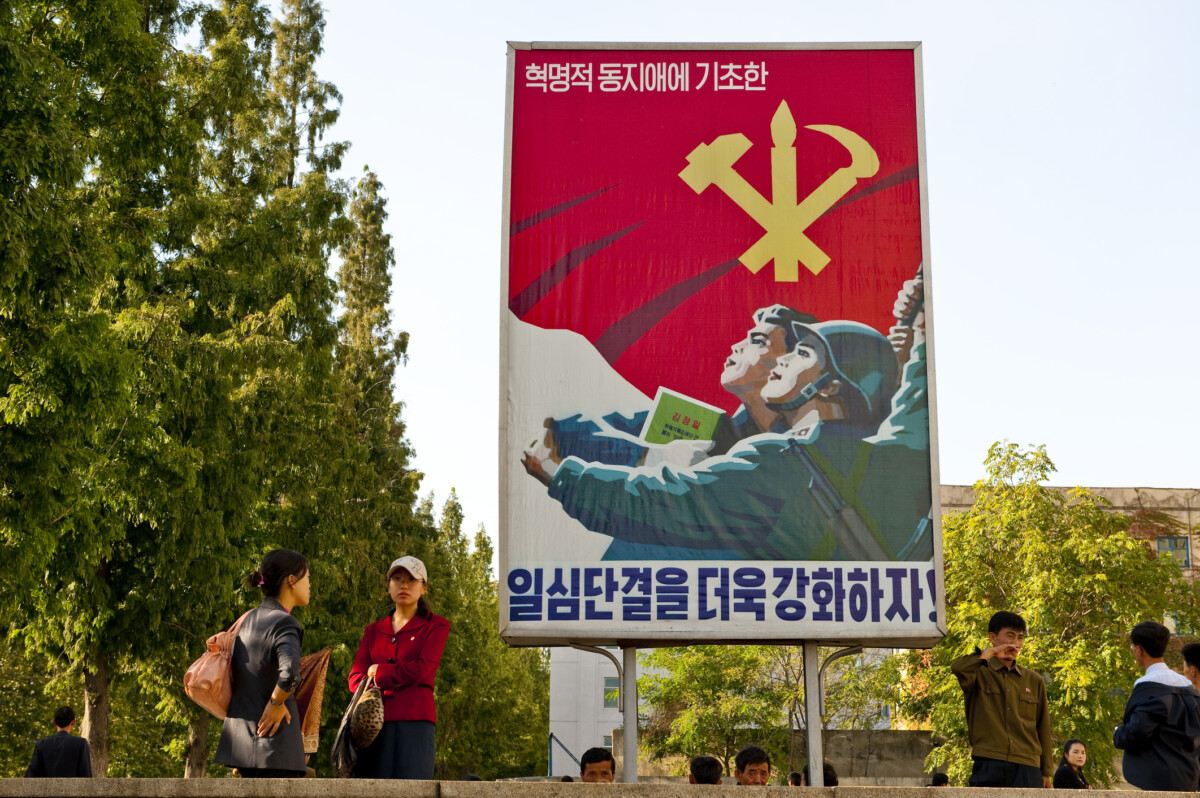
“Let us further strengthen the single-hearted unity based on revolutionary comradeship.” (Image: iStock/Tarzan9280)
The most important factor for advancement is never ability or loyalty. It is family background.
If your parents worked in the security services, you will one day become a security official.
If your parents were Party officials, you will become Party cadres and act arrogantly.
The children of miners or farmers also inevitably repeat their parents’ lives. Even though they may have worked harder than anyone else to try and escape their fate, what they eventually face is a life identical to that of their parents.
Only in their fifties do they slowly realize their efforts were in vain. That is when they hear their own children bitterly declare they will never live like them, and remember it is what they once said to their own parents.
North Korea today has a worse system of advancement than in the past. Even centuries ago in the Goryeo and Joseon dynasties, there were opportunities for a person to change their status. For example, hunting competitions and the civil service exams allowed a lowly person to become a military or civil official.
But in today’s North Korea, no such opportunities exist. The only way to be promoted to a cadre post is to be recommended. But this system creates serious problems.
Incompetent people occupy key posts, leading the country’s political and economic systems to ruin. The system fosters corruption and destroys moral standards. Bribes are openly exchanged for promotions, undermining the law itself.
With the rules thus weakened, people compromise with injustice, submit to authority, and flatter those with power.
The sight of an elderly, white-haired man bowing to a young cadre is shameful for a nation that calls itself the “land of courteous people in the East.”
If you want an example just look at media photos of an aged general kneeling before the teenage Kim Ju-ae. When the leader encourages such behavior, why would cadres hesitate to imitate it?
With the reward system broken, do people still desire the badge of Party membership? Let’s examine the reward system again. Rewards can be material or psychological. Under Kim Jong-il, hereditary power destroyed material rewards, but psychological rewards remained.
Not just anyone could become a Party member. No matter how much money someone had, without enduring hardships like military service, admission was impossible.
Even Kim Jong-un was not exempted. To become the Party’s leader, he had to join the Party, and for that he too had to serve in the army.
Of course, no one ever saw him actually serve. But through propaganda, citizens heard endlessly about his bravery and genius in artillery units. This showed how strict and demanding the conditions for Party admission were.
The title of “chosen ones who passed the harsh conditions” gave even those living miserable lives in shabby rooms a sense of pride.
But after he became the leader, even this psychological reward system began to collapse.
In 2012, the Party introduced the following slogan: “The powerful with power, the wealthy with money. Rear-area work is also political work.”
Soon, people who were able to donate large sums to the state were being awarded Party membership cards. That was the moment membership became a means of getting rich.
The state even publicized this. University students began to flood into the Party. In 2011, to solve financial difficulties, the state organized shock brigades from Pyongyang’s university students.
Think about it: could hands that had held pens half their lives suddenly wield shovels and pickaxes? Did the government really expect labor from them? Parents worried about their children’s burdens and sent large amounts of diesel fuel and bulldozers instead. Thus, construction in Pyongyang was ultimately funded by students’ families.
At that time, the Party made a shocking proposal: any student who contributed $20,000 would be awarded Party membership.
For the first time ever, a 20-year-old student became a Party member, and everyone felt the overwhelming power of money.
Some earned their membership through ten years of military service, while others bought it effortlessly with cash. Worse still, some who completed ten years of service were discharged without Party membership. That was because as new types of members entered, the Party began limiting the number admitted through military service.
The shaky, inconsistent admission standards stripped existing members of their pride.
We should ask now whether Party membership still holds value. The fact is many North Koreans have realized that joining the Party does not guarantee advancement. Instead, it can even become a burden.
For example, consider squid fishermen. The government knows that some of them, whether by accident or intent, steer their boats toward Russia, Japan, or even South Korea. If those defectors are non-members, the government’s shame is less. But if they are Party members, outsiders will see how lax and weakened Party loyalty has become.
For this reason, those with Party cards must pay extra bribes to inspection agencies just to go to sea. For the poor, Party membership acts like shackles.
My cousin even looked at her Party card and casually said, “Do you want it?” This was something unimaginable in the past.
Recently, I heard that South Korea’s National Intelligence Service has been pondering and predicting the following: Will North Korea admit Kim Ju-ae into the Party to prepare for handing power to her? If so, is it appropriate for such a young girl to join?
Honestly, it depends entirely on Kim Jong-un’s will. If he wants her admitted, she will be; if not, she won’t be. The procedures and considerations that once existed have now vanished.
The value of Party membership is being devalued.
What consequences will this bring?

Born in Chongjin in 1990, Jang Mi was not a studious child, but under her mother’s influence, she graduated from high school and went on to university to take math and science. She worked as a wedding video editor for seven years until her defection in 2019.
Latest posts by Jang Mi (see all)
- The value of a being a Party member - March 4, 2026
- The value of a being a Party member - March 2, 2026
- North Korea: How much longer will their hollow dynasty last? - February 6, 2026