

The value of a being a Party member
(Part One)
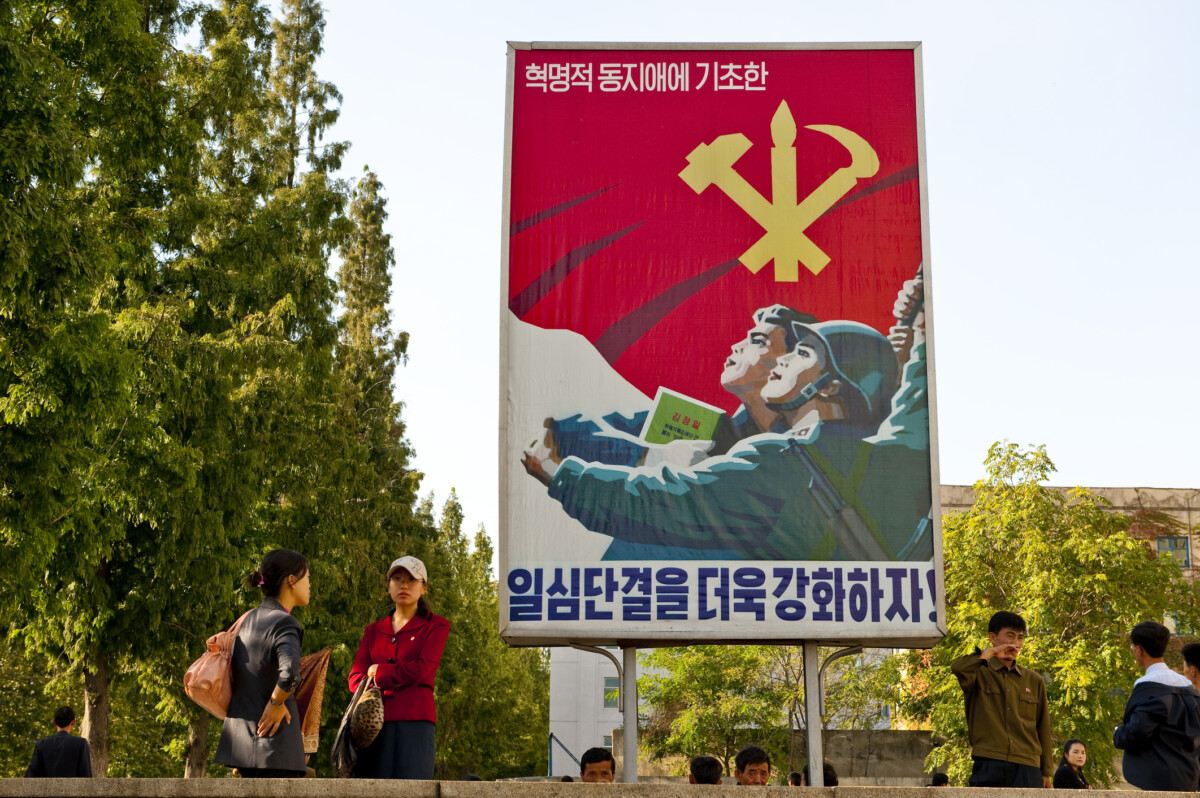
A Workers’ Party poster reads, “Let us further strengthen the single-hearted unity based on revolutionary comradeship.” (Image: iStock/Tarzan9280)
Every North Korean dreams of becoming a member of the ruling Workers’ Party of Korea.
Why? To be more loyal to the Party and the state? Or because they don’t want to bear the disgrace of being labeled a dropout?
What exactly lies behind this desire to wear the badge?
To figure this out, we should go back to the time when being a Party member wasn’t popular. Readers probably thought there wasn’t such a time. But let me share a family story. My maternal grandmother was a Communist Party member. That detail—Communist Party member—is what you should pay attention to.
In its early days, the Communist Party merged with the New People’s Party to expand its size and influence, changing its name to the Workers’ Party of Korea.
As it was the predecessor of the Workers’ Party, the Communist Party was far more prestigious.
“Even if I die, I’ll remain a Communist!” That’s how they described people with exceptional loyalty and ideological commitment.
But the grandmother I knew behaved quite differently from the “Communist Party membership card” she held. When I was little, I saw that she was not particularly devoted to Party principles.
When the state banned alcohol sales, for example, she secretly sold liquor and made money with great enthusiasm.
I was curious why she became a Party member in the first place. Right after liberation at the end of World War Two, she explained to me, there were several parties. The largest was the New People’s Party.
One day, some of its members came to her house and promised her 3 kilograms of rice and 2 bolts of cloth if she joined. Later, Communist Party people came round and said that while they couldn’t give her anything immediately, in the future she would enjoy rice and meat soup for life.
She had never heard of the Communist Party before, but after weighing the options, she decided it was better to join them. She was someone who could delay gratification. Unfortunately, though, the Communist Party never kept its promise.
She never got rice and meat soup. But she did have a Party membership card. She carried it proudly like a treasure, especially flaunting it in front of those who hadn’t been admitted.
“If you want to see my loyalty, look at my Party card.” That was her favorite saying. And, as I mentioned, her Party card dating back to the early days, looked different from ordinary ones.
By the 1970s, membership had become like a tag that followed people everywhere. Personal records included not only gender but also whether a person had joined the Party.
Every official document required throughout life included membership status.
Not being a member could be interpreted as lacking loyalty, an unbearable stigma in a society where loyalty was the highest measure of a person.
Children entering elementary school had to submit their parents’ background information, including Party membership. Immature and disrespectful kids would loudly point this out.
Even when they were very young, they keenly sensed how important and sensitive this was.
Those whose parents were members looked down on others. Children humiliated by their peers, would return home crying and confront their parents.
Thus, Party membership was no longer just a personal matter. It impacted children too. Hence the common refrain, “You must join the Party before your child enters elementary school.”
There was another reason to join: advancement. To escape poverty and provide a better life for your family is everyone’s wish. In capitalist societies, that means becoming a capitalist. In bureaucratic North Korea, it means becoming an official and joining the Party is a prerequisite for becoming one.
Perhaps that’s why young men endured ten long years of military service, hoping for that chance. Party membership cards were bundled together with discharge papers like a package deal.
People put up with so much, firmly believing that fortune would eventually smile upon them. Poor but bright university students studied late into the night, convinced that high grades would secure their future. Young men in the army pushed themselves to be exemplary soldiers, even sustaining injuries during training, believing that the medals they earned would prove their Party loyalty.
But after years passed, they witnessed something entirely different. The student who cheated in exams in college appeared later as their boss. The soldier who skipped training thanks to his father’s connections became a Party cadre, overseeing their factory and village.
Why did this happen? What had they failed to understand? The answer: power is inherited.
In the past, especially during the era of Kim Jong-un’s grandfather Kim Il-sung, sometimes a “dragon would rise from a humble stream.” In other words, if you were prepared, you could seize opportunities regardless of background or age.
As long as you had loyalty to the Party, the state would actively promote you. This was called “broad politics.”
But under the next ruler, Kim Jong-il, this gradually stopped. Broad politics had served its purpose during the Party’s weak years, helping stabilize a chaotic country and strengthen it. After that, the focus shifted to consolidating power, and loyalty was no longer in short supply thanks to relentless indoctrination.
From then on, power began to be inherited, and social mobility became increasingly difficult.
(To be continued)

Born in Chongjin in 1990, Jang Mi was not a studious child, but under her mother’s influence, she graduated from high school and went on to university to take math and science. She worked as a wedding video editor for seven years until her defection in 2019.
Latest posts by Jang Mi (see all)
- The value of a being a Party member - March 2, 2026
- North Korea: How much longer will their hollow dynasty last? - February 6, 2026
- Can Chanel bags spark a revolution? - February 3, 2026