
Report on HRF-Supported USB Distribution into North Korea in May
Because the work described in this brief is sensitive, this article is not publicly listed and is accessible only to those with the direct URL.
The Human Rights Foundation recently supported NK Times, a Seoul-based Korean-language media outlet founded by North Korean defector and journalist Sewon Kim, with 750 USB drives for distribution into North Korea. NK Times specializes in reporting on North Korean politics, the economy, military affairs, culture, and human rights violations, and has continued to work closely with HRF and NK Insider on information access efforts.
This distribution took place under urgent and sensitive circumstances. NK Times had been maintaining a secure, in-person network connected to North Korean workers and managers in China, primarily in Changbai Korean Autonomous County and Dandong. At present, this Northeast China route remains one of the only viable channels for this work, particularly as the South Korean government continues to restrict information dissemination activities near the inter-Korean border.
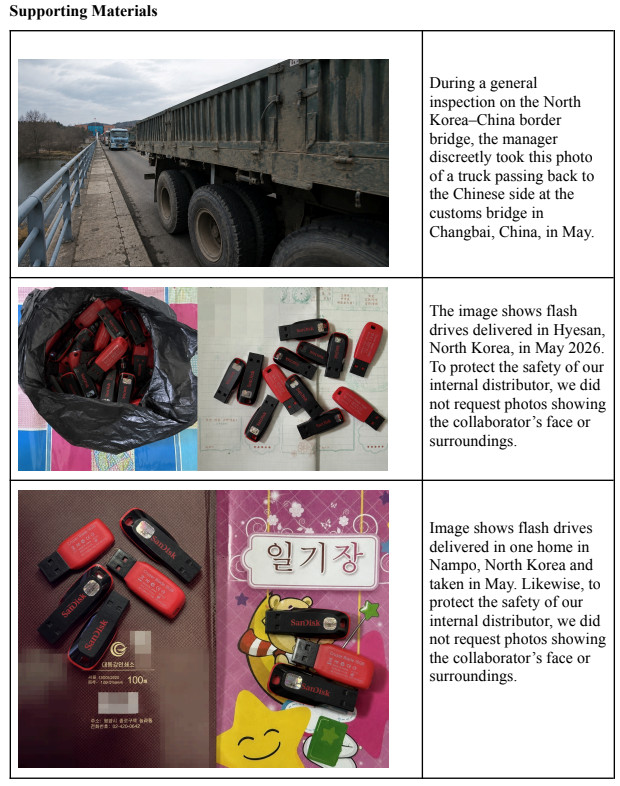
In mid-May, one of NK Times’ contacts in Changbai was unexpectedly ordered to return to North Korea on a business trip. The team learned that the vehicle had enough concealed space to carry 1,000 USB drives. NK Times had only 250 drives available at the time, so HRF’s support of 750 additional 16GB USB drives enabled the group to meet this urgent opportunity. The drives were quickly prepared and allocated across four target regions, with approximately 250 drives designated for each area.
The materials were first brought into Hyesan City, Ryanggang Province, after crossing through China’s Changbai Customs. From Hyesan, they were redistributed to Pyongyang, Nampo, Sariwon, and Haeju, with the expectation that the content would continue circulating covertly into surrounding counties and villages.
The content was selected based on internal demand, not merely availability. NK Times tailored materials for different audiences, including officials, middle-class residents, ordinary citizens, and young people. For officials and middle-class residents, the USBs included foreign news and current affairs unavailable through North Korean state media, including reports on the U.S.-Iran conflict, the Russia-Ukraine war, North Korean soldiers deployed to Russia, and North Korean prisoners of war who expressed a desire to go to South Korea.
Feedback from inside North Korea suggests that international security issues and global perceptions of North Korea are of particular interest to some officials. One instructor at the Hyesan City People’s Committee in Ryanggang Province requested further updates on North Korean soldiers captured by Ukrainian forces, noting the painful contrast between the deaths of young North Korean soldiers abroad and how those deaths are glorified inside the country. A Workers’ Party official at a factory in Hyesan also expressed surprise at new information about North Korean troops in Russia and the U.S.-Iran conflict, and requested more reporting on U.S. policy toward North Korea and how the international community evaluates the regime.
For younger audiences, South Korean films, dramas, music, speech, clothing, and lifestyle materials remain highly sought after despite intensified crackdowns. One young person from Samsu County said she enjoyed the Korean dramas Dear X and Love Scout, both included in this shipment. She explained that South Korean films and dramas are not only entertainment, but also a way to understand daily life, living standards, language, and culture beyond North Korea’s borders.
NK Times also found that mixed content is more effective than exclusively political material. Films, dramas, music, lifestyle content, and international news are more likely to attract repeated viewing, especially among young people, and may be consumed in a comparatively safer manner than overtly political materials. This finding is especially important as the North Korean regime has expanded laws and punishments targeting people who watch unauthorized foreign content.
The security environment remains extremely dangerous. North Korean authorities continue to intensify surveillance, surprise inspections, and enforcement through bodies such as the 82nd Unified Command and the 617th Command. Inspections are now more unpredictable and frequent, targeting households suspected of watching South Korean or other foreign films and dramas. Individuals may also be stopped and searched at random.
Despite these risks, residents continue to adapt. One collaborator reported that people have “developed a kind of immunity,” finding creative ways to hide and consume outside content. Some reportedly purchase two identical USB drives: one containing state-approved content to show inspectors, and another containing banned content that can be quickly hidden or switched. Others hide memory devices in pits, storage areas, and other concealed locations.
The most important finding from this project is that demand for outside information remains strong. Young people seek entertainment and lifestyle content, the jangmadang generation is interested in practical economic and livelihood-related information, and some officials want international news and analysis of how North Korea is viewed abroad. These trends point to the need for more targeted, discreet, and multi-layered information delivery strategies.
HRF’s support has strengthened NK Times’ ability to reach North Koreans living under one of the most restrictive information environments in the world. In North Korea, USB drives are more than storage devices. They are rare windows into outside realities, cultures, ideas, and freedoms. As one resident who accessed the content said, “When can we live a life like theirs? I hope the next generation can live freely in a world like free people.”
For more details, the full report can be accessed here.
If you have requests for further details, please reach out to Seongmin for a briefing at [email protected].

Seongmin is the director of the Korea Desk at the Human Rights Foundation.
Latest posts by Seongmin Lee (see all)
- Tyranny Tracker: identifying authoritarianism, illuminating freedom - March 10, 2026
- Exclusive: Documents and personal items found on the body of a North Korean soldier in Kursk Oblast region (1) - January 10, 2025
- Exclusive: Documents found on the body of a North Korean soldier in Kursk Oblast region (2) - January 9, 2025