

Is Trump about to try to solve the Korea question?
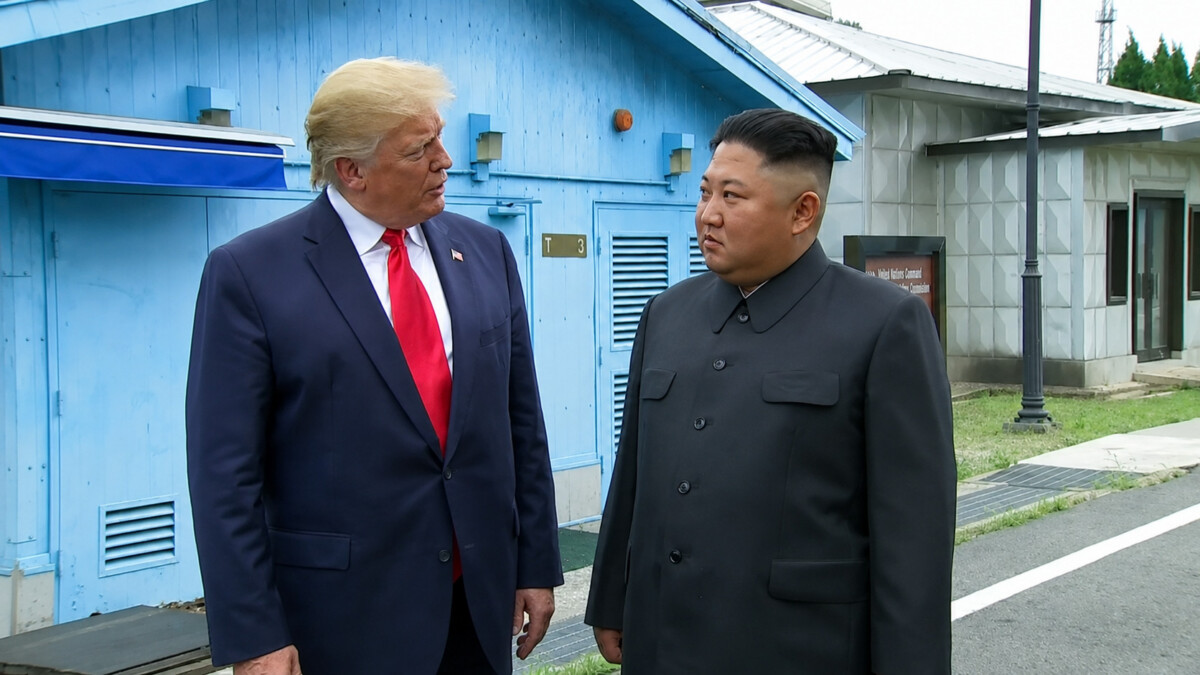
Donald J. Trump meets Kim Jong-un at the DMZ in South Korea on June 30, 2019. (Image: NKIN Archive)
Eighteen months into his second term – after tariffs, serious arguments with America’s closest allies, and interventions in Nicaragua, Gaza and Iran – is U.S. President Donald J. Trump now turning his attention to another long-festering problem: the Korean Peninsula?
And if he is, what could go right – and what could go wrong?
For more than 70 years, the basic arrangement on the peninsula has been nerve-wracking in theory but remarkably stable in reality.
The Korean War stopped, but did not end. American troops remained in South Korea. North Korea remained isolated and heavily armed. South Koreans took advantage of their protective alliance with America to transform from an impoverished nation into one of the world’s great industrial economies.
There have been provocations, moments of anxiety and occasional moments of hope. But the fundamental structure has endured.
The question now is whether Donald Trump wants to change it from a holding pattern into something more permanent.
Two developments point in that direction.
The first is that Trump is reportedly exploring another summit with Kim Jong-un, potentially as early as this autumn.
The second came on August 16, when Trump suddenly ordered the Pentagon to shrink the 11-day joint U.S.-South Korean Ulchi Freedom Shield exercises to five days. The decision reportedly took the two countries’ militaries by surprise. Had the complex annual drills not already begun, we might reasonably assume that Trump would have canceled them altogether.
What was the reason for this? Ostensibly, it was an expression of presidential displeasure at South Korea’s unwillingness to support the U.S. in keeping the Strait of Hormuz open. Whether or not that was the real reason, it doubly sweetened the pill being offered to North Korea: not only did Trump cut the exercises that North Korea always sees as threatening, but he did so while blaming his own ally, North Korea’s enemy.
A parallel point to note is that on August 15, President Lee Jae-myung used his Liberation Day address to propose talks with North Korea aimed at formally ending the Korean War and replacing the 1953 armistice with a permanent peace regime.
On the surface, this was a kind of typical Democratic Party leader’s Liberation Day speech – can’t we all get along? But the framing this time was nevertheless significant because, just like an end to military maneuvers, a Korean War peace treaty is a longstanding North Korean demand.
We should remind readers that the demand to turn the armistice into an actual peace has always come from North Korea and has always been batted away by the South and the U.S. That is because of a lack of trust and an assumption that a peace treaty would be used as justification to end the U.S.-South Korea defense alliance.
For Seoul, that could mean dismantling the very security arrangement that has kept the peace.
So why is Lee proposing it now?
Part of the answer is that North Korea itself has changed its longstanding commitment to reunification. Kim Jong-un has spent the past two years declaring that South Korea is a hostile state rather than a partner in eventual reunification.
Lee’s proposal, then, can be read as an attempt to change the conversation. It is, in effect, a message to Pyongyang: if you regard the South as hostile, let us demonstrate that we are not.
The problem is that Kim may have little interest in responding. He has made it clear that, regarding the peninsula, his preferred interlocutor is Washington.
That brings us back to Trump.
Before he came into office, U.S. presidents had treated North Korea as a pariah state led by an unhinged leader and had refused to consider anything, let alone diplomatic relations. Then Trump came along in his first term and astonished the foreign policy community by meeting Kim. The issue then was nuclear weapons, and the talks went nowhere.
In his second term, he has taken personal ownership of a range of problems that previous administrations struggled to resolve. He has also shown little hesitation about putting pressure on countries that previous presidents regarded as close allies.
Given that he has never been particularly interested in following the conventional diplomatic playbook, that leads to questions about how he would approach Kim this time around.
North Korea is, in fact, a different proposition from what it was during Trump’s first term. Kim would arrive this time with a larger nuclear arsenal, a much closer strategic relationship with Russia and, as mentioned, a very different conception of North Korea’s relationship with the South.
If Trump concludes that the old objective of denuclearizing North Korea is unrealistic, he could decide to pursue something more achievable: an agreement that freezes or limits the North Korean nuclear program, reduces the risk of war and establishes diplomatic relations between Washington and Pyongyang.
He could even decide that formally ending the Korean War is part of the bargain.
That would be a historic development.
But it could also be dangerous for the South, despite Lee’s apparent support for the idea. That is because the United States, South Korea and their allies have always approached North Korea on the assumption that the security of the South is central to any settlement.
If Trump takes a different approach and sees North Korea primarily as a problem between himself and Kim Jong-un – a problem he believes he can solve by negotiating directly with the North Korean leader – Seoul is likely to find itself expected to accept the consequences of an agreement that it has had no part in crafting.
The result could be called peace. But this is where Lee’s initiative becomes interesting – and could even complicate matters. North Korea may offer Trump peace on condition that South Korea drop its constitutional commitment to reunification. Such a commitment may be politically impossible for Lee.
And if it is impossible for Lee, then a permanent peace treaty could leave us with an extraordinary paradox.
America and North Korea could formally end the Korean War, while South Korea remains committed to reunification. Pyongyang could therefore continue to regard the South as a hostile state even after the war had officially ended.
Given this, it might actually be better if Kim were to reject Trump’s call for talks, and all sides were to continue with the current unsatisfactory but otherwise stable arrangement.
But there is a catch.
If Kim refuses to talk, Trump may look for ways to encourage him to change his mind.
And if that happens, we may discover that the very man trying to solve the Korean problem has found a way to make the problem more dangerous.

Hae-song is a Seoul-based analyst and writer on North and South Korean affairs. Having grown up overseas, he has lived his working life in South Korea where he consults on South Korean political and economic issues and on North Korea and defector related issues.
Latest posts by Jun Hae-song (see all)
- Resolute, denuclearization, blah blah…. North Korea has heard this before - September 23, 2026
- Is Trump about to try to solve the Korea question? - August 28, 2026
- Is the day coming when the world admits North Korea has won? - July 27, 2026