

Is a purge or at least a crackdown in the offing in North Korea?
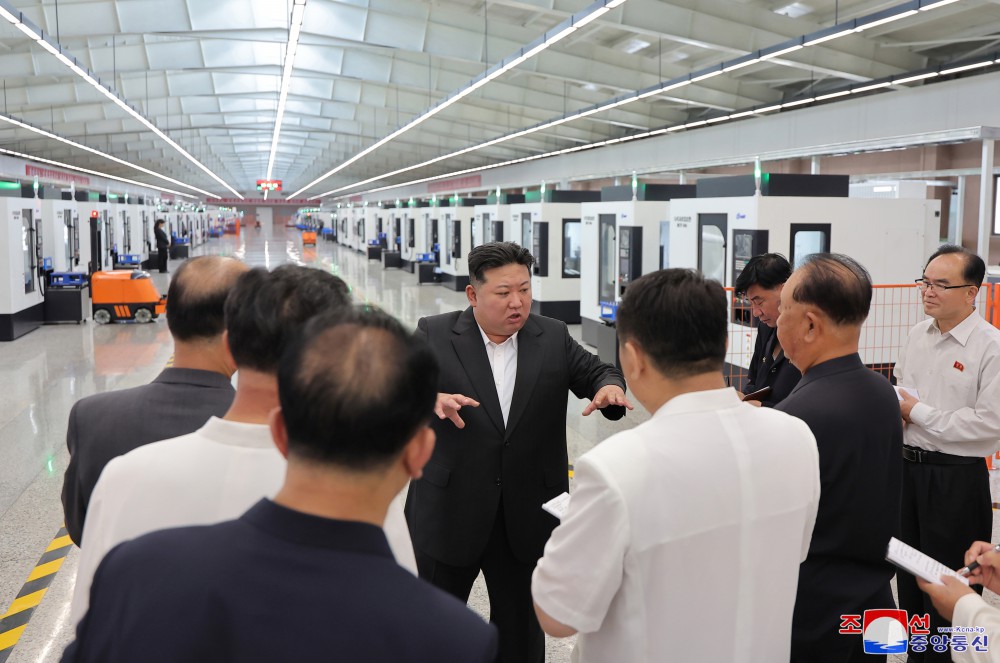
Kim Jong-un visiting a munitions factory in this July 3, 2024 photo released by the state-run Korean Central News Agency.
Even the best of the previous century’s Kremlinologists who monitored trends in the former Soviet Union, and “China Hands” who followed developments in Communist China, including those whose predictions were often borne out, would frankly admit that the prognostications which they cautiously offered were a risky endeavor.
With far less information on which to base their analyses, today’s Pyongyang watchers have significantly greater difficulties in assessing the future path of the Kim Jong-un regime.
This is, of course, due to the self-imposed, sealed off situation of the North and the nature of its internal politics, which is exceptionally byzantine even by the standards of other communist dictatorships.
In spite of the hurdles inherent in making forecasts as to future moves by the North, however, there are sometimes reliable signals.
The usual methods of studying the state media, often reading between the lines, as well as gleaning bits of information from defectors, may sometimes be sufficient to make reasonably educated guesses about what to expect from Pyongyang.
Given recent hints from Rodong Shinmun, the official organ of the ruling Workers’ Party, it seems that a purge, or at least a crackdown in the aftermath of the 9th Party Congress in February may be in the offing, which though it may include some among the nomenklatura, seems to be aimed primarily at lower level cadres and ordinary citizens.
It may not even be a major purge or crackdown, relative to the seemingly never ending waves of such campaigns since the foundation of the regime, but there are signs that some type of disciplinary “rectification” may soon be initiated.
On March 26, Rodong Shinmun published a piece entitled “What Is Lacking?” which had a rather harsh and almost threatening tone. It chastised workers who “only complain that there is too much work.”
“Neglecting the improvement of practical skills by claiming a lack of time or being too busy is, in fact, nothing more than an excuse and a disguise to conceal one’s incompetence and slacker-like nature,” it said.
Those are strong accusations in the North. They can result in an individual, or even an entire work team or other unit, being at least administratively punished or demoted, or at worst being removed, exiled, or in some cases even shot. These warnings coupled with exhortations are apparently part of a new “work harder” campaign similar to the many such efforts which the North has conducted over the years.
An ever more strongly worded piece entitled “Break Down Self-Preservationism” was published by Rodong Shinmun on March 28th. It ominously declared that an individual’s very “existence” depended on the value of his work, a rather new and creative interpretation of Marx’s labor theory of value, to say the least.
The article menacingly warned that “a worker who is unfaithful…is as good as non-existent, and is a useless existence whose absence leaves no void.” This is eerily reminiscent of the Khmer Rouge’s infamous slogan, “To Keep You Is No Benefit. To Destroy You Is No Loss.”
The piece further said, “If a worker falls into self-preservation, fails to devote himself to his work, and does not take responsibility for the results of his work, he will lose the trust and confidence of the Party and the people, and ultimately, instead of serving as a driving force for the implementation of Party policies, he will become a stumbling block to the revolution.”
In the North, such “stumbling blocks” are not dealt with lightly.
The piece characterized “self-preservationism” as no mere ordinary error, but rather as a grave “ideological tendency.” The “harmful presence” of such people could not only “hinder the implementation of Party policies,” which would be an extremely serious offense in itself, but might also develop into the “stage of betrayal and defection.”
The solution demanded by the piece was that of “ideological transformation,” to be implemented by officials who must “aggressively implement ideological education” aimed at those who “are preoccupied with maintaining the status quo while caring only about their own safety and self-preservation.”
These directives are clearly meant to spur harder, faster, and more responsible work, while denying any tolerance for excuses offered by those individuals or units not meeting quotas.
Echoing the hoary Maoist concept and methodology of the “mass line,” but of course, of political necessity portrayed as some original “thought” of Kim Jong-un, Rodong Shinmun on March 30th published a piece stressing that, “Mass nature is a revolutionary character that always goes into the masses, mingles freely, shares joys and sorrows, humbles oneself infinitely, and respects and cares for the masses.”
“Mass nature is an important criterion that characterizes the qualifications of officials in the new era,” it said.
It further insisted that the implementation of this policy is the only way that “progress will be made in today’s struggle to fulfill the tasks of the 9th Party Congress.” Officials were exhorted to “keep a firm conviction to share their fate with the Party Central Committee until the end.”
The piece then launched into a stark warning against, “political insensitivity that cannot even discern the Party’s intentions, political immaturity that does not know how to breathe the Party’s appeal and the breath of the times, and non-revolutionary spirit that lacks the resolve to take full responsibility for one’s work before the Party.”
These articles, and others of a similar nature published after the Party Congress, are apparently part of a series of pieces on the “12 Communist Characteristics That Officials of the New Era Must Possess,” which flow from Kim Jong-un’s “Five Programs for Party Building in the New Era – Political Construction, Organizational Construction, Ideological Construction, Discipline Construction, and Work Style Construction” mentioned at the Congress.
To some extent, the rhetoric is consistent with standard jargon typically employed by the North as well as by other communist regimes. However, considering the esoteric nature of Party statements, whose meaning may not be immediately clear to outsiders, but is well understood by Party apparatchiks, these themes are likely more significant than the standard and often-heard exhortations and criticisms.
Even within the military, a core loyalty group for the regime, troops have recently been subjected to increased ideological indoctrination, beyond the typically intensive level of political instruction.
The General Political Bureau, whose mission is to enforce total control of the Party over the military, has reportedly launched a major obedience campaign warning all ranks to “trust exclusively in the Baekdu bloodline,” as the Kim dynasty is referred to.
Sources inside the North also more generally report that in the wake of the Party Congress, regime officials in the provinces have been “caught off guard” by the imposition of “new and exacting standards.” These disclosures serve to reinforce the indications of a possible purge.
If the targets of these warnings are high-level officials, that may become clear if and when there are indications that such individuals have been demoted or removed. If, on the other hand, the warnings are aimed at low-level officials and the general public, then reports from defectors may be the best or only source of information.
The “reading of tea leaves” inherent in such an analysis is certainly subject to misinterpretations, but it nevertheless appears that there may be some form of shake up planned in the aftermath of the Congress, at least with regard to the lowest ranks of the Party, or units which are seen as lacking in sufficient performance and zeal.
In any case, the losers are the people of the North, who as in the past, are again being compelled to work ever harder and make even greater sacrifices in a bid to prop up an inhumane and failed system.

Lawrence Peck is a correspondent for NK Insider based in Seoul and Los Angeles. Having intensively researched and closely monitored the activities of pro-North Korea and other extremist groups and activists in the U.S. for over 25 years, he has been recognized in the U.S. and Korea as one of the leading American authorities on such topics, and has lectured, written extensively and been interviewed on such topics in the U.S. and Korea. He has a Bachelor of Arts degree in Political Science from the University of California, Los Angeles (UCLA) and a Juris Doctor degree from Loyola Law School of Los Angeles. He previously worked in Korea for several of the largest Korean business groups in the fields of intellectual property licensing and international business development. He also serves as an advisor to the North Korea Freedom Coalition of the U.S. Lawrence may be reached at the email address: lawrence.nkinsider@gmail.com
Latest posts by Lawrence Peck (see all)