

From test to drill: North Korea signals hypersonic missile readiness
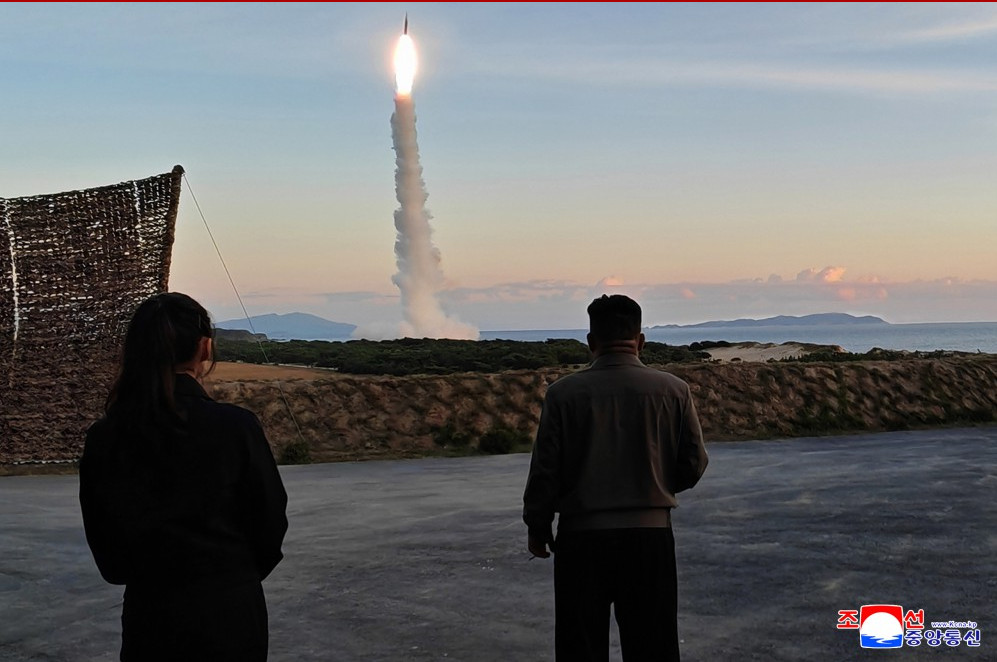
Kim Jong-un and his daughter, Kim Ju-ae, watch the missile launch. Photo: KCNA
North Korea launched an intermediate-range hypersonic missile late last week, describing the event not as a weapons “test” but as a “launching drill” to assess its operational readiness. The Korean Central News Agency (KCNA) reported Oct. 4 that the missile, launched from the country’s eastern region early the previous morning, struck a designated target 1,000 kilometers away in the East Sea. At the launch site, leader Kim Jong-un said North Korea must “continuously and repeatedly make its adversaries aware of the reliability and lethality of our strategic strike means.” He added that such activities were “clearly aimed at further enhancing the country’s nuclear war deterrent.”
The emphasis on a “launching drill” rather than a “test launch” was particularly significant. Pyongyang sought to portray the hypersonic missile not as a prototype still under development, but as a weapon that missile units could repeatedly operate in the field. Hong Min, a senior research fellow at the Korea Institute for National Unification, said North Korea’s disclosure of the precise coordinates of the impact point could also signal that the weapon was moving beyond the testing phase toward operational deployment.
Photographs released by North Korea show a long booster topped by a white, cone-shaped vehicle, with a large flame and column of smoke rising immediately after launch. Although the missile’s appearance has prompted comparisons with earlier North Korean hypersonic systems, the images alone are insufficient to establish its precise type, speed or maneuvering capabilities.
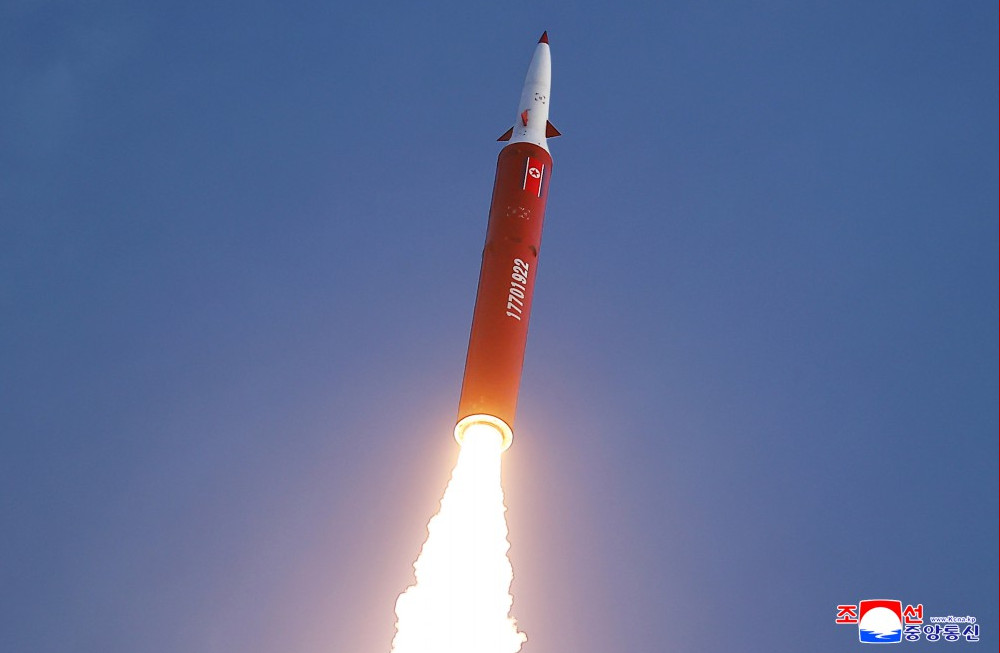
The cone-shaped vehicle rises into the sky. Photo: KCNA
KCNA named Kim Jong-un, Kim Jong-sik, first vice department director of the Workers’ Party of Korea Central Committee, and Jang Chang-ha, director general of the Missile Administration, as attendees. Neither Kim Jong-un’s daughter, Kim Ju-ae, nor his wife, Ri Sol-ju, was mentioned in the report. However, accompanying photographs show Kim Ju-ae watching the launch with her father, while other images appear to show Ri Sol-ju at the site.
The distinction between those formally identified in the report and those visible in the photographs is important. The apparent presence of the leader’s family alongside senior officials responsible for missile development and operations also helped frame the event as more than a technical exercise: it was a public demonstration of a national strategic capability.
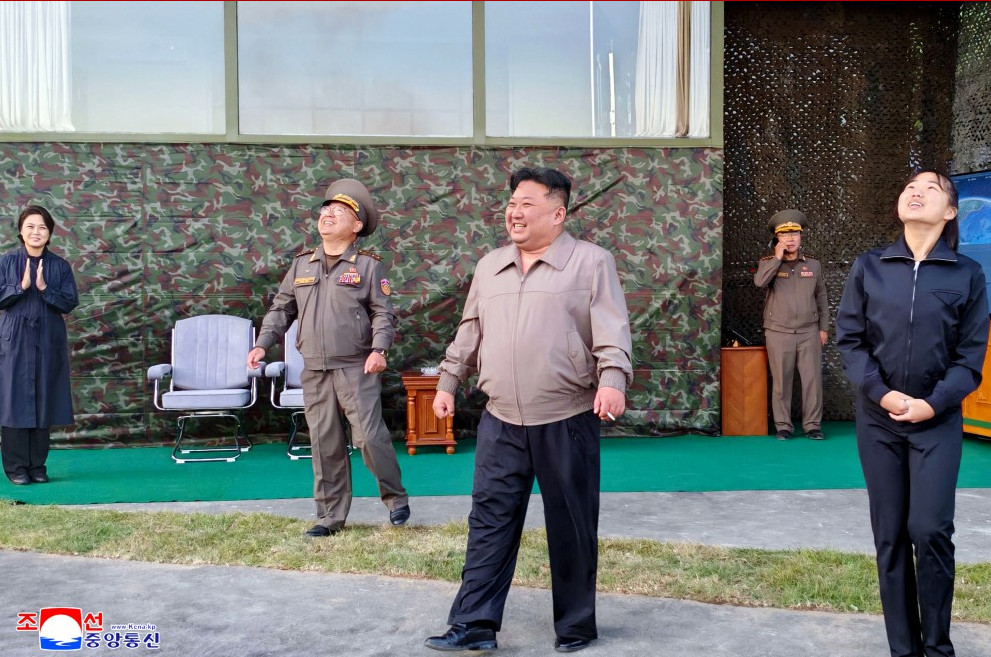
Members of the Kim family and senior military officials attend the missile launch. Photo: KCNA
North Korea’s description of the weapon as an “intermediate-range strategic missile” is significant in its own right. Tactical missiles are generally designed to strike military targets such as troops, airfields and command posts within a theater of operations. Strategic missiles, by contrast, are more closely associated with nuclear deterrence and the ability to threaten an adversary’s critical military infrastructure and command systems. Pyongyang’s use of the term “strategic” therefore implies more than a particular range; it suggests that North Korea considers the missile part of its nuclear deterrent.
However, North Korea’s account of the missile’s flight differed substantially from assessments by neighboring countries. Pyongyang said the missile traveled 1,000 kilometers before hitting its designated target at sea. South Korea’s military assessed that it flew more than 700 kilometers, while Japan’s Defense Ministry estimated a distance of about 680 kilometers and a maximum altitude of approximately 90 kilometers. Japan said the missile was believed to have landed outside its exclusive economic zone.
North Korea sought to use the discrepancy to bolster its claims about the weapon’s capabilities. Kim Yo-jong, Kim Jong-un’s sister, said the missile followed what Pyongyang described as a “wave-like flight trajectory”, making it difficult for South Korea and Japan to track. South Korea’s military rejected that claim, saying it had monitored both preparations for the launch and the missile’s flight. The difference between North Korea’s reported distance of 1,000 kilometers and the 680-to-700-kilometer estimates from South Korea and Japan does not, in itself, establish that either country lost track of the missile.
South Korea maintains that its detection and interception systems, operated in coordination with the United States, can counter the missile despite Pyongyang’s claims of enhanced maneuverability. North Korea, meanwhile, argues that the weapon’s low-altitude flight and maneuvering capabilities are designed to penetrate existing missile defenses. The U.S. Indo-Pacific Command assessed that the launch posed no immediate threat to U.S. personnel, territory or allies. Japan reported no direct damage but described North Korea’s repeated ballistic missile launches as a threat to regional security.
The significance of the launch lies less in whether North Korea has achieved a new range record than in its effort to portray hypersonic weapons as an operational component of its nuclear deterrent. Kim Jong-un emphasized not speed alone, but the missile’s “reliability” and “lethality,” as well as the military’s readiness to conduct a counterstrike at any time.
North Korea’s claims that the missile traveled 1,000 kilometers and could evade interception have not been independently verified. Nevertheless, its choice of the word “drill” rather than “test” conveys a clear message: Pyongyang wants its adversaries to regard the missile not as a weapon still under development, but as an operational element of its nuclear deterrent, ready to be used when needed.

Taesung offers informed perspectives on North Korean society, grounded in years of experience within a key state-run institution. After defecting to South Korea in 2024, he now focuses on providing analysis of the country.
Latest posts by Kim Taesung (see all)
- From test to drill: North Korea signals hypersonic missile readiness - October 7, 2026
- Two North Korean prisoners, one diplomatic dispute: What was agreed between Seoul and Kyiv? - September 28, 2026
- North Korea is building new weapons and drones. Russia may be making them better - September 24, 2026