

Trump wants Kim back at the table. This time, Kim holds the cards.
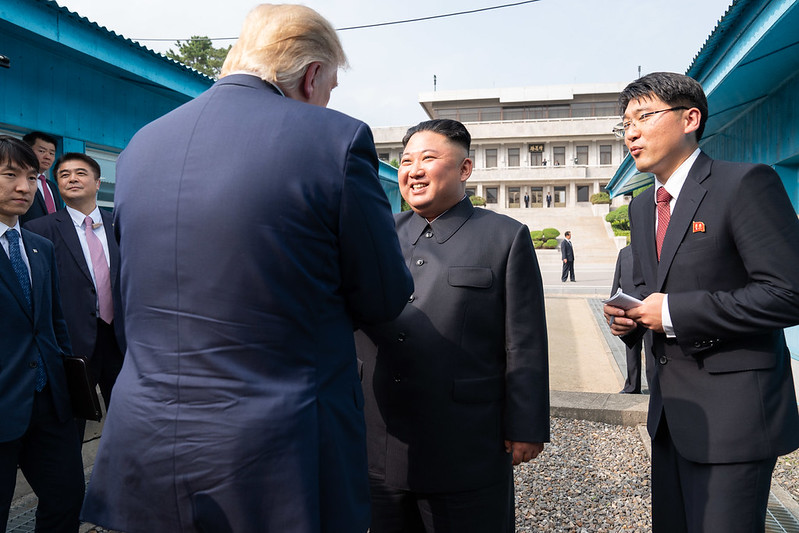
rump and Kim at the DMZ in 2019. Image: Shealah Craighead/The White House via Flickr.
U.S. President Donald Trump wants to revive summit diplomacy with North Korean leader Kim Jong-un.
American officials told The Wall Street Journal that Trump was pressing aides to arrange a meeting as early as this autumn and had privately discussed meeting Kim during a trip to Asia for the Asia-Pacific Economic Cooperation (APEC) summit in Shenzhen, China, in November.
The August 18 story noted that no formal preparations were under way.
Reuters, meanwhile, carried the report while noting that it could not independently verify it. The distinction matters: Trump clearly wants a meeting, but there is still no evidence that Kim has agreed to one.
Trump’s approach is familiar. On August 16, he ordered a reduction in joint U.S.-South Korean military exercises, explicitly citing his “very good relationship” with Kim. The following day, he said Kim had responded to his overture, and on August 19 he said he expected to meet the North Korean leader before the end of the year.
Victor Cha, the Korea chair at the Center for Strategic and International Studies, said the exercises had given Trump a concrete opportunity to demonstrate to Kim that he was serious about meeting.
It was a reprise of a tactic Trump used during his first term: easing military tensions as an incentive for North Korea to return to summit diplomacy.
But there is an important difference this time. North Korea is stronger.
Trump and Kim held their first summit in Singapore in June 2018 and their second in Hanoi in February 2019. They met again at Panmunjom that June. The Singapore joint statement pledged to work towards the “complete denuclearization of the Korean Peninsula,” but contained none of the crucial implementation details, including declarations of nuclear facilities, verification or a timetable for dismantlement.
Hanoi ended without an agreement over sanctions relief and the scope of denuclearization measures. The Panmunjom meeting failed to revive negotiations. Since then, North Korea’s nuclear and missile capabilities have continued to grow.
No one outside Pyongyang knows the exact size of its nuclear arsenal. Independent arms-control experts have estimated that North Korea has assembled around 60 warheads and may possess enough fissile material for as many as 90. Jeffrey Lewis of Stanford University has argued that those estimates are dated and that the arsenal could now be in the low hundreds.
The U.S. intelligence community’s 2026 Annual Threat Assessment likewise judged that Pyongyang continues to expand its strategic-weapons programs, including missiles and nuclear warheads, while strengthening its deterrent.
That makes a new summit fundamentally different from the one Trump pursued in 2018.
Pyongyang’s response to the latest overture looks less like a rejection than a price tag. In an August 19 statement carried by the Korean Central News Agency, Kim Yo-jong, a top official and sister of Kim, said she knew “nothing” about Trump’s claim of recent communication between the two leaders. She dismissed the reduction in the joint exercises as unworthy of comment and said North Korea had “no interest” in it.
Yet she also said Kim retained “good personal memories and feelings” toward Trump and that the relationship between the two leaders remained “excellent.”
The message was carefully calibrated. Pyongyang was preserving the personal relationship with Trump without treating it as evidence of a change in U.S. policy.
Kim Yo-jong’s broader statement made the bargaining position clearer still. She defended North Korea’s military cooperation with Russia, rejected Ukrainian claims that Pyongyang was preparing another major troop deployment, threatened Japan over what she described as the wrong military choices, and argued that a stronger North Korean deterrent would make the regional security structure more balanced and stable.
That is not an explicit rejection of denuclearization talks. But it is a strong indication that Pyongyang does not regard its growing nuclear and missile capabilities as assets to be surrendered before negotiations begin.
Experts cited by Reuters reached similar conclusions. Lim Eul-chul of Kyungnam University argued that personal ties would not be allowed to compromise North Korea’s national-security interests or its military build-up. Jenny Town of the Stimson Center said Pyongyang’s conditions could include major changes to what it calls America’s hostile policy, acceptance of North Korea’s nuclear status or, at a minimum, removal of denuclearization as an American objective.
Hong Min of the Korea Institute for National Unification took a somewhat more hopeful view, arguing that Kim Yo-jong’s statement looked less like a rejection of dialogue than an attempt to manage Trump’s expectations and prepare the ground for possible future negotiations.
In other words, North Korea is not closing the door. It is raising the price of entering it.
There are good reasons why Kim can afford to do so.
By providing troops and weapons to Russia, North Korea has gained battlefield experience, while its diplomatic relationship with Moscow and Beijing has reduced the prospect of further international pressure. South Korea’s Defense Intelligence Agency estimated in March that North Korea had shipped more than 15 million artillery shells to Russia. It also assessed that battlefield data and Russian technical assistance may have helped improve the accuracy of North Korean missiles.
In this environment, Kim is less dependent on sanctions relief and American approval than he was in 2018.
That is why cutting the joint exercises first carries a real cost.
Mark Montgomery, a retired U.S. Navy rear admiral, told The Wall Street Journal: “This was a mistake in 2018 and it’s a bigger mistake in 2026.” His argument is that, with North Korea stronger as a result of technology and equipment obtained from Russia, reducing exercises imposes a greater cost on deterrence and readiness than it did before.
Chun In-bum, a former commander of South Korea’s Special Warfare Command, has also warned that Trump’s abrupt decision raises concerns among Asian allies about the predictability of America’s security commitments.
Eroding an alliance’s military readiness before a summit has even taken place looks less like bargaining than prepayment.
That does not mean that a meeting without preconditions would itself be a mistake. Mintaro Oba, a former U.S. State Department official who worked on Korea, has argued that summits and stability are preferable to confrontation. Robert Abrams, a former commander of U.S. Forces Korea, likewise said that talking is preferable to fighting or threatening to fight.
Compared with the threats of nuclear war in 2017, leader-level dialogue could reduce the risk of miscalculation and reopen diplomatic channels.
And if complete denuclearization is impossible in the near term, Washington could pursue more limited risk-reduction measures: restrictions on nuclear and missile testing, a freeze on fissile-material production, or the restoration of military hotlines.
The problem is not the meeting. It is what Trump is prepared to give away to get it.
Bruce Klingner, a former CIA analyst, has criticized Trump’s personal diplomacy, arguing that it rests on the assumption that a personal relationship can deliver U.S. foreign-policy objectives.
If Washington were to abandon denuclearization as a long-term goal, or unilaterally reduce joint exercises and the role of U.S. forces in South Korea without obtaining verifiable military steps from North Korea, a summit could become something more consequential than another piece of diplomatic theatre.
It could help normalize North Korea’s status as a nuclear-armed state.
That is the paradox of Trump’s new overture. A summit is more necessary because North Korea has become more dangerous. Yet for precisely that reason, Kim has less need than before to make concessions.
The U.S. State Department has said that Washington remains open to dialogue with North Korea without preconditions while maintaining its commitment to the complete denuclearization of North Korea.
That is a sensible distinction. Dialogue without preconditions can be useful. Concessions without preconditions are not.
In 2018, Trump achieved a meeting that much of the world had thought impossible. It lowered tensions, but it did not eliminate North Korea’s nuclear weapons.
This time, the ability to sequence a bargain matters more than the ability to produce a photograph.
Meeting Kim is not in itself a failure. Giving him what he wants before getting something measurable in return would be.

Taesung offers informed perspectives on North Korean society, grounded in years of experience within a key state-run institution. After defecting to South Korea in 2024, he now focuses on providing analysis of the country.
Latest posts by Kim Taesung (see all)
- A 52-year-old gunshot reopens South Korea’s historical divide - October 11, 2026
- A DMZ mine tests Lee Jae-myung’s North Korea policy - October 8, 2026
- From test to drill: North Korea signals hypersonic missile readiness - October 7, 2026