

“Patriots who gave their lives without compensation” — Apartments in Pyongyang for families of fallen soldiers
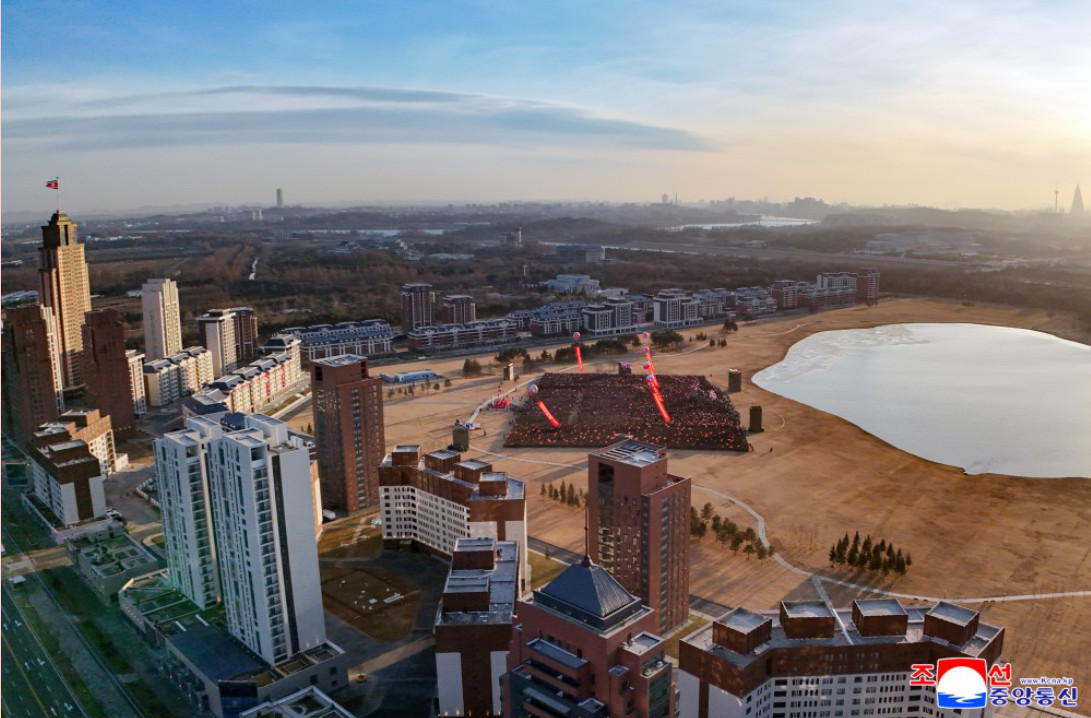
Newly constructed Saebyŏl Street in Pyongyang. Image: KCNA
Kim Jong‑un attended the completion ceremony on February 15 of a new apartment district in Pyongyang that has been specially built for the families of soldiers killed in action fighting for Russia in the war with Ukraine.
Called Saebyŏl Street, the apartment district was created as a symbolic showcase of country’s compensation system. It designates the fallen soldiers as “heroes,” brings their bereaved families into the center of the capital, and grants them luxury housing.
Saebyŏl Street is “a monumental tribute of our era that honors the noble souls of the war heroes and elevates their families to a place of glory,” Kim said at the event.
But behind this emotional staging lies the deeply troubling reality of overseas troop deployments, an issue recently confirmed by the international community and South Korean intelligence.
On February 12, South Korea’s National Intelligence Service (NIS) reported to the National Assembly’s Intelligence Committee that over 10,000 combat troops are currently deployed, along with more than 1,000 engineers for reconstruction tasks, in Russia’s Kursk region. The NIS estimates that there have been around 6,000 casualties.
Although North Korea does not officially acknowledge this, the flow of Russian military technology, cash, and energy support—along with public exchanges between the two countries’ leaders—has already made it a widely accepted fact that Kim is directly and continuously supporting Russia’s war effort.
In this context, the creation of Saebyŏl Street as a “district exclusively for the families of war heroes” is not simply a housing policy. It is a compensation mechanism designed to manage the political cost of sending troops abroad.
In his speech, Kim explicitly referred to the deployed soldiers as “patriots who, without expecting any compensation, obeyed the call of the motherland and fought without hesitation, even at the cost of their precious lives.” This phrasing is widely interpreted as an indirect admission that the troops sent to Russia receive little to no actual pay. At the same time, it reframes their sacrifice as “patriotism,” a political message aimed at suppressing internal discontent.
Saebyŏl Street emerged precisely within this political logic. By relocating the families of fallen soldiers from provincial regions to Pyongyang and granting them high‑end apartments, the regime is offering a powerful incentive.
Since Pyongyang residency is the most coveted privilege in North Korea, this system is likely to function as part of a broader mobilization strategy to sustain future overseas deployments. It allows the regime to simultaneously secure military technology from Russia, obtain sanctions‑evading funds, and break out of international isolation.
Kim also personally visited the families during the ceremony, toured the interiors of their new homes.
“From now on, our Party and government will take full responsibility for the families of the fallen,” he said.
This demonstrates that North Korea is further strengthening its long‑standing governing principle: rewards for loyalty, punishment for betrayal. The repeated purges of high‑ranking military officers in recent years make this dual strategy of “compensation and fear” even clearer.
The speed of Saebyŏl Street’s construction is also noteworthy. North Korea claims it completed an entire district of high‑rise and mid‑rise apartments, commercial facilities, and service buildings in just a few months. But given chronic shortages of materials, electricity, and construction equipment, concerns about structural safety are inevitable.
Internal sources report widespread issues such as poor concrete quality, lack of rebar, and reckless speed‑driven construction. Saebyŏl Street may look impressive on the outside, but whether its infrastructure will function reliably remains uncertain.
Ultimately, the Saebyŏl Street ceremony served as a political event through which North Korea showcased its “honoring of heroes” to the outside world, soothed the dissatisfaction of bereaved families at home, and strengthened its mobilization system for future overseas deployments.
Kim’s remark that the regime will “preserve the names and faces of the war heroes for all generations to come” can also be read as indication that North Korea intends to continue using overseas military operations for the foreseeable future.

Taesung offers informed perspectives on North Korean society, grounded in years of experience within a key state-run institution. After defecting to South Korea in 2024, he now focuses on providing analysis of the country.
Latest posts by Kim Taesung (see all)
- Seoul reverses course, joins U.N. resolution on North Korean human rights - March 30, 2026
- Carbon‑fiber solid‑fuel engine test marks new phase in North Korea’s ICBM advancement - March 30, 2026
- The horizon I had to cross, the life I had to endure - March 10, 2026