

Never-ending repression: The continuous purges and ideological campaigns of North Korea and other communist regimes
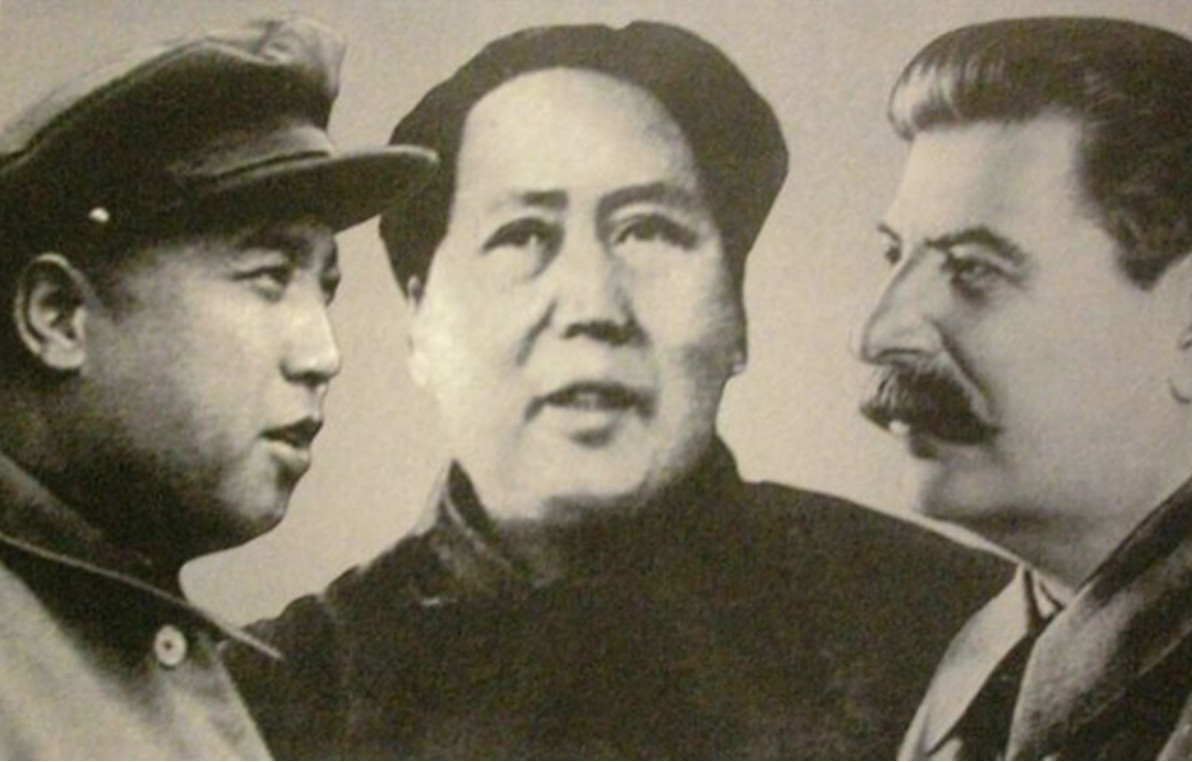
Kim Il-sung, Mao Zedong, and Joseph Stalin (Image: Cheonji Daily)
The historiography of communist states often portrays them as featuring cyclical patterns of repression and liberalization, of murderous crackdowns followed by calm and normalcy.
However, more perceptive historians see a series of never-ending repression taking the form of political purges and ideological campaigns. Rather than cyclical, the more historically accurate and therefore persuasive approach has been to characterize such regimes as subject to an uninterrupted process of political struggle.
The former Soviet Union, its Eastern European satellites, Communist China, and North Korea all demonstrate this pattern, even during periods which were supposedly marked by liberalization and political relaxation.
In the Soviet Union, the Leninist terror and war communism during and in the immediate wake of the Bolshevik coup and the civil war were followed by the “New Economic Policy,” which was seen in purely economic terms as a retreat from total state control, but which in fact was temporary and saw little respite from repression in the overall political realm.
In the early 1930s, there was also a period of alleged “normalcy” and “relaxation.” And yet during this time there were not only show trials of imagined opponents of the regime, but also the “Holodomor” man-made famine and related purges in the Ukraine. This period was almost immediately followed by the “Great Terror” of the mid-to-late 1930s. During the war, a relatively more tolerant approach to religion for the purpose of national unity against the invader was accompanied by the deportations of entire ethnic groups.
Stalin initiated a new round of purges after the war. Even after the so-called “thaw” by Khrushchev after his partial condemnation of some aspects of Stalin’s rule, repression and ideological campaigns continued, including against the diehard Stalinists.
In Communist China, even prior to Mao Zedong’s assumption of power, the supposedly “open” atmosphere (presented in contradistinction to those areas under the control of the Nationalist central government) of the Yan’an and other communist base areas, was actually a period of intense and bloody political purges and ideological “Rectification” campaigns which served as models for even more murderous repressions later.
The Maoist united front “New Democracy” concept which allowed some aspects of civil society and private economic activity to temporarily survive was accompanied by the severe political persecutions of the regime’s “Three Anti” and “Five Anti” campaigns and the extremely brutal land reform.
The very brief period of the “Hundred Flowers” did not see any truly substantial let up in the persecution of “counter-revolutionaries” or ethnic minority groups, and was in any case soon followed by the “Anti-Rightist” campaign crackdown, which in turn was followed by the “Great Leap Forward” and the “Socialist Education” campaign, which in turn led to the blood-letting and massive purges of the “Cultural Revolution.”
China’s chaotic years of the mid-1960s gave way in the late 1960s and early 1970s, as historians have noted, to the even more severe and deadly military control by the “Revolutionary Committees” and the subsequent “Criticize Lin Biao and Confucius” campaign. Some communist officials were purged, rehabilitated and reinstated, purged again, and then rehabilitated and reinstated several times between the 1930s and the 1970s.
During and after the purge of the “Gang of Four,” Maoist diehards were themselves repressed, and new ideological campaigns emerged. The period of relative “liberalization” and “relaxation” of the early 1980s was accompanied by campaigns against “Spiritual Pollution,” and was eventually followed by the brutal repressions during and after the Tiananmen massacre of 1989.
Current headlines about China demonstrate the continuous nature of such purges and ideological campaigns. The rule of Xi Jinping has been characterized by constant purges of leading officials, including, most recently, major purges of senior-level military officers.
In North Korea, we have also witnessed the never-ending nature of purges and ideological campaigns under Kim Il-sung, his son Kim Jong-il, and his grandson Kim Jong-un.
Even in the short period before the Soviets had firmly placed Kim Il-sung in power, there were purges and ideological campaigns ranging from land reform and subsequent total collectivization (which revisionist historians have mischaracterized as being entirely peaceful), the repression of Christians, and the elimination of nationalist, democratic figures such as Cho Man-shik and his followers.
To consolidate his rule, in the aftermath of the Korean War, Kim purged Pak Hon-yong and South Korean communists who had fled to the North before and during the war. He went on to eliminate other real and imagined opponents, such as the old pro-Soviet faction and the pro-China “Yan’an Koreans”in the “August Incident,” and later the “Kapsan” faction veterans of the anti-colonial struggles of the 1930s and 1940s, and even some of his own close guerrilla comrades.
These purges of factions and individual leaders over the decades coincided with a continuous imposition on society of many major and minor ideological campaigns of various political, economic, and cultural natures, which repressed and created terrible hardships for the people.
In addition to the “Hate America” and “Class Education” campaigns which have continued from even before the Korean War to the present day, some of the most important of these campaigns included the Stakhanovite-style “Chollima Movement” of the 1950s, the “Three Revolutions” and “Three Revolution Red Flag Movement” of the 1970s linked to the rise of Kim Jong-il.
Then there were the “Movement to See the Stars” and the “Speed of the Eighties Campaign” to compel the populace to work harder, the “Arduous March” privations of the famine years, and the“Deepening Group Incident” purges of the late 1990s in the aftermath of the famine, during which the dead body of the purged Minister of Agriculture So Kwan-hee was reportedly dug up and shot a second time as a convenient scapegoat for the famine.
After the failure of the North’s 2010 currency reform, Pak Nam-gi, who for years was effectively in charge of economic matters, was executed. This was followed in 2013 by Kim Jong-un’s purge of his uncle Jang Song-taek, his close aides, and other officials associated with Jang.
The much-touted existence of low-level “Jangmadang” semi-private markets and also black markets which developed after the famine have often been subjected to crackdowns, dispelling the exaggerated predictions of some observers that the phenomenon would lead to an official and society-wide opening of the North’s economy.
In recent years, the North’s “Anti-Reactionary Thought” law and ideological campaign and related movements against “anti-socialist” behavior were motivated by the regime’s efforts to combat outside influences and particularly South Korean culture.
All of these examples demonstrate that, rather than looking at the development of these regimes as being marked by fluctuating periods of repression and liberalization, it is more accurate to see them as characterized by continuous, never-ending waves of major and minor political purges and ideological campaigns. Even those periods which appear to temporarily indicate relaxation are nevertheless characterized by continuing repressive measures.
Reputable, non-revisionist historians of communist regimes and perceptive observers of current trends in China and North Korea have increasingly come to realize that past predictions that such regimes would inevitably develop in a much more open and democratic direction, leading to a “convergence” with the free world, have certainly not come to pass.
This realization has significant ramifications for how free nations should perceive the nature of such regimes and how they should be dealt with. Governments need to craft effective foreign policies which avoid the types of wishful thinking that have given rise to disastrous attempts at appeasement and one-sided, unreciprocated efforts at conciliation.
Lawrence Peck is a correspondent for NK Insider based in Seoul and Los Angeles. Having intensively researched and closely monitored the activities of pro-North Korea and other extremist groups and activists in the U.S. for over 25 years, he has been recognized in the U.S. and Korea as one of the leading American authorities on such topics, and has lectured, written extensively and been interviewed on such topics in the U.S. and Korea. He has a Bachelor of Arts degree in Political Science from the University of California, Los Angeles (UCLA) and a Juris Doctor degree from Loyola Law School of Los Angeles. He previously worked in Korea for several of the largest Korean business groups in the fields of intellectual property licensing and international business development. He also serves as an advisor to the North Korea Freedom Coalition of the U.S. Lawrence may be reached at the email address: lawrence.nkinsider@gmail.com
Latest posts by Lawrence Peck (see all)
- Never-ending repression: The continuous purges and ideological campaigns of North Korea and other communist regimes - March 7, 2026
- The threat of America’s isolationist faction and Korea’s autonomy faction to the U.S.-ROK alliance - February 25, 2026
- On Kim Jong-un’s “two hostile enemy states” theory and de-emphasis on unification policy - February 13, 2026