

Can ordinary joy awaken the people of North Korea?
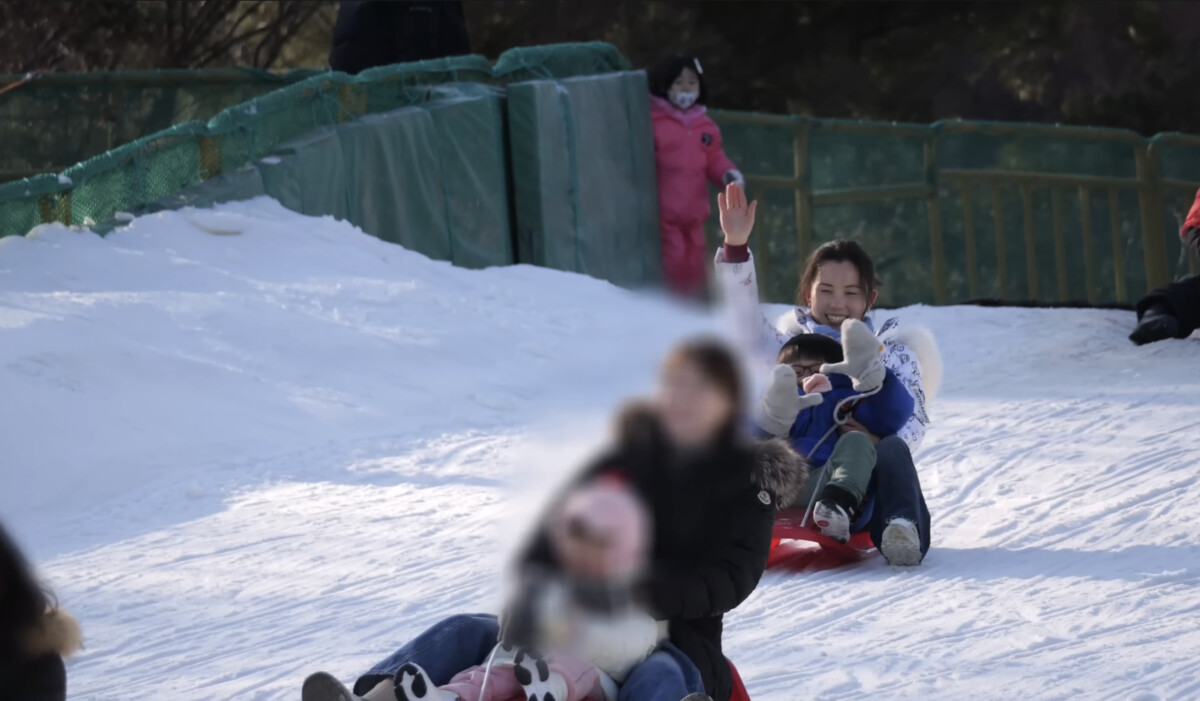
Kim Yumi with her son. Image: Still from YouTube channel Kim YumiTV
Today I went to the playground with my children. It’s already been three years since I came to South Korea, but everyday moments like this still feel unfamiliar. Sometimes they’re even shocking.
The playground was full of children, and there was non-stop laughter. But what surprised me most was the adults.
Next to the playground was a small slope for sledding. I naturally assumed it was for children and didn’t give it much thought. But then I noticed there were more adults than children there. Fathers and mothers, young people, even people who looked middle-aged. They were pulling sleds, riding them, falling, and laughing together with the kids. Some laughed louder than the children. Some even looked more excited than the kids. I stood there, stunned, transfixed. Actually, I was so struck I couldn’t move.
Such a scene is unimaginable where I come from. Adults riding sleds? I had never even thought of it. Sleds were for children, and even then only in very limited circumstances. Adults were always told: “Do not put personal emotions ahead of revolutionary tasks.” To laugh and play was labeled immature behavior or ideological weakness. Especially for adults to laugh and play like children—that was considered incompatible with the system.
Growing up in North Korea, we always heard things like:“A person must live within the organization.” “The collective comes before the individual.” “In a revolutionary country, you must not think of playing first.”
These sayings shaped everyday life. That was why adults always had to be serious. Joy was something to be guarded against. Even in front of children, adults had to remain “adult-like,” careful even with laughter.
But here in the South Korean playground, the adults’ faces carried none of that tension. No one seemed self-consciously aware of other people. No one worried about who was watching or what others might say.
In North Korea, you always had to be aware of who might be looking at you. Even laughter needed a reason, every action needed an explanation. You had to constantly ask yourself: “Why am I laughing? Why am I in this place?”
But here, adults were simply playing with children—for no reason other than joy, simply because they wanted to be together.
Besides the need to avoid joy, parents rarely have the time to hold their child’s hand and go to a playground. They are always worried about survival, tied up with organizational life and endless mobilizations. Though they say “the family is the cell of society,” in reality the organization comes first. Time spent with children was not natural time. It was barely permitted time.
In South Korea, I saw for the first time parents who play together. A society where taking your child to the playground is not special, where spending time with your child does not bring guilt. That realization moved me deeply. Watching the children run and the adults beside them, I kept repeating the same question in my heart: “This really is possible.”
I grew up being taught that South Korea is a society of individualism, that children are spoiled, and that affection between parents and children is dry. I was told that in capitalist society, people care only about money, not about human warmth. But what I saw with my own eyes was totallly different. Parents looked into their children’s eyes instead of yelling. They held their hands and moved together with them. Spaces for children to play are everywhere, and adults enjoy them too.
What would North Koreans think if they saw this with their own eyes? Would it jolt them out of their indoctrination? Surely it would, for no matter how old a person is, the desire to play, to laugh, to enjoy even a brief moment of happiness never disappears from the human heart.
To be honest, I don’t think awakening happens instantly. North Korea’s indoctrination is not just a series of lies that can be exposed. It is a structure built from long years of fear and control.
“The outside world is capitalist.” “We live in a socialist paradise.” These words have entirely dominated our lives. They form a structure that needs to be dismantled.
That’s why I believe that what North Koreans most need if they are to wake up is not grand ideology or political slogans, but everyday scenes such as adults riding sleds with children, families going to the playground together, in a society where it’s okay to laugh. Each of these moments carries far more power than any propaganda slogan.
Life in South Korea is not always easy. The language, the culture still feel unfamiliar, and financially I am not well-off. But here I am learning how to live like a human being. How to look into my child’s eyes and smile, how to feel that it’s okay to rest, how to believe that it’s okay to play. These are things I never learned in North Korea.
Today at the playground, I realized many things. Freedom is not a grand word. Awakening from indoctrination is not about changing ideology. It is about the moment when the standards of life change.
If North Koreans could one day see and feel this kind of everyday life, then the questioning would finally begin: “Why can’t we live like this?”
I want to tell my people that another way of life is not just fantasy. It truly exists. A society where adults can ride sleds, where parents can hold their child’s hand and go to the playground, is not a world from a storybook. It is the reality I live in now.
As I held my children’s hands and walked home today, I thought: this ordinary day I experienced might become the most powerful truth for someone.
Not through grand speeches or political slogans, but through ordinary everyday life—where adults can laugh and play with children—this may be the quietest, yet deepest way to stir the hearts of people in North Korea.
This, I believe, is the quietest yet strongest way to awaken them.

Kim Yumi, a North Korean defector, was born and raised in Haeju, South Hwanghae Province, a coastal military area. Growing up near a naval base, she was able to secretly watch South Korean news programs and TV shows, thereby uncovering the vibrant, democratic society of South Korea. Yumi and her husband made the brave decision to escape North Korea and seek a better future. Now in Seoul, she is actively involved in raising awareness about the realities of life in North Korea, especially on her YouTube channel, “@KimYumiTV.”
Latest posts by Kim Yumi (see all)
- Why North Koreans are unable to understand South Korea - April 7, 2026
- Rising oil prices send ordinary North Koreans into survival mode - March 30, 2026
- Is Kim Ju-ae being groomed for a support role? - March 17, 2026