

North Korea is building new weapons and drones. Russia may be making them better
KCNA reported on Sept. 19 that Kim Jong-un had spent Sept. 16–18 inspecting major defense-industrial enterprises, where he reviewed weapons production and called for greater production capacity, automation and the use of artificial intelligence in offensive and defensive systems. He described powerful artillery forces as central to both deterrence and warfighting and demanded more concentrated, destructive and versatile firepower.
As has become increasingly common in North Korean state-media coverage, the report was accompanied by a carefully selected set of photographs offering unusually detailed views of weapons and production facilities. The significance of the images is not that North Korea has suddenly learned how to mass-produce launch vehicles or drones; it has demonstrated both capabilities before.
What stands out is the simultaneous emphasis on mobile artillery and missile launchers, one-way attack drones, and larger reconnaissance or strike UAVs — all while North Korea is gaining battlefield experience and operational feedback from a major war in which its weapons and troops have been employed.
The important question, therefore, is not whether Russia designed North Korea’s newest weapons. It is whether the war in Ukraine is giving Pyongyang something its weapons programs previously lacked: a sustained stream of battlefield data that can be fed back into production and tactics.
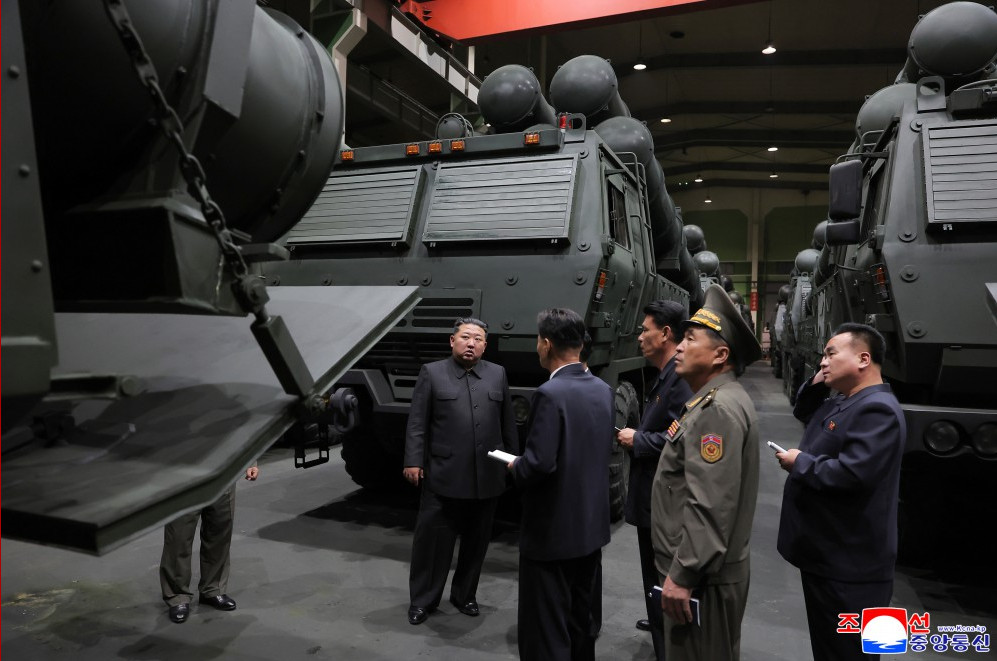
Kim Jong-un inspects production among large armored launch vehicles. Several vehicles of similar configuration are visible inside the factory. Outside analysts have identified facilities shown in the September 19 coverage as producing upgraded 600 mm and new 240 mm multiple-launch rocket systems, although KCNA did not identify individual factories or weapon models. Photo: KCNA.
North Korea has shown large-scale launcher production before. In May 2024, Kim inspected production of vehicles for an upgraded 240 mm multiple-launch rocket system. In August that year, Pyongyang displayed 250 launchers for a new tactical ballistic missile system, claiming they were being transferred to military units. South Korean intelligence later questioned whether North Korea possessed enough missiles to equip all 250 launchers, illustrating the difference between displaying launchers and fielding complete operational units.
The latest photographs therefore fit a longer expansion of mobile firepower. More significant is that the launcher program is now appearing alongside a much broader push into unmanned systems.
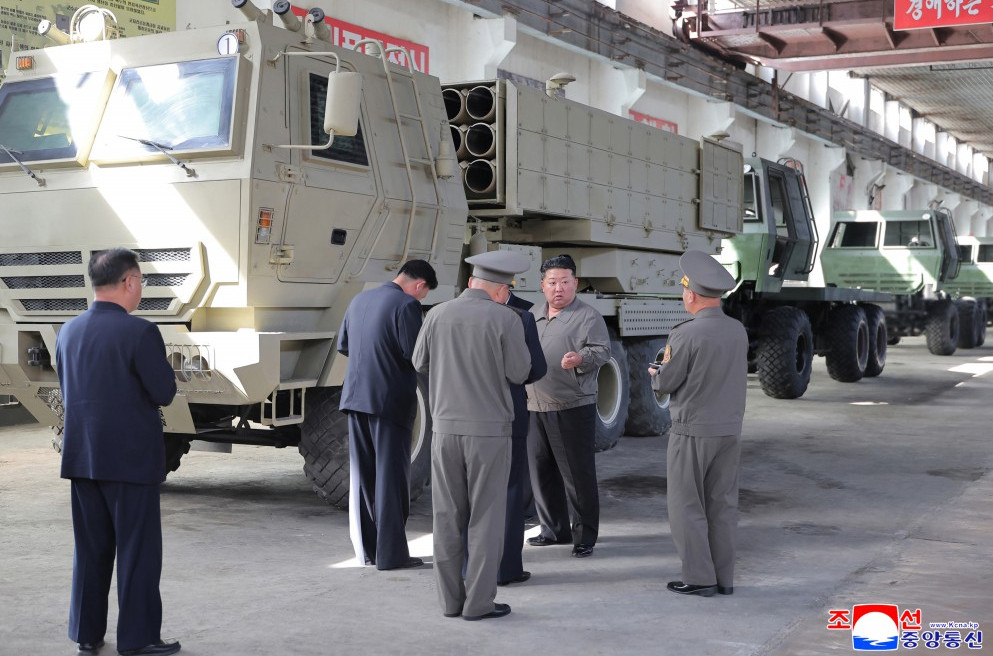
Multiple-launch rocket vehicles inside a production facility. Eight tube openings are visible on the lead vehicle from this angle. South Korean analysts have identified one of the facilities shown in the KCNA coverage as connected with a new 240 mm system, but KCNA did not identify this particular vehicle. North Korea previously said its upgraded 240 mm MLRS would incorporate automatic fire control and enter replacement deployment from 2024 to 2026. Photo: KCNA.
The broader modernization effort is increasingly focused not simply on the number of launchers, but on mobility, guided firepower, automation and the ability to conduct rapid, dispersed strikes. Japan’s 2026 Defense White Paper similarly highlights North Korea’s development of simultaneous and short-interval missile launches as part of a more practical operational capability.
Foreign comparisons remain useful, but only up to a point. The KN-23 has long been compared with Russia’s Iskander-M and the KN-24 with the U.S. ATACMS. The 600 mm KN-25 falls awkwardly between traditional multiple-launch rockets and short-range ballistic missiles. These similarities help explain the systems, but resemblance is not evidence of technological lineage. North Korea had been testing these weapons years before its current level of military cooperation with Russia.
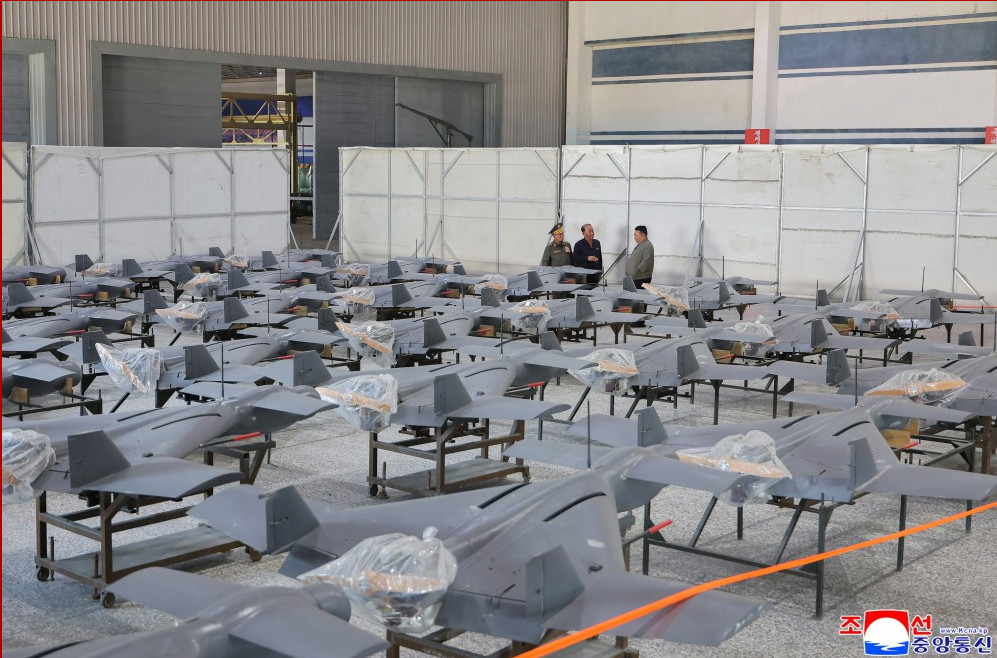
One-way attack UAVs arrayed inside a production hall. Dozens of apparently related airframes sit on work stands. The image cannot establish annual production rates or how many have entered operational service, but it differs markedly from earlier North Korean imagery centered on individual prototypes and flight tests. Photo: KCNA.
North Korea first publicized tests of one-way attack drones in 2024. Analysts compared one delta-wing design with Israel’s HAROP and another with Russia’s Lancet. Kim subsequently ordered mass production of such weapons.
There have also been claims of deeper Russian assistance. Ukraine’s military intelligence said in 2025 that Moscow and Pyongyang had arrangements concerning North Korean production of Geran and Garpiya-type drones, systems linked to Russia’s adaptation of Iranian-origin Shahed technology. That is an intelligence claim, however, not independently established proof of a specific technology transfer.
The one-way attack drone shown in the latest photographs does not appear to be a simple Shahed-type copy. Its shape is closer to the North Korean design previously compared with HAROP. The more consequential issue is whether North Korea can manufacture such weapons cheaply and in quantity, and whether their navigation, sensors and communications remain effective under electronic warfare.
A large inventory of comparatively simple attack drones can pose a significant challenge even without matching the sophistication of U.S. systems. Used alongside artillery rockets and ballistic or cruise missiles, they create more targets, trajectories and timing problems for a defender.
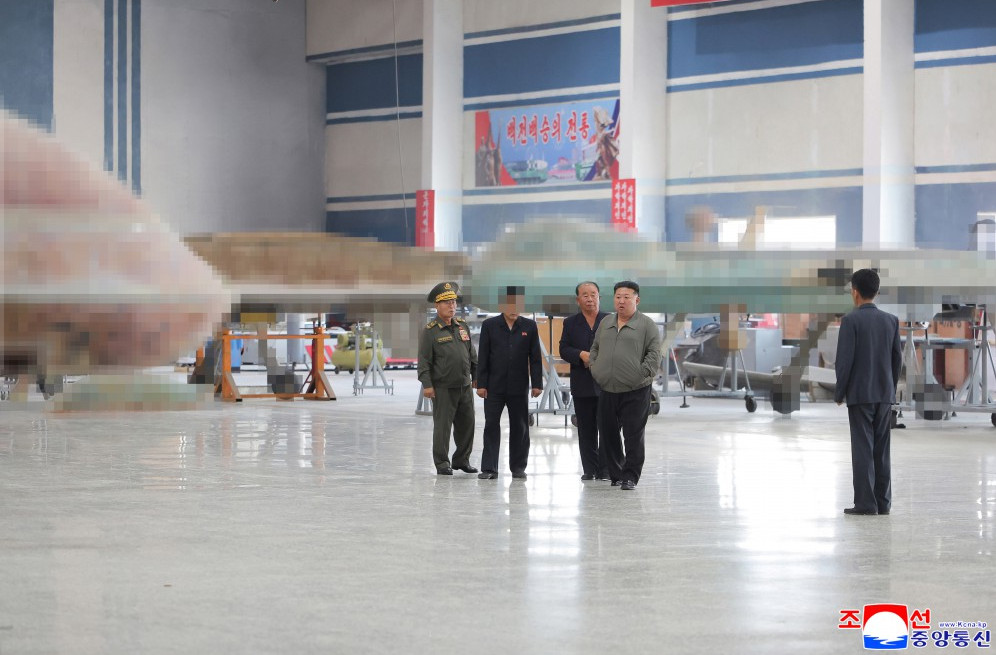
Large UAVs under assembly, with identifying features obscured. KCNA pixelated significant portions of the aircraft. North Korea’s Saetbyol-9, first unveiled in 2023, is a roughly 20-meter-class propeller-driven multirole UAV whose appearance and mission concept strongly resemble the U.S. MQ-9 Reaper. The latest aircraft cannot be identified confidently because its propulsion and tail sections are obscured; South Korean analysts have also raised the possibility of a new design resembling China’s Wing Loong family. Photo: KCNA.
North Korea is pursuing at least two distinct UAV development tracks. Alongside smaller one-way attack systems, it has developed larger aircraft such as the Saetbyol-9 and the approximately 35-meter-span Saetbyol-4, which resembles the U.S. RQ-4 Global Hawk. 38 North assesses that North Korea has produced multiple examples of both designs.
Their resemblance to U.S. aircraft should not be confused with equivalent capability. The real value of platforms such as the MQ-9 and Global Hawk lies heavily in their sensors, communications, satellite links, engines and command networks — areas where the performance of North Korean systems remains largely unknown.
The factory photographs are nevertheless significant because small attack drones and much larger UAVs are appearing within the same broader industrial expansion.
Only days before KCNA released the factory photographs, North Korea disclosed a military firing exercise. South Korean analysts assessed that it involved four different types of weapons: cruise missiles, one-way attack drones, KN-23 short-range ballistic missiles and 600 mm KN-25-class weapons. The exercise was interpreted as an attempt to test or demonstrate a mixed strike capable of placing different demands on air and missile defenses at the same time.
One exercise does not prove that North Korea has perfected an integrated force capable of combining these systems at scale. But viewed together, the exercise and the factory photographs raise a more useful question than whether individual North Korean weapons resemble foreign designs:
Is North Korea building the industrial base for a force that can employ missiles, rocket artillery and drones together in larger and more varied attack packages?
The available evidence does not yet answer that question conclusively. It does make the question increasingly relevant.
The chronology matters. KN-23, KN-24 and KN-25 development predates the current phase of North Korea-Russia military cooperation, while Saetbyol-4 and Saetbyol-9 were unveiled in 2023. It would therefore be misleading to explain North Korea’s current arsenal simply as a Russian creation.
The evidence for Russia accelerating North Korean military learning is stronger, however.
The U.S. Intelligence Community’s 2026 Annual Threat Assessment says North Korea’s support for Russia has increased its capabilities by giving its forces equipment and combat experience in “21st-century warfare.” Japan’s Defense Ministry says there are indications that data supplied by Russia improved the accuracy of North Korean short-range ballistic missiles and warns that experience with drones and other new methods of warfare could spread through the North Korean military.
South Korea’s Defense Intelligence Agency reached a similarly cautious conclusion in August: North Korean missiles used in Ukraine may have improved through accumulated combat data, possible Russian advice and component support. It also assessed that Hwasong-11-series missiles and 600 mm systems have improved in accuracy, ability to evade interception and mass-launch capability.
This does not demonstrate that Russian engineers redesigned North Korean weapons. The evidence points instead to a shorter feedback loop. Weapons that once could only be tested on North Korean ranges are now being used repeatedly under real air-defense and electronic-warfare conditions. Failures, navigation problems and successful tactics can generate information useful for the next production batch.
That is why Russia is better understood, on present evidence, as a potential accelerator rather than the original designer of North Korea’s modernization.
The September photographs are most useful when read as an industrial snapshot rather than a weapons catalogue.
North Korea is simultaneously emphasizing mobile artillery and missile launchers, guided firepower, numerous one-way attack drones and larger unmanned reconnaissance or strike aircraft. At nearly the same time, its forces are experimenting with mixed employment of missiles, rockets and UAVs.
For policymakers and military planners, the important questions are therefore becoming less about whether a North Korean airframe looks Russian, American, Israeli or Chinese — and more about production rate, reliability, electronic-warfare performance and the speed with which battlefield lessons can be fed back into new weapons.
North Korea already had a substantial weapons industry before its partnership with Russia deepened. What the war in Ukraine may now be providing is something much harder to reproduce in a test program: sustained combat experience and a faster cycle between production, battlefield use and modification.
That may prove more consequential than any single new missile or drone.

Taesung offers informed perspectives on North Korean society, grounded in years of experience within a key state-run institution. After defecting to South Korea in 2024, he now focuses on providing analysis of the country.
Latest posts by Kim Taesung (see all)
- North Korea is building new weapons and drones. Russia may be making them better - September 24, 2026
- North Korea drops ‘unification’ from party charter, boosts Kim Jong-un’s power - September 13, 2026
- Man jailed for spying on defectors and soldiers for North Korean agent - September 9, 2026